

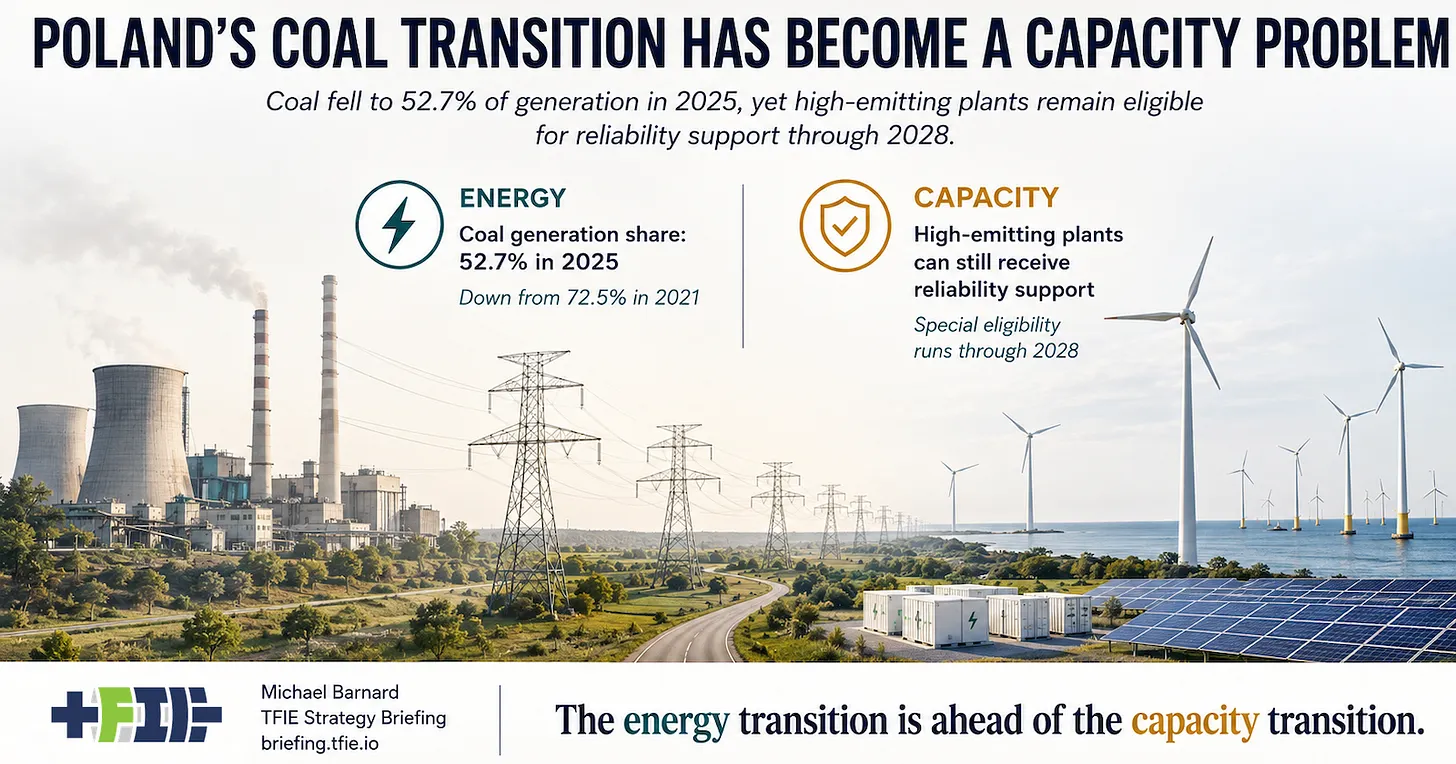
Poland is undergoing one of the most remarkable and accelerated energy transformations in contemporary Europe, yet its path away from fossil fuels highlights a deeply complex structural challenge. While the nation’s reliance on coal for annual electricity generation is plummeting at a pace that frequently defies its traditional reputation as Europe’s industrial heavy coal-user, dependable high-emitting capacity remains fundamentally baked into the nation’s grid reliability calculations.
The core friction of Poland’s energy transition no longer lies in how quickly traditional coal-fired power plants are losing their market share as energy producers. Instead, the defining hurdle is a nuanced, system-level dilemma: why the nation must continue financially supporting and retaining heavy-emitting coal infrastructure as insurance against grid failures during peak stress hours. As renewables scale up and reshape the generation mix, Poland finds itself navigating a two-tier transition where the decline of coal as an energy source is far outpacing the phase-out of coal as a structural necessity for grid reliability.
Main Facts
The transformation of Poland’s power sector is anchored by a rapid pivot toward a cleaner energy mix, though fossil fuels continue to play a transitional role alongside renewables.
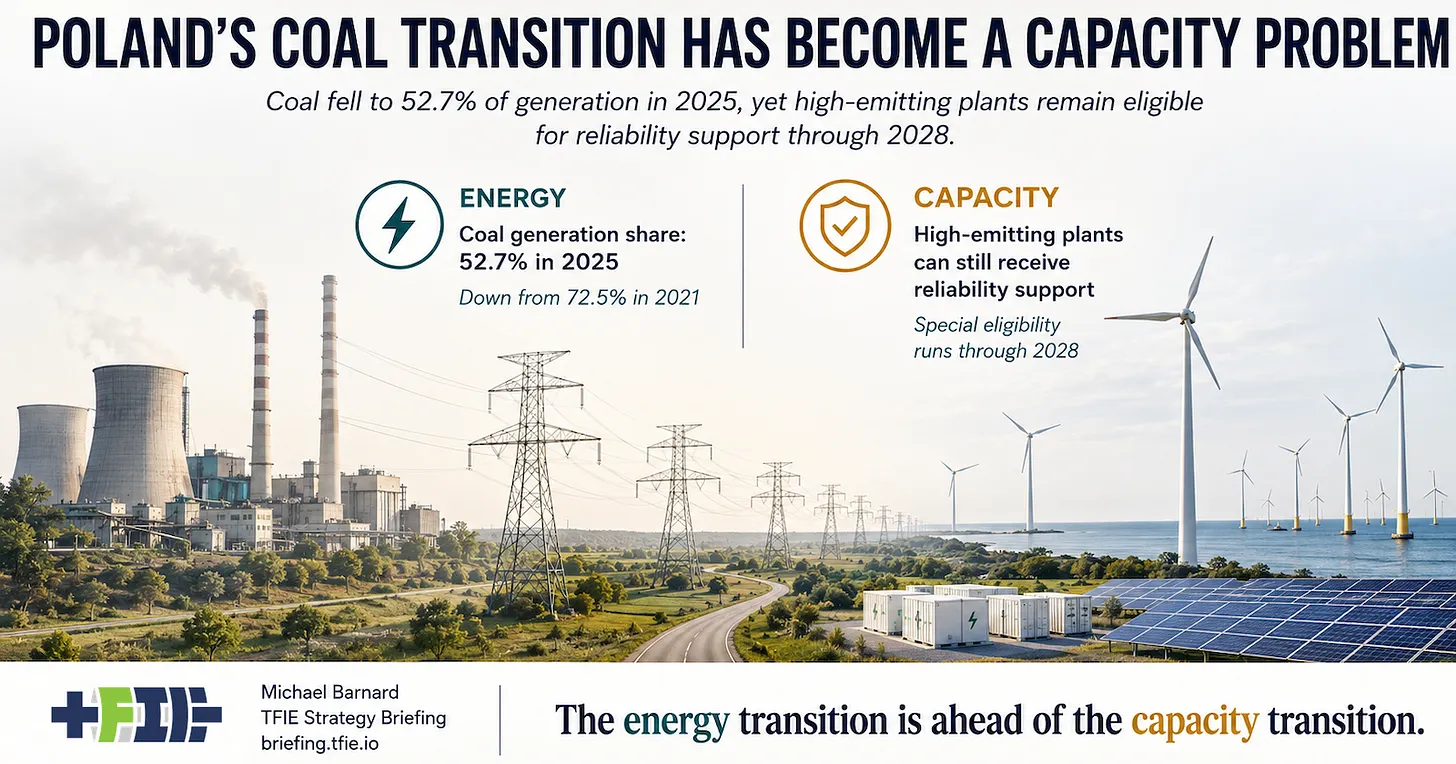
- The Generation Shift: In 2021, coal accounted for a dominant 72.5% of Poland’s electricity generation. By 2025, that figure dropped sharply to 52.7%, while renewable energy sources surged to capture 31.4% of the market.
- Milestones Reached: The transition reached symbolic and practical turning points in 2025, when coal supplied less than half of the nation’s monthly electricity generation in five separate months. Most notably, June 2025 marked the first time in history that renewables generated more electricity than coal over the course of a full calendar year month.
- The Role of Natural Gas: Renewables are not replacing coal on a direct one-to-one basis. Natural gas has emerged as a major transitional bridge, recording the largest increases in generation share across both 2024 and 2025. In 2025 alone, Poland produced 24.4 TWh from natural gas, running closely alongside 23.8 TWh from onshore wind and 20.3 TWh from solar photovoltaic installations.
- Capacity Versus Energy: A critical distinction defines the Polish power market: annual generation (measured in MWh or TWh) versus system capacity (measured in dependable MW). Even as coal plants run fewer hours annually and lose economic viability as energy producers, they are retained as system insurance for hours of high demand, weak wind, absent solar, and constrained cross-border imports.
- Curtailment Realities: As low-marginal-cost renewable capacity scales up, the rigid legacy power grid struggles to absorb surplus energy. In 2025, Poland curtailed 1.4 TWh of renewable electricity—double the volume recorded in 2024—primarily for system balancing rather than physical transmission congestion.
- Future Projections: According to International Energy Agency (IEA) outlooks, Polish renewable generation is projected to expand at an average annual rate of roughly 13% through 2030, eventually overtaking coal on an annual generation basis by 2028 and claiming roughly 53% of the total mix by the decade’s end.
Chronology of the Polish Coal Transition
Understanding how Poland arrived at this precarious juncture requires tracking the rapid acceleration of policy, market forces, and infrastructure milestones over recent years.
2021: The Coal Baseline
Poland enters the decade heavily dependent on domestic coal mining and coal-fired generation. Coal supplies 72.5% of the country’s total electricity, leaving it heavily exposed to carbon pricing mechanisms under the European Union Emissions Trading System (EU ETS) and positioning the nation as a primary target for decarbonization scrutiny.
2024–2025: The Acceleration of Wind, Solar, and Gas
A massive buildout of onshore wind and solar assets begins to alter the market merit order. Renewable energy scales to 31.4% of generation by 2025, while coal’s share falls to 52.7%. Simultaneously, natural gas steps into the void, recording the largest individual generation share increases across 2024 and 2025 to balance the intermittency of the rapidly growing renewable fleet.
September 2025: The Supplementary Capacity Auction
Highlighting the ongoing reliance on legacy assets, a supplementary capacity auction for the 2026 delivery year contracts 7.58 GW of capacity obligations. Under a special European Union derogation, high-emitting plants exceeding the threshold of 550 kg of CO₂ per MWh are permitted to participate, illustrating the regulatory tension between climate targets and grid security.
July 2026: Offshore Wind Enters the Grid
Poland officially steps into offshore wind generation as the Baltic Power project—the country’s first offshore wind farm—delivers its inaugural electricity to the national grid. Upon achieving full commercial commissioning, the 1.2 GW installation is slated to produce approximately 4 TWh annually, equating to roughly 3% of total domestic electricity demand.
2028 (Projected): The Tipping Point
International energy analysts and the IEA forecast that 2028 will mark the historic crossover year where annual renewable electricity generation in Poland definitively surpasses annual coal-fired generation, altering the nation’s economic and environmental landscape permanently.
Supporting Data & Market Metrics
The underlying data of Poland’s power sector reveal a system caught between rapid decarbonization and legacy structural engineering.
The math of the transition is stark:
| Metric / Year | 2021 | 2024 (Trend) | 2025 | 2030 (Projected) |
|---|---|---|---|---|
| Coal Share of Generation | 72.5% | Declining | 52.7% | Falling rapidly (~11% drop/year) |
| Renewable Share | Low | Scaling | 31.4% | ~53% |
| Natural Gas Generation | Moderate | Growing | 24.4 TWh | Continuing growth |
| Onshore Wind Generation | Moderate | Scaling | 23.8 TWh | Expanding |
| Solar PV Generation | Low | Scaling | 20.3 TWh | Expanding |
| Renewable Curtailment | Low | 0.7 TWh | 1.4 TWh | Rising if storage lags |
The data emphasizes that while the energy transition (measured in volume of clean electrons produced) is moving at a breakneck speed, the capacity transition (ensuring that the lights stay on during a dark, windless winter evening) relies on a completely different set of metrics.
When solar generation peaks at midday, Poland frequently experiences an overabundance of low-cost electricity that its inflexible grid cannot fully utilize. This dynamic forced the curtailment of 1.4 TWh in 2025. Conversely, during periods of peak demand coinciding with adverse weather, the system falls back on legacy thermal assets, exposing the critical deficit in system flexibility, interconnections, and grid-scale storage.
Official Responses & Regulatory Dynamics
The governance of Poland’s energy pivot involves a delicate balancing act between European Union decarbonization mandates, national energy security imperatives, and the economic survival of legacy industrial sectors.
The Capacity Market and EU Derogations
Poland’s capacity mechanism has become the primary regulatory battleground for managing the transition. Because renewable deployment is pushing coal down the merit order faster than the broader power system can build alternative balancing infrastructure, policymakers argue that shutting down coal plants prematurely would risk catastrophic blackouts.
To prevent grid instability, Poland secured special European Union exemptions allowing high-emitting coal plants—those exceeding 550 kg of CO₂ per MWh—to participate in capacity auctions. Auctions conducted for delivery years running through 2028 rely on these derogations. However, with the European exemption legally expiring at the end of 2028, Polish energy authorities face a hard deadline to secure alternative capacity solutions, such as cleaner peaking plants, demand-response frameworks, nuclear investments, and utility-scale battery storage.

Industry and Expert Perspectives
Energy strategists and system modelers emphasize that policymakers must separate the two distinct numbers governing Poland’s coal phase-out:
- Annual Generation Share: A metric demonstrating how far renewables have come in replacing fossil fuels in everyday power consumption.
- Dependable Capacity Need: A metric dictating how much physical coal infrastructure must remain on standby to safeguard the country during its most demanding grid stress tests.
Industry analysts note that building additional solar farms or wind turbines does not inherently solve the structural reliability problem. True decarbonization requires a systemic overhaul encompassing high-voltage transmission upgrades, cross-border interconnectors, battery energy storage systems (BESS), smart electric vehicle (EV) charging infrastructure, flexible industrial demand, and the modernization of district heating networks.
Implications for Poland’s Energy Future
The trajectory of Poland’s power sector holds profound implications for Central and Eastern Europe, the European Union’s climate goals, and industrial competitiveness.
The Infrastructure Challenge
The overarching lesson from Poland’s transition is that phasing out coal as an energy source is merely the first act. Getting coal out of the physical power system entirely—the second, more difficult act—requires transforming a centralized grid built around massive, inflexible coal-fired boilers into a decentralized, highly responsive, and digitally managed energy mesh.
Economic and Environmental Realities
As natural gas continues to serve as a vital transitional bridge, Poland must carefully manage the risk of carbon lock-in, ensuring that gas infrastructure does not become a long-term emissions liability. At the same time, the successful integration of offshore wind assets like Baltic Power demonstrates that large-scale clean generation is no longer theoretical.
Ultimately, Poland’s ability to successfully phase out coal capacity by the close of the decade will depend on the speed and scale of its complementary infrastructure investments. If grids, storage, and flexibility mechanisms arrive in time, Poland can close the book on its coal era permanently. If not, the tension between maintaining grid reliability and meeting stringent climate commitments will continue to define the nation’s energy landscape for years to come.
