SAN DIEGO, Calif. — For nearly four years, the culinary footprint of Gwyneth Paltrow’s lifestyle empire existed primarily as a digital phantom. Launched in 2021 during the height of the pandemic delivery boom, Goop Kitchen operated strictly as a network of ghost kitchens, optimizing clean, health-conscious meals to survive the turbulence of transit bags and doorstep drops.
Now, the brand is stepping out from behind the smartphone screen. On August 31, Goop Kitchen opens its very first brick-and-mortar, dine-in restaurant in the sun-drenched coastal enclave of Del Mar, San Diego. Complete with an entirely new dine-in menu, the location represents a major strategic pivot for the nearly 20-year-old lifestyle brand. A second flagship outpost is slated to open in Manhattan later this year, signaling that Paltrow’s vision for modern wellness hospitality is ready for the physical world.
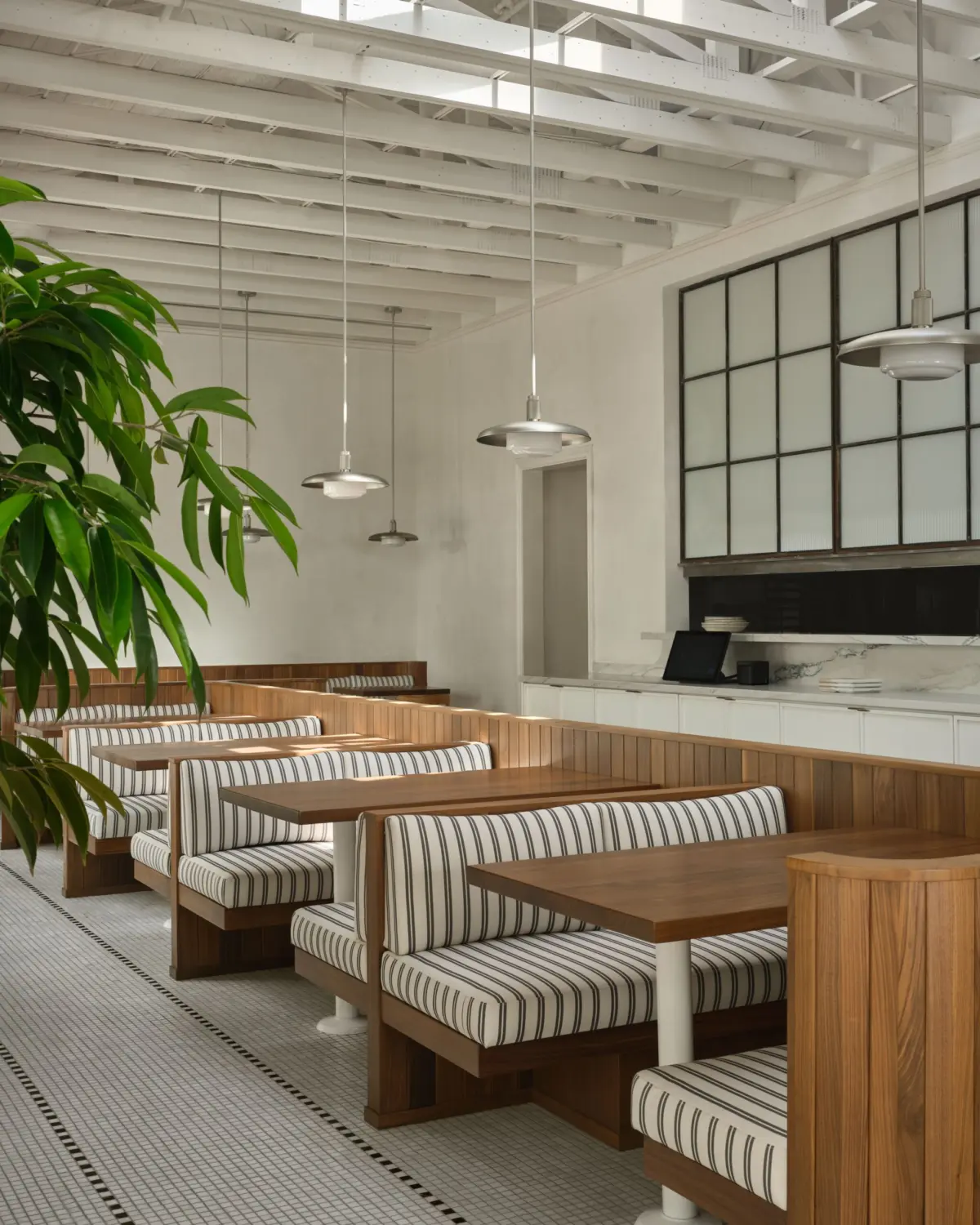
Yet, for a brand synonymous with celebrity culture and high-end aesthetics, the physical realization of Goop Kitchen is refreshingly devoid of wellness tropes. Designed in collaboration with the renowned architecture firm Michael Hsu Office of Architecture, the Del Mar space trades clinical white-box minimalism and earnest, reclaimed-wood rusticism for something far more nuanced: a timeless, European-inspired brasserie aesthetic that treats fast-casual dining with unprecedented architectural seriousness.
Main Facts: The Anatomy of Goop’s First Dine-In Restaurant
The physical manifestation of Goop Kitchen is built on a foundation of tactile luxury and anti-trend design principles. Spearheaded by Michael Hsu and principal Maija Kreishman, the design team approached the project by actively refusing to lean on familiar restaurant archetypes.
Instead of shouting its wellness credentials, the restaurant whispers through meticulous material choices:
The Flooring: A seamless expanse of honed marble, featuring a one-inch Thassos mosaic framed by an alternating Thassos and Nero Marquina border.
The Kitchen Window: Perhaps the most labor-intensive feature of the entire build, this reeded, translucent glass partition from Pulp Studio obscures the line cooks behind it. Built and rebuilt multiple times, it stands as a focal point of architectural craftsmanship.
The Lighting and Walls: True pewter fixtures are utilized throughout the space—deliberately chosen because they tarnish and develop a natural patina over time rather than pretending to remain static. The interior walls feature fine-grain lime plaster from Domingue Finishes, complemented by moldings painted in a high-gloss Benjamin Moore Classic Gray.
The Statement Focal Point: Dominating the space behind the point-of-sale area is a massive slab of veined Breccia Capraia marble, into which the minimalist Goop Kitchen logo is delicately carved.
Custom Millwork: Solid walnut tables and booth structures anchor the dining room, paired with custom-woven striped Schumacher upholstery designed specifically for Goop Kitchen, featuring bespoke dark green tonality and stripe widths influenced directly by Paltrow.
Chronology: From Delivery-Only Startup to Architectural Showcase
The journey from a purely digital delivery service to a physical architectural showcase required years of conceptualization, deep material studies, and meticulous execution.
2021: Goop Kitchen launches as a delivery-only ghost kitchen concept, engineered to provide clean, satisfying meals that maintain their integrity and flavor profile during delivery.
Late 2023 – Early 2024: Paltrow and her team engage Michael Hsu Office of Architecture to conceptualize the brand’s first physical spaces. The mandate is clear: avoid wellness cliches, establish a throughline between future urban and coastal locations, and draw inspiration from Haussmannian Paris and classic New York brasseries.
Summer 2024: Construction concludes on the Del Mar, San Diego location. Unlike typical commercial builds where clients sign off on photographs or digital renderings, Paltrow takes a notoriously hands-on approach. She visits the site to personally touch textures, test how matte a finish reads, and examine how materials behave under the shifting daylight of the California coast.
August 31, 2024: The Goop Kitchen flagship officially opens its doors in San Diego, marking the brand’s first-ever dine-in experience and introducing an expanded menu designed explicitly for sit-down consumption.
Late 2024 (Upcoming): Goop Kitchen is scheduled to expand its physical footprint further with the opening of its Manhattan outpost, bringing Paltrow’s vision of "Parisian New York" to the East Coast.
Supporting Data: Rethinking the Fast-Casual Infrastructure
Fast-casual dining has historically treated customer logistics—such as ordering queues, waiting areas, and pickup zones—as utilitarian afterthoughts. Goop Kitchen’s Del Mar debut subverts this model entirely, using spatial design to eliminate the friction points traditionally offloaded onto the consumer.
Eliminating "Line Anxiety"
The design team spent considerable time diagnosing what they term "line anxiety"—the subtle stress customers feel when figuring out where to stand, when they are next, or how to navigate a crowded counter. At Goop Kitchen, the order counter has been redesigned to look and feel like an antique furniture piece featuring a clouded stone top, moving far away from the sterile touch-screen kiosk model. Furthermore, human interaction remains central: a staff member hands patrons their food directly, eliminating the impersonal scanning of tagged paper bags off metal shelves.
Dual-Entry Logistics for Modern Crowds
Urban and suburban mixed-use developments present unique traffic challenges. To solve this, the Del Mar location features two distinct entry points:
A comfortable, dedicated lobby tailored for delivery couriers.
A lush, planted waiting garden designed for families and dine-in guests.
By treating both delivery drivers and sit-down patrons with equal spatial dignity, the design successfully mitigates the chaos typically associated with hybrid delivery-and-dine-in restaurants. Families with strollers and couriers rushing to their next drop-off arrive into spaces crafted with the exact same level of architectural rigor.
Official Responses: Gwyneth Paltrow and Michael Hsu on the Vision
For Gwyneth Paltrow, the stakes of entering the physical restaurant space are high, and her creative posture is uncompromising.
"I’m never willing to compromise on details," Paltrow shared in an interview. "Every single detail, as small as it is, is as important as the biggest one. The impact is an aggregation of small decisions. Every fixture, every tile, every piece of millwork is as important as the toilet paper holder."
Paltrow explicitly rejects the notion that her brand is simply constructing another "wellness space." Instead, her primary design references hail from Haussmannian Paris and the classic New York brasseries of her youth—spaces that evoke tradition, togetherness, and enduring elegance.
"I don’t think we’re making a wellness space, and that’s the point," Paltrow explains. Her goal is to anchor the restaurant in a sense of time passing, drawing on Goop’s nearly two-decade history. She envisions a room where guests feel comfortable enough to linger rather than rush. Citing traditional Chinese medicine principles regarding the mindful nature of eating, Paltrow hopes to fundamentally alter how patrons approach their meals: "You should never stand up and eat… I want to change how people eat."
Architect Michael Hsu echoes this sentiment, praising Paltrow’s deep design vocabulary and exceptionally hands-on involvement.
"Spaces and places should almost mimic the human condition," Hsu notes, explaining that interiors should be layered, slightly contradictory, and reveal themselves slowly rather than being fully legible at a single glance. By setting rough lime plaster against statement-making veined marble, Hsu’s design creates a visual tension that prevents the near-monochrome palette from feeling flat.
Implications: What Goop Kitchen’s Evolution Means for the Industry
The launch of Goop Kitchen’s first physical restaurant carries significant implications for both the celebrity-led hospitality sector and the broader fast-casual dining industry.
1. The Maturation of the Ghost Kitchen Model
During the pandemic, ghost kitchens promised a low-overhead revolution. However, many digital-first culinary brands struggled with customer retention and brand equity in the absence of a physical home. By successfully scaling from a delivery-only operation to an upscale, design-forward dining room, Goop Kitchen establishes a new blueprint for digital-first brands seeking hybrid longevity. It proves that virtual concepts can build deep enough brand loyalty online to warrant major capital investments in high-end physical architecture.
2. Redefining Fast-Casual Luxury
The fast-casual segment has long been dominated by standardized layouts, industrial-chic metals, and plastic-laminate efficiencies. Goop Kitchen’s deployment of honed marble, custom limewash plaster, and bespoke Schumacher fabrics sets a new, elevated standard for the category. It demonstrates that consumers are increasingly hungry for spaces that offer tactile luxury, emotional warmth, and thoughtful hospitality, even when purchasing a quick, health-focused meal.
3. The Future of Wellness Hospitality
As wellness culture matures, consumers are suffering from "wellness fatigue"—pushing back against clinical, preachy, or excessively earnest environments. By explicitly rejecting wellness cliches in favor of a timeless, European brasserie aesthetic, Goop Kitchen points the way forward for lifestyle brands entering the physical realm. The takeaway for the hospitality industry is clear: wellness is no longer about signaling purity through stark white walls; it is about creating spaces that feel human, grounded, enduring, and deeply comfortable.