

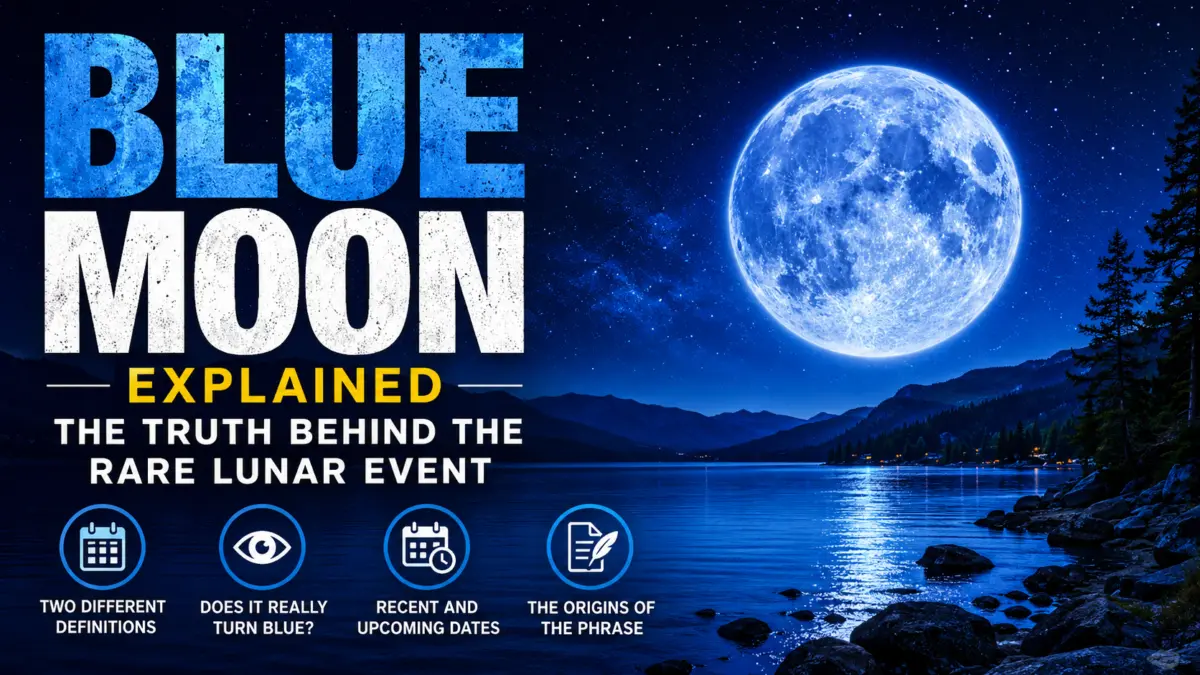
Few celestial phrases carry as much poetic weight as "once in a blue moon." For centuries, this idiom has been invoked to describe rare occurrences, personal transformations, or improbable events. Yet, despite its deep entrenchment in everyday language and popular culture, the term "Blue Moon" is widely misunderstood. Far from being a rare lunar spectacle bathed in sapphire hues, a Blue Moon is a fascinating collision of calendar mathematics, agricultural history, and folklore.
As stargazers look toward the future—tracking a series of upcoming celestial alignments—astronomers and historians continue to untangle the complex narrative of how we define, measure, and experience this famous lunar event.
Main Facts: What Is a Blue Moon, Really?
To understand a Blue Moon, one must first confront a surprising historical reality: there are two distinct definitions of the phenomenon, and they have spent decades locked in a quiet debate among astronomers, almanac writers, and calendar historians.
The Modern Definition: The Monthly Extra
The definition most familiar to the general public today is deceptively simple. A Blue Moon is classified as the second full moon occurring within a single calendar month.
Because the synodic month—the time it takes for the Moon to cycle through all of its phases from one new moon to the next—averages approximately 29.5 days, a lunar cycle neatly fits inside standard calendar months, which range from 28 to 31 days. However, because 29.5 days is shorter than most months, a rare alignment can occur. If a full moon happens on the very first or second day of a 31-day month, there is just enough time for a second full moon to squeeze in before the month ends, usually falling on the 30th or 31st.
This mathematical overlap happens roughly every two to three years, providing the statistical basis for the modern interpretation of "once in a blue moon"—not impossibly rare, but infrequent enough to feel special.
The Original Definition: The Seasonal Anomaly
Long before television broadcasts and digital calendars popularized the two-full-moons-in-a-month rule, an older and more complex definition reigned supreme. Rooted in the pages of historical editions of the Maine Farmer’s Almanac, a traditional Blue Moon refers to the third full moon in a seasonal cycle that contains four full moons instead of the usual three.
Typically, a standard astronomical season (spring, summer, autumn, or winter) spans roughly three months and hosts three full moons. However, because the lunar cycle is shorter than a calendar month, the calendar occasionally accumulates an "extra" full moon over the course of a year, resulting in 13 full moons instead of the standard 12.
In the old ecclesiastical and agricultural calendars, each full moon of the year had a specific name and purpose tied to farming, hunting, or seasonal changes (such as the Harvest Moon or the Hunter’s Moon). Throwing in an extra 13th moon disrupted this carefully structured system. To keep the calendar names aligned with their proper seasonal markers, almanac editors designated the third of four full moons in a single season as the "Blue Moon."
While more mathematically intricate, this seasonal definition remains the true historical benchmark of the term.
Does the Moon Actually Turn Blue?
Perhaps the most common misconception about a Blue Moon is that the lunar surface physically changes color. In reality, the Moon almost never appears blue.
A true blue-tinted moon is an exceedingly rare atmospheric phenomenon that has nothing to do with lunar calendars. It occurs only when the Earth’s atmosphere is heavily laden with specific-sized particles—typically smoke or volcanic ash—following catastrophic events such as major volcanic eruptions (such as the legendary 1883 Krakatoa eruption) or massive forest fires. These particles act as a selective optical filter, scattering longer red and yellow wavelengths of light while allowing shorter blue wavelengths to pass through to the human eye.
Barring such extraordinary atmospheric disasters, the Moon during a "Blue Moon" event looks just like any other full moon: pearly white, gray, or bathed in golden hues when rising near the horizon. Nearly all striking photographs capturing a deep blue lunar orb rely on specialized color filters, post-processing software, or dramatic atmospheric pollution.
Chronology: Recent and Upcoming Lunar Alignments
The rhythm of Blue Moons follows a predictable yet staggered astronomical clock. Examining recent history and looking forward into the coming decades reveals a fascinating tapestry of lunar alignments.
Recent History: The May 2026 Micro-Moon
The astronomical community recently marked a notable Blue Moon event on May 30–31, 2026. This marked the second full moon of May under the modern calendar definition.
What made this particular event uniquely compelling to astronomers was its coincidence with orbital mechanics. This Blue Moon occurred near apogee—the point in the Moon’s elliptical orbit farthest from Earth—placing it approximately 252,360 miles away. Consequently, it was classified as a "micro-moon," appearing roughly 7% smaller and noticeably dimmer than an average full moon.
The Horizon: Upcoming Blue Moons (2027–2035)
Stargazers and astronomy enthusiasts do not have to wait long for the next alignments. The calendar boasts several notable dates over the next decade:
- May 20, 2027: The next seasonal Blue Moon (following the traditional Maine Farmer’s Almanac definition).
- December 31, 2028: The next monthly Blue Moon, closing out the year on New Year’s Eve.
- August 24, 2029: A seasonal Blue Moon aligning late in the summer season.
- August 21, 2032: Another occurrence of the rare seasonal four-moon cycle.
- May 22, 2035: A spring seasonal Blue Moon.
The Rare "Double Blue Moon" Phenomenon
Even more infrequent is the coexistence of both definitions in a single calendar year. Very rarely, a calendar year will host both a monthly Blue Moon and a seasonal Blue Moon.
Astronomical projections indicate that this double phenomenon will next occur in 2048. During that year, a monthly Blue Moon will grace the night sky on January 31, followed later in the year by a seasonal Blue Moon on August 23. Such years are prized by astrophotographers and calendar enthusiasts as true once-in-a-generation milestones.
Supporting Data: Astronomical Calculations and Orbital Mechanics
To fully appreciate the mechanics behind a Blue Moon, one must examine the precise temporal data governing Earth and its satellite.
- The Synodic Month: 29 days, 12 hours, 44 minutes, and 2.8 seconds (commonly rounded to 29.53 days). This is the time required for the Moon to phase from new moon back to new moon.
- The Calendar Year: 365.24 days (in a standard non-leap year).
- Total Lunar Cycles per Year: Dividing 365.24 days by the 29.53-day synodic month yields approximately 12.37 full lunar cycles per calendar year.
Because the Earth experiences roughly 12.37 full moons annually, the fractional remainder (.37) accumulates over time. Every 2.7 years on average, this accumulation builds up enough variance to grant a calendar year 13 full moons instead of 12.
Similarly, because the four astronomical seasons are roughly equal in length (averaging about 91 days each) and three lunar cycles take about 88.5 days, a seasonal gap of roughly 2.5 to 3 years ensures that one season will inevitably capture four full moons before the cycle resets.
Official Responses and Scientific Perspectives
Major scientific institutions, including NASA and organizations such as EarthSky and Time and Date, frequently use Blue Moon events as educational outreach opportunities to bridge the gap between popular folklore and hard astrophysics.
The Misunderstanding That Became Official
Interestingly, the modern definition of a Blue Moon—two full moons in a single month—is largely the result of a historical misunderstanding that gained mainstream traction.
In a 1946 issue of Sky & Telescope magazine, an amateur astronomer named James Hugh Pruett interpreted the complex Maine Farmer’s Almanac definition incorrectly, writing that the second full moon in a month was a "Blue Moon." The definition caught on, was amplified by popular culture and radio quiz shows (most notably Star Trek creator Gene Roddenberry’s favorite trivia and the popular radio show Pepsi Cola Playhouse), and was eventually cemented into public consciousness when it was used as an answer on the game show Jeopardy! in the 1980s.
Rather than dismissing the modern definition as "wrong," modern astronomers embrace both definitions. They recognize that language evolves, and while the seasonal definition holds historical pedigree, the monthly definition serves as a fun, accessible touchpoint for public engagement with astronomy.
Implications: Cultural Resonance and the Human Connection to the Sky
While a Blue Moon holds no unusual gravitational anomalies or supernatural properties—its physical effects on Earth are identical to any other full moon, limited to standard ocean tides—its psychological and cultural implications remain profound.
The Power of Astronomical Terminology
Human beings are narrative-driven creatures who seek patterns, milestones, and poetic markers in the natural world. Terms like "Blue Moon," "Supermoon," and "Blood Moon" serve as cultural invitations to look up. In an increasingly urbanized, light-polluted world where many citizens rarely notice the night sky, Blue Moons act as prompt cards for collective curiosity. They drive traffic to public observatories, inspire amateur astrophotography, and spark conversations across generations about the mechanics of the solar system.
A Linguistic Legacy
The phrase "once in a blue moon" has endured for nearly five centuries. The earliest recorded literary reference to a blue moon dates back to 1528, appearing in an anti-clerical pamphlet titled Rede Me and Be Not Wrothe, where the phrase was used to describe something utterly absurd and impossible (akin to saying "the moon is made of green cheese").
Over the centuries, the idiom shifted in meaning. Rather than denoting an absolute impossibility, it softened into a descriptor of profound rarity—events that defy the routine of daily life but do, eventually, come to pass.
Whether viewed through the lens of agricultural almanacs, calendar mathematics, or ancient folklore, the Blue Moon remains a testament to humanity’s enduring fascination with the rhythms of the cosmos. As we gaze up at the night sky waiting for the next alignment, we participate in a ritual as old as time itself: measuring our fleeting human lives against the steady, eternal clockwork of the universe.
