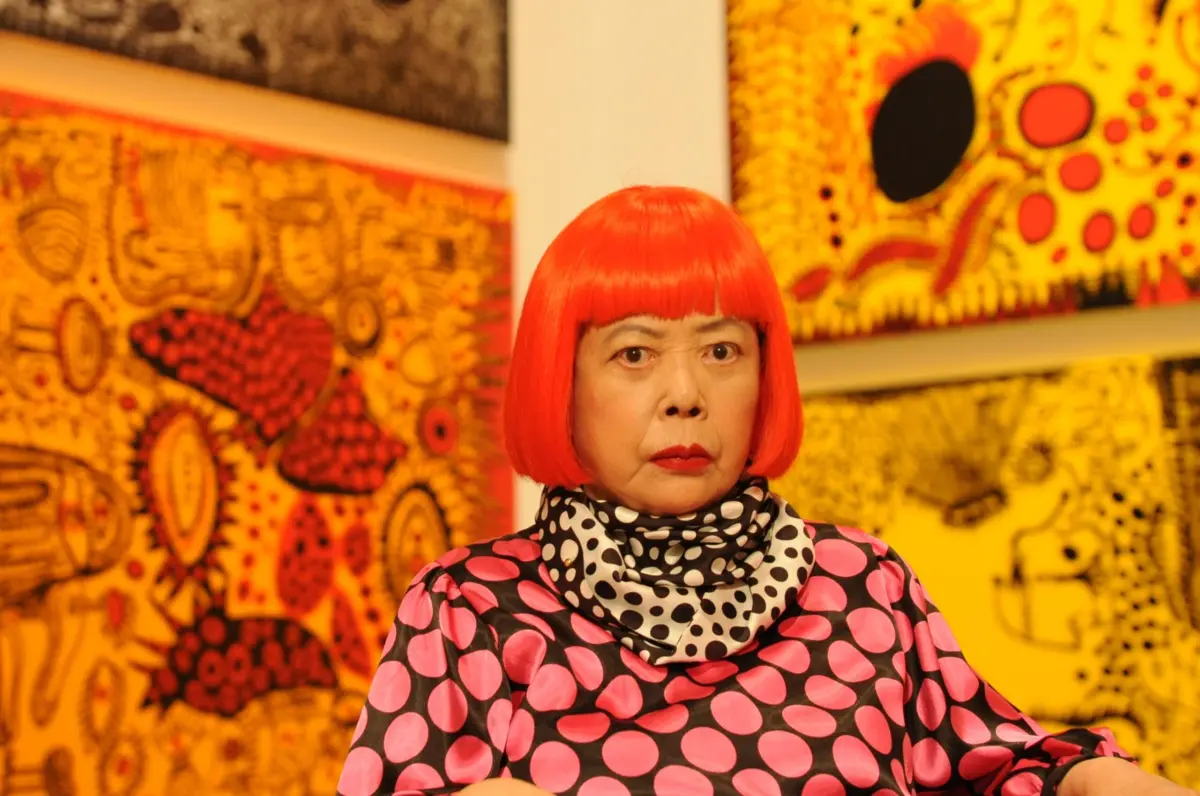
The contemporary art world is in mourning following the death of Yayoi Kusama, the visionary Japanese artist whose hypnotic polka dots, monumental pumpkin sculptures, and dizzying Infinity Mirror Rooms captivated millions across the globe. Kusama passed away on August 14 at a Tokyo hospital at the age of 97, according to an official statement published by her studio.
For decades, Kusama stood as a towering titan in the international art landscape, bridging the gaps between Abstract Expressionism, Pop Art, Minimalism, and experiential design. Her passing marks the end of an era for the global avant-garde, bringing to a close a phenomenal, nearly century-long life defined by relentless creativity, psychological resilience, and aesthetic innovation.
Kusama’s work crossed cultural, generational, and digital divides, transforming fine art into an immersive phenomenon. Long before the era of social media, she understood how to invite audiences inside her art, making her one of the most widely recognized and celebrated living artists of the 21st century.
Chronology: A Life Carved in Dots and Nets
Early Life and Wartime Resilience (1929–1957)
Born in Matsumoto, Japan, in 1929, Kusama endured a turbulent childhood marked by a strict and abusive household. During World War II, as a teenager, she was forced to work in a military factory, sewing parachutes for the Imperial Army. It was during this period of immense psychological stress that Kusama began experiencing the vivid hallucinations that would forever shape her artistic trajectory. Her vision would suddenly flood with glowing spots, nets, and optical distortions, transforming her immediate surroundings into overwhelming visual fields.
Seeking an outlet for her profound inner turmoil, she briefly studied the traditional nihonga style of painting in Kyoto before realizing that her artistic ambitions lay far beyond the confines of academic convention.
The New York Avant-Garde (1958–1972)
In 1958, at the age of 27, Kusama took a bold leap and immigrated to the United States, settling in New York City. She quickly embedded herself in the burgeoning downtown avant-garde scene, exhibiting alongside such luminaries as Andy Warhol, Donald Judd, and Claes Oldenburg.
During this fertile period, she developed her celebrated Infinity Net paintings—massive canvases covered in meticulous, frenetic loops and layers of paint that translated her neurological hallucinations into a universal visual language. Working tirelessly, sometimes painting for 60 consecutive hours, Kusama subverted the male-dominated, gestural bravura of Abstract Expressionism with her obsessive, meditative approach.
By the mid-1960s, Kusama expanded her practice into three dimensions. In 1965, she debuted her first Infinity Mirror Room, an installation that utilized mirrors and flashing lights to transform finite physical spaces into endless vistas. Concurrently, she became a prominent figure in 1960s counterculture, staging political and social "happenings." These performances—such as the Church of Self-Obliteration—featured naked bodies painted with polka dots as statements against the Vietnam War and restrictive heteronormative social structures. Notably, she penned a public Letter to Nixon, offering him intimacy in exchange for ending the bloodshed in Vietnam.
Return to Japan and Sanctuary (1973–1999)
Exhausted by the physical and emotional toll of the New York art scene, Kusama returned to Japan in 1973. In 1977, she made the voluntary decision to admit herself to Seiwa Hospital for the Mentally Ill.
This facility became her permanent residence, providing a structured, safe environment where she could manage her mental health. Demonstrating unwavering dedication to her craft, Kusama walked across the street each day to her private studio, where she continued to paint, sculpt, and plan future installations. While she receded somewhat from the global spotlight during the late 1970s and 1980s, her foundational contributions to installation and performance art were quietly laying the groundwork for a massive resurgence.
Global Renaissance and Digital Omnipresence (2000–2025)
The turn of the millennium witnessed a triumphant global revival of Kusama’s work. Retrospectives traveled to major institutions worldwide, from London’s Tate Modern to the Crystal Bridges Museum of American Art in Arkansas. Her immersive Infinity Mirror Rooms became cultural touchstones, drawing multi-hour queues at David Zwirner galleries in New York and turning museum-going into a viral, digital-age event.
Deep into her 80s and 90s, Kusama remained astonishingly prolific, expanding her footprint into high-fashion collaborations with luxury houses like Louis Vuitton while installing her iconic, spotted pumpkins across natural landscapes and urban centers globally.
Supporting Data: The Economics and Reach of Kusama’s Art
The staggering cultural footprint of Yayoi Kusama is backed by extraordinary market metrics and institutional statistics:
Market Valuation: In 2023 alone, Kusama’s works amassed an astonishing $190.5 million at global art auctions, cementing her status as one of the most commercially successful female artists in history.
Exhibition Attendance: Exhibitions featuring her Infinity Mirror Rooms regularly shatter museum attendance records, with flagship shows generating wait times upwards of five hours.
Literary Contribution: Her 2011 autobiography, Infinity Net: The Autobiography of Yayoi Kusama (published by the University of Chicago Press), provided scholars and fans with an intimate look into her psychological landscape and creative philosophy.
Global Footprint: Over her lifetime, her work has been showcased in hundreds of solo and group exhibitions across North America, Europe, Asia, and South America, bridging high art, public installations, and commercial luxury markets.
Official Responses and Tributes
The global art community, cultural institutions, and world leaders have poured forth tributes honoring Kusama’s monumental legacy.
In its official announcement, the Yayoi Kusama Studio stated:
"Our beloved artist, Yayoi Kusama, dedicated her entire life to the pursuit of beauty, truth, and infinity. Even in her final days, her passion for creation remained undiminished. She taught us how to look beyond the boundaries of our physical reality and find solace in the infinite patterns of the universe. Her light will continue to shine in the hearts of all who experienced her art."
Curators, gallerists, and fellow creators have similarly reflected on her monumental impact. David Zwirner, whose galleries hosted many of her record-breaking exhibitions in New York, shared a statement celebrating her fearlessness:
"Yayoi was a force of nature. She took the deepest pains of her existence and alchemized them into joy, wonder, and boundless generosity for the world. Working alongside her was the privilege of a lifetime."
Museum directors worldwide have noted that Kusama fundamentally transformed how contemporary audiences interact with space, light, and sculpture, proving that avant-garde conceptual art could simultaneously achieve universal populist appeal.
Implications: The Enduring Legacy of an Avant-Garde Pioneer
The passing of Yayoi Kusama prompts a profound reflection on the trajectory of contemporary art and the democratization of museum experiences.
Shaping the Architecture of Experience
Kusama’s pioneering work with mirrors, light, and infinity fundamentally altered the trajectory of experiential design. Long before "Instagrammable" installations became a staple of modern marketing and museum curation, Kusama was engineering spatial illusions that forced viewers to confront their own place in the cosmos. Contemporary interior designers, gallery architects, and hospitality brands continue to draw inspiration from the immersive frameworks she established in the mid-1960s.
Normalizing Mental Health in Art
Throughout her career, Kusama was unapologetic and transparent about her struggles with mental illness. By channeling her hallucinations and psychological distress directly into her art—turning obsessions into intricate "nets"—she destigmatized psychological vulnerability. Her life serves as a powerful testament to the healing and transformative power of creative expression, proving that art can act as both a sanctuary and a communicative bridge to the human soul.
Redefining Longevity in Creative Industries
Kusama defied conventional age barriers in the art and fashion worlds. By continuing to innovate, produce monumental sculptures, and collaborate with global luxury brands well into her 90s, she redefined what a late-career artistic practice could achieve.
As the art world moves forward without her physical presence, Yayoi Kusama’s universe remains infinite. Through her polka-dotted canvases, mirrored chambers, and enduring spirit, she has left behind a legacy that ensures she will forever remain at the center of the cosmos she so brilliantly mapped.