

Main Facts: Redefining Flow Through Creative Transitions
In the realm of physical movement and mindful discipline, humans naturally crave consistency. There is a distinct, measurable sigh of relief that reverberates through the human nervous system when daily routines are executed with predictable precision—whether it is adhering to a strict sleep schedule, commuting via a well-worn route, or mechanically stepping back into Downward-Facing Dog immediately following a Low Lunge.
However, growth rarely happens within the confines of absolute automation. According to movement experts and yoga educators, breaking out of these rigid patterns is essential for both physical longevity and mental engagement. One of the most effective, yet frequently overlooked, ways to achieve this on the mat is by reimagining standard transitional movements.
Demonstrated by yoga instructor Jordan Baggot, altering how practitioners move from a foundational posture like Low Lunge into subsequent asanas can fundamentally transform a sequence. Rather than sticking to the traditional, linear flows that dominate modern vinyasa classes, introducing inventive transitions challenges the body in novel ways. These micro-adjustments act as the on-the-mat equivalent of taking an unfamiliar road home: they jolt the nervous system out of autopilot, spark fresh creative inspiration, and force stabilizing muscles to fire in sequences they may have never experienced before.
Chronology: The Evolution of Modern Vinyasa and the Quest for Creative Sequencing
To understand the significance of introducing unconventional transitions, one must look at the historical trajectory of modern postural yoga.
- The Classical Era: Traditional lineages often prioritized holding static postures for extended periods, focusing on breath control (pranayama) and internal focus (drishti). Transitions were treated merely as functional bridges to get from one shape to the next.
- The Rise of Vinyasa: In the late 20th century, dynamic styles of yoga popularized the concept of vinyasa, linking breath directly with movement. While this revolutionized the accessibility and cardiovascular benefits of yoga, it also inadvertently standardized sequences. The ubiquitous Low Lunge-to-Plank-to-Chaturanga cycle became the default blueprint for millions of practitioners worldwide.
- The Contemporary Shift (2020s–Present): As sports science, physical therapy, and functional movement principles have increasingly integrated into yoga instruction, educators have recognized the limitations of linear movement patterns. Repetitive strain injuries, movement plateaus, and mental fatigue prompted instructors like Baggot to explore lateral, rotational, and multi-planar pathways.
- The Current Landscape: Today, the focus has shifted toward movement vocabulary expansion. By treating transitions not as empty space between poses, but as postures of strength in their own right, modern practitioners are redefining what a holistic practice looks like.
Supporting Data: The Science of Movement Variety and Neuroplasticity
Why do small alterations in physical routines yield such profound mental and physical benefits? The answer lies at the intersection of neuroscience and kinesiology.
1. Neuroplasticity and Habit Breaking
Human brains are wired to optimize energy consumption by turning frequent activities into subconscious habits. While efficient, this limits cognitive engagement. When a practitioner introduces a novel movement—such as shifting from a Low Lunge directly into a Seated Twist or a Horizon Lunge—the brain is forced to exit autopilot. This process stimulates neuroplasticity, the brain’s ability to form new neural pathways, which has been linked to improved cognitive flexibility, enhanced mindfulness, and mental rejuvenation.
2. Multi-Planar Strength and Joint Health
Standard yoga classes heavily favor sagittal plane movements (forward and backward folding). However, the human body operates in three dimensions. Introducing transitions that incorporate lateral bending and spinal rotation strengthens the joints—particularly the hips, shoulders, and spine—through a wider range of motion.
- Injury Prevention: Strengthening stabilizing muscles around the hips and knees reduces the likelihood of overuse injuries.
- Fascial Health: Varying movement vectors hydrates the fascia, the connective tissue web that surrounds muscles, improving overall elasticity and reducing chronic stiffness.
Official Responses and Expert Perspectives
Leading voices in the contemporary movement and yoga community emphasize that variability is the ultimate antidote to burnout—both for seasoned teachers and everyday students.
"Sometimes it’s the small decisions that will inspire you the most," notes Jordan Baggot. "Think of mixing up your transitions as the on-the-mat equivalent of driving a different route home. It’s the seemingly small decisions that can bring you to new levels of inspiration, understanding, and zest for your yoga practice—and your life."
Physical therapists and biomechanics specialists echo this sentiment. By disrupting the predictability of a sequence, practitioners are forced to rely on active muscular engagement rather than passive ligamentous support. When a transition requires shifting weight laterally or lifting a limb into space—such as in a Three-Pointed Push-Up—the core stabilizers and proprioceptive systems must work overtime to maintain balance. This elevates a routine flow into an active conditioning session without requiring heavier weights or more complex primary postures.
Implications: How to Integrate These Transitions Into Your Practice
For yoga teachers, incorporating these variations offers a powerful tool to revitalize class sequencing and keep students mentally present. For individual practitioners, experimenting with these movements at home can unlock a deeper understanding of balance, weight distribution, and spatial awareness.
Below are seven distinct, surprising transitions derived from a standard Low Lunge. Rotate one or two of these into your next flow to test your stability, challenge your neuromuscular pathways, and discover an entirely new dimension to familiar shapes.
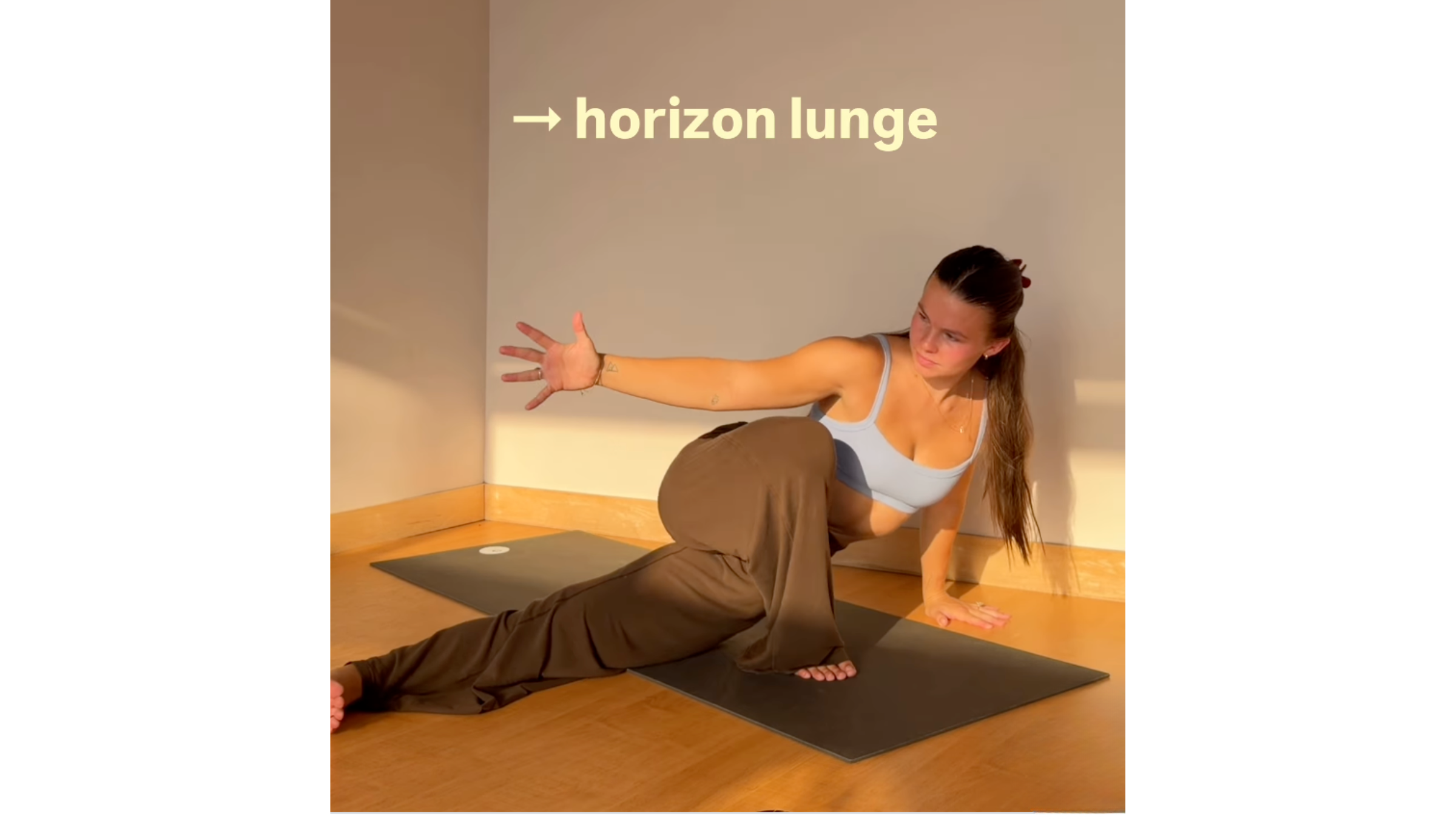
1. Horizon Lunge
- The Execution: From a Low Lunge, ground down by shifting your weight into your right foot. Lower your left hand to the mat directly beneath your shoulder. Sweep your left leg behind and to the outside of your right foot, planting the outer edge of the left foot firmly against the floor. Straighten your left leg as much as mobility allows.
- The Benefit: Reach your right arm straight out to the side above your left leg. Shifting a portion of your weight into your left hand allows you to gently lean left and let your hips sink toward the mat, delivering a deeply satisfying stretch across the outer hips and lateral body.
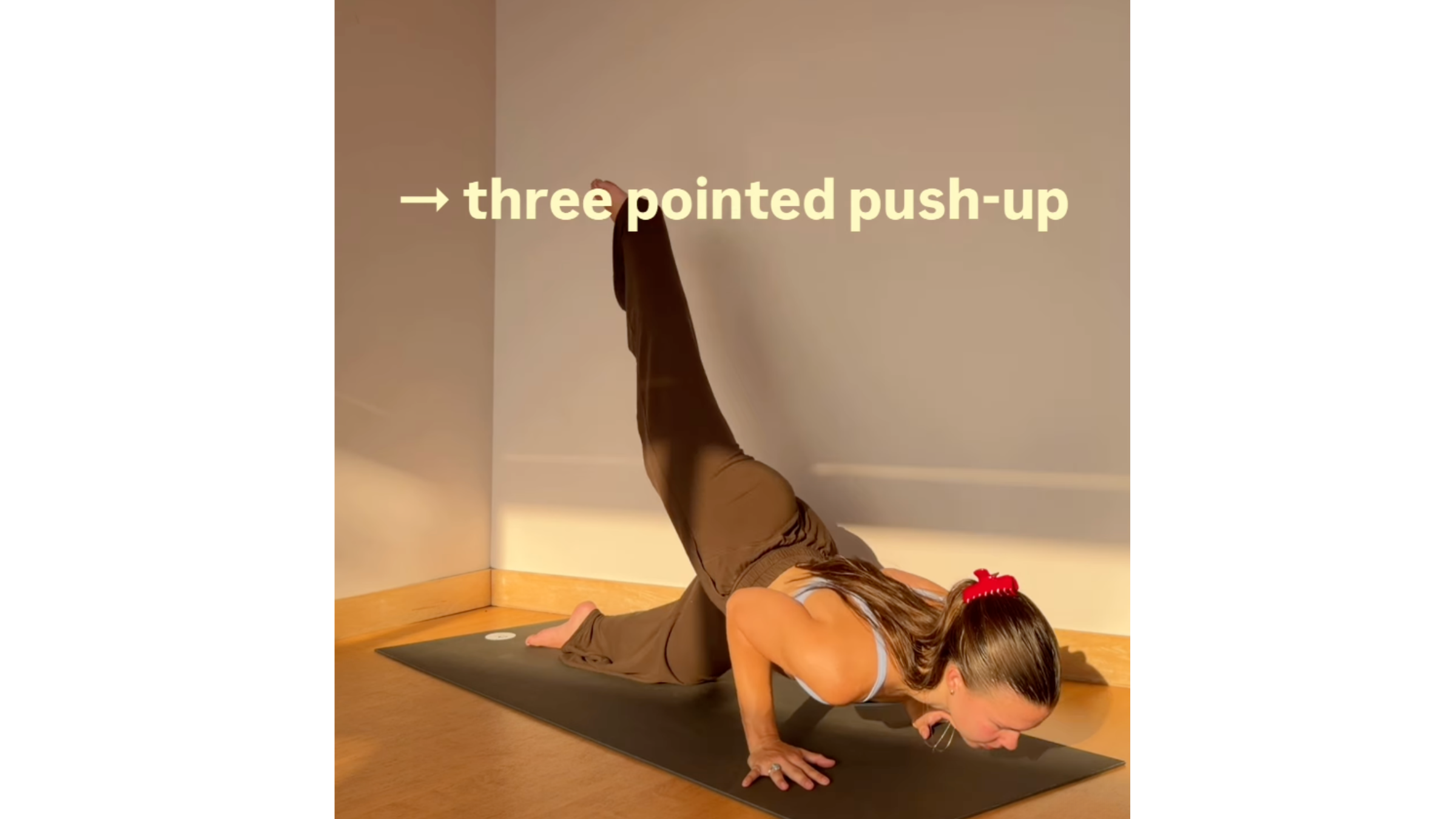
2. Three-Pointed Push-Up
- The Execution: Begin in a Low Lunge, then plant both hands firmly on the mat on either side of your right foot, shifting your center of gravity forward into your palms. Lift your right foot entirely off the mat and extend your right leg straight back behind you.
- The Benefit: From this suspended leg position, bend your elbows and lower your chest halfway down toward the mat in a modified, highly demanding variation of a Chaturanga. This heavily engages the core, upper back, and stabilizing shoulders.
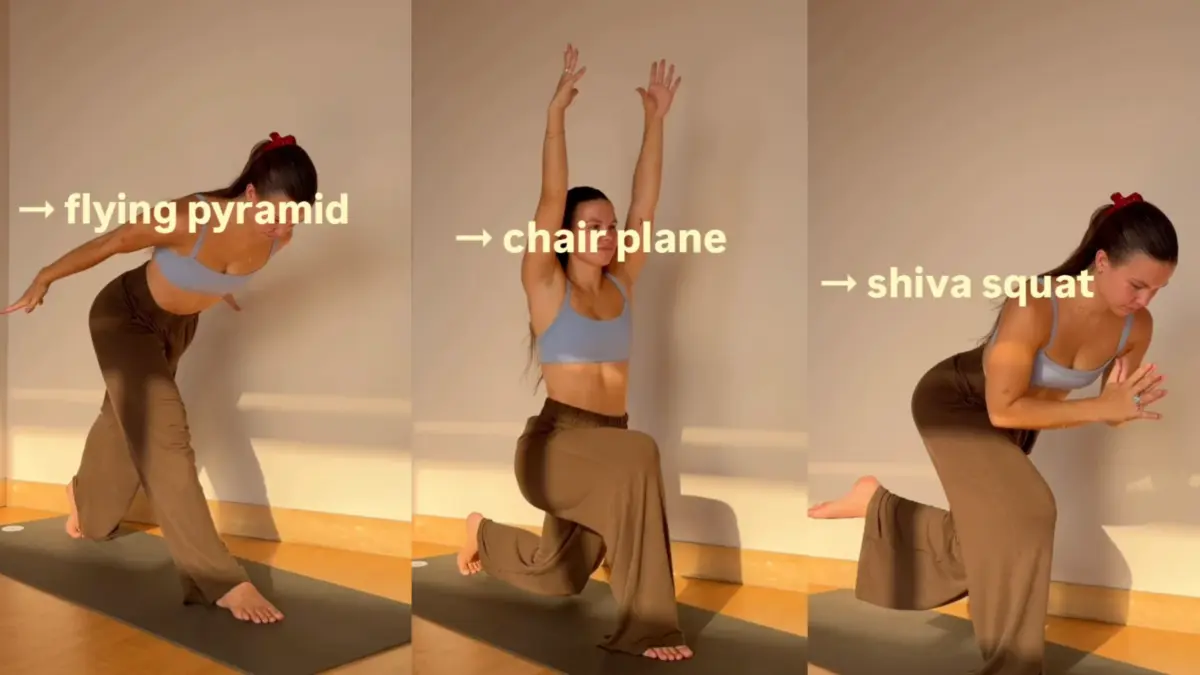
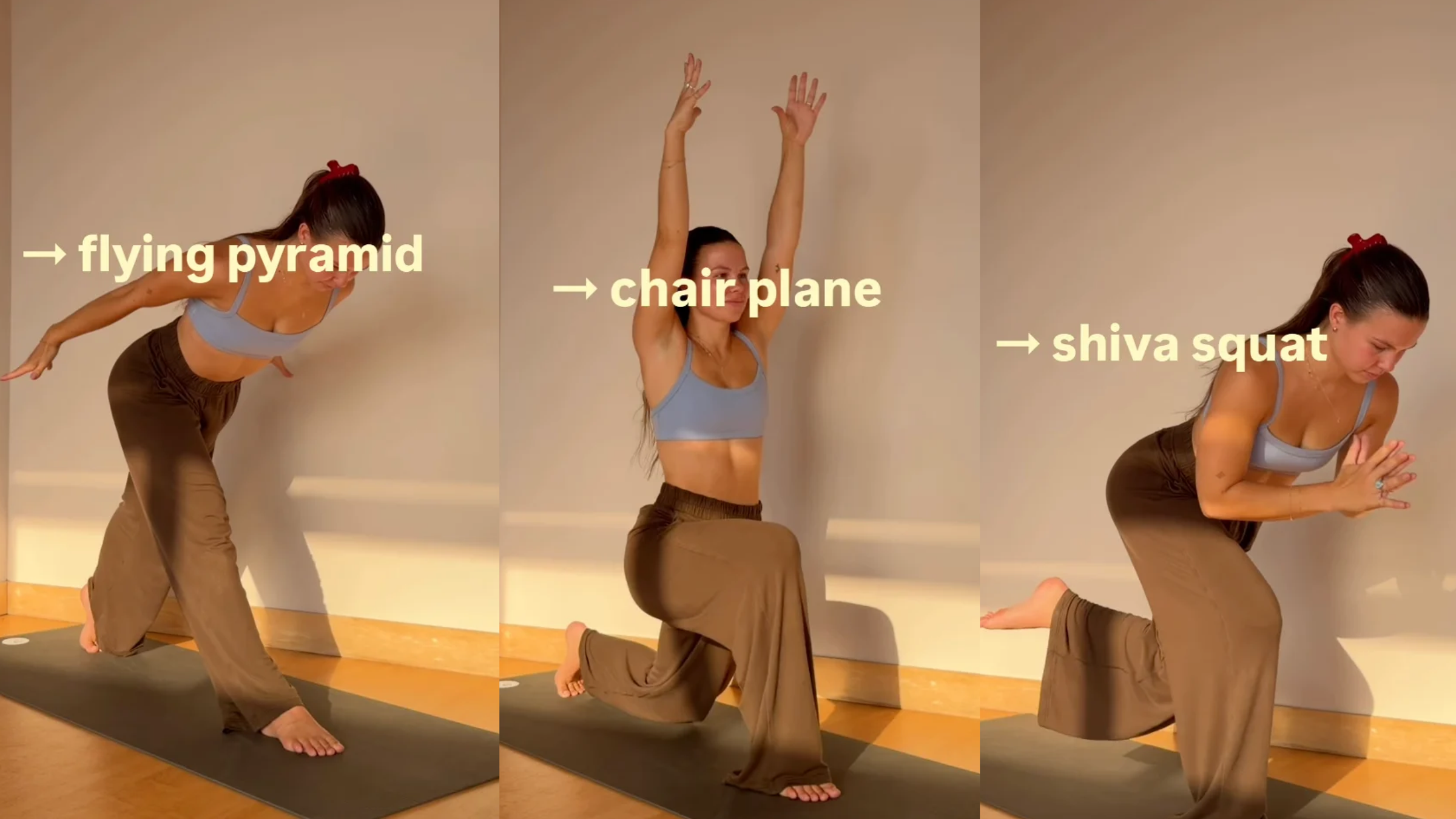
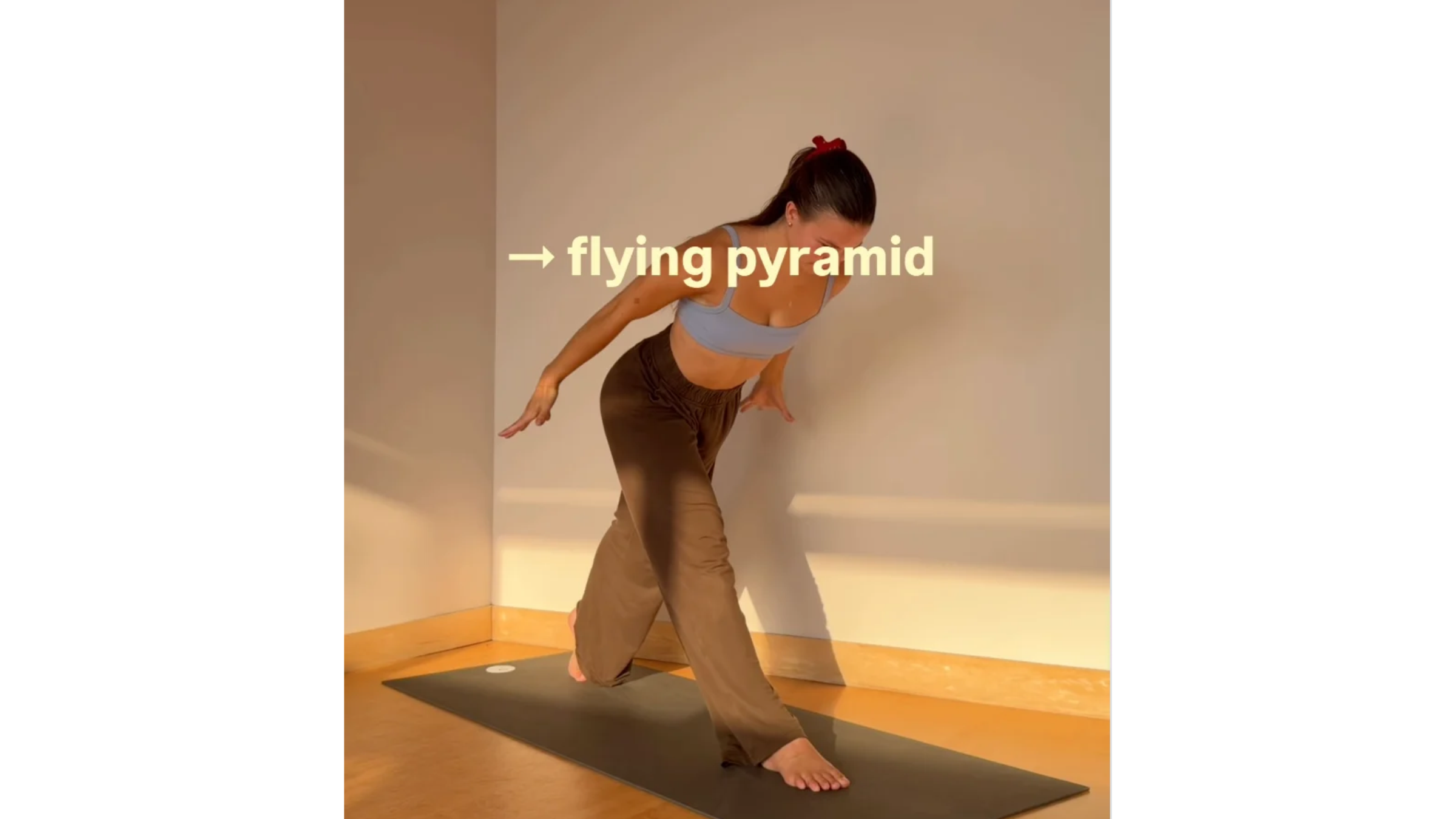
3. Flying Pyramid
- The Execution: From Low Lunge, tuck your left toes under and straighten both legs. Lengthen your spine forward, reaching your chest over your right leg as if entering a traditional Pyramid pose, but keeping your back heel actively lifted.
- The Benefit: Sweep both arms down alongside your torso and reach them slightly backward, palms facing down toward the floor. This transition challenges your balance while building profound isometric strength in the hamstrings, calves, and postural muscles of the back.
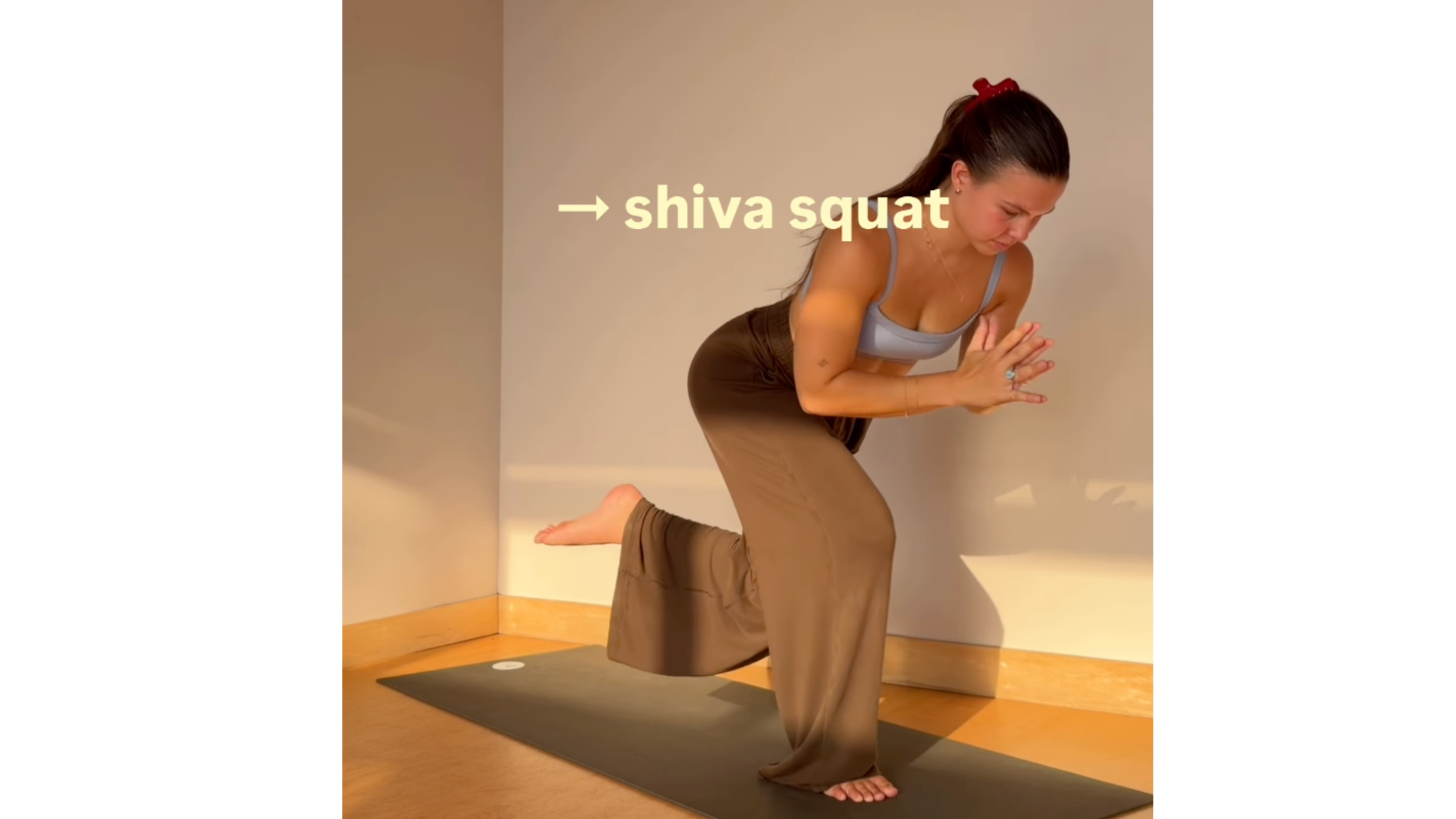
4. Shiva Squat
- The Execution: Starting in Low Lunge, tuck your left toes, engage your core, and rise up slightly while keeping both legs deeply bent. Draw your left knee across and behind your right knee, keeping your left foot hovered off the mat. Gently squeeze your inner thighs together while pointing your left toes toward the right side of the room.
- The Benefit: Bring your hands into a prayer position (Anjali Mudra) at your chest. Sink your hips low toward the floor and angle your chest forward into Shiva Squat. This movement targets the outer glutes and improves single-leg balance and ankle mobility.
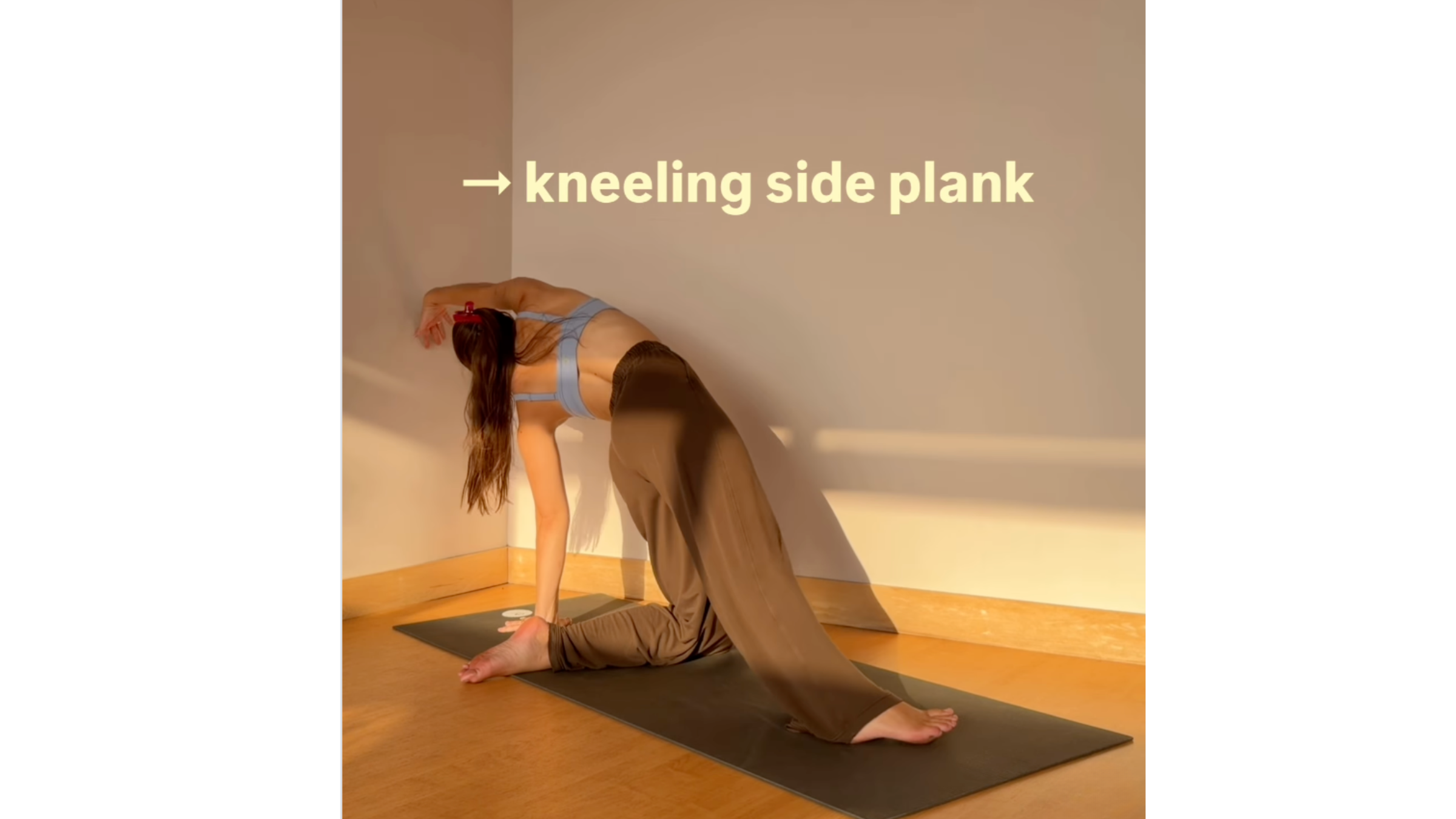
5. Kneeling Side Plank
- The Execution: From Low Lunge, maintain your leg positioning while pivoting your torso to open toward the left side of the mat. Reach your left hand back behind your left foot and anchor it to the floor.
- The Benefit: Shift your weight into your grounded left hand and left knee while extending your right leg out long. Reach your top right arm overhead toward the back wall to enter a supportive yet expansive Kneeling Side Plank, opening the chest and side body.
6. Seated Twist
- The Execution: In Low Lunge, lift your left foot off the mat and swing your left knee forward to the outside of your right foot. Lower your hips smoothly down to the mat, bringing your left foot behind you to the right and placing your right foot to the outside of your left thigh.
- The Benefit: You will land gracefully in a grounded Seated Twist (similar to Half Lord of the Fishes Pose). This transition provides a fluid, restorative pathway from an active standing lunge directly into a deeply detoxifying spinal rotation.
7. Chair Plane
- The Execution: From Low Lunge, tuck your back left toes and powerfully step your left foot forward to meet your right foot, bending both knees simultaneously.
- The Benefit: Reach your chest forward over your thighs and drop your hips as if settling into an imaginary chair. Sweep your arms dynamically back past your hips into Chair Plane. This transition builds lower body endurance, ignites the quadriceps, and introduces a burst of cardiovascular energy into a static sequence.
Conclusion
Ultimately, yoga is not about perfection or mindless repetition; it is a moving meditation on presence and adaptability. By swapping out standard transitions for unexpected variations like the Horizon Lunge or Shiva Squat, practitioners can dismantle the monotony of routine. Whether you are teaching a packed studio class or rolling out your mat for a quiet solo practice at home, these micro-decisions offer a reliable pathway back to inspiration, physical resilience, and joy.
