


High-voltage direct current (HVDC) transmission is experiencing a quiet revolution. Once viewed as an exotic, bespoke technology reserved for extreme engineering challenges—such as marathon subsea interconnections or uniquely complex grid bottlenecks—HVDC is rapidly becoming a standard tool in the transmission planner’s arsenal.
However, as hardware manufacturing converges around repeatable, large-scale building blocks, the surrounding electrical grids are facing a reckoning. The primary constraints of modern grid expansion are no longer rooted in factory floors or cable availability; instead, they are shifting toward complex software controls, multi-vendor interoperability, antiquated regulatory frameworks, and a severe shortage of specialized electrical engineering talent.
Main Facts
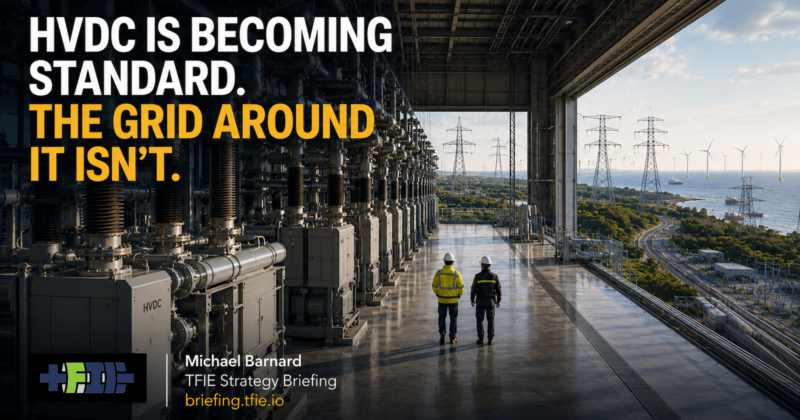
The modern HVDC landscape is defined by a paradox: physical standardization is accelerating globally, while software and institutional integration are lagging behind.
- Physical Standardization: The European market is converging around a repeatable 2 GW, 525 kV HVDC building block featuring common converter configurations and bipolar designs. Other major global markets are establishing their own macro-scale patterns, with 3 GW projects emerging across the United States and India.
- The Interoperability Challenge: Transitioning from isolated point-to-point links to complex, multi-terminal, and multi-vendor meshed grids introduces steep integration hurdles. Converters from different suppliers must seamlessly communicate across control modes, protection behaviors, and proprietary interfaces.
- The Planning and Regulatory Gap: While Europe has established multi-national institutions to handle regional grid planning, North America struggles significantly with inter-regional alignment, cost allocation, and unified definitions of "system benefits."
- The Engineering Talent Crunch: Despite technological advancements and automation potentials, the transition to an inverter-dominated grid faces a severe human bottleneck: a shortage of experienced power engineers capable of managing complex high-voltage systems.
Chronology of Transmission: From Exotic Niche to Mainstream Tool
To understand the current state of HVDC, it is necessary to examine how the technology has evolved within the broader context of electrical grid development.
Phase 1: The Era of Specialization (Late 20th Century to Early 2010s)
Historically, alternating current (AC) dominated nearly all transmission landscapes. HVDC was deployed selectively. If utilities needed to move power across hundreds of miles of ocean—such as linking UK grids to continental Europe—or connect asynchronous grid regions, HVDC served as a costly, highly customized engineering marvel. Every project required a blank-sheet approach, pushing timelines out by a decade and locking utilities into single-vendor ecosystems.
Phase 2: The Renewable Influx and Supply Chain Strain (2015–2023)
As massive offshore wind farms and remote solar installations proliferated, the limits of legacy AC grids became glaringly obvious. Long-distance bulk power transfer required lower electrical losses, pushing demand for HVDC skyward. However, demand quickly outstripped global manufacturing capacity. Transformer factories, specialized cable-laying vessels, and power electronics manufacturers faced severe backlogs, creating bottlenecks that slowed the global energy transition.
Phase 3: The Modular Convergence and Current Reality (2024–Present)
Today, the industry has crossed a threshold. Manufacturing capacity is catching up, and the focus has shifted toward replication. By standardizing around modular 2 GW and 3 GW blocks, developers and equipment manufacturers can treat converter stations less like custom civil engineering projects and more like repeatable product families. Yet, as Cornelis Plet, CTO of Grid Systems Integration at GE Vernova, highlighted in a recent Redefining Energy discussion, this hardware maturity has exposed deeper, structural cracks in grid controls, planning, and institutional readiness.
Supporting Data & Technical Realities
The pivot toward standardization is best illustrated by the sheer scale of modern power modules.
[Traditional Custom HVDC] ---> Long engineering timelines, high costs, single-vendor lock-in.
           ↓
[Modern Modular HVDC]    ---> 2 GW (Europe) / 3 GW (US & India) standardized building blocks.
           ↓
[The Remaining Bottleneck] ---> Grid-forming software, multi-vendor interoperability, and human capital.
The Power of Scale
In Europe, the consensus has coalesced around 525 kV, 2 GW bipolar systems. This specific capacity strikes an optimal balance between thermal limits, physical footprint, and the sheer volume of renewable energy pouring in from massive North Sea wind arrays. Meanwhile, the United States and India—driven by vast continental landmasses and massive load centers—are pushing the envelope further with 3 GW configurations.
The Software and Stability Conundrum
As conventional thermal and nuclear generators retire, they take their physical inertia with them. Grids are increasingly dominated by power electronics (inverters and converters). Consequently, HVDC converter stations can no longer act merely as passive tollbooths moving electricity from Point A to Point B; they must actively contribute to grid stability using grid-forming controls.
However, a major hurdle remains: there is no single, globally unified definition of how these grid-forming controls should behave. Different regions and grid codes demand distinct operational parameters. Vendors are forced to maintain fragmented software implementations, leaving utilities to figure out how disparate systems will react during a sudden grid disturbance.
Official Responses and Expert Insights
Industry leaders emphasize that the narrative surrounding transmission bottlenecks requires an urgent update. For years, the narrative focused exclusively on factory constraints—specifically shortages of copper, specialized high-voltage cables, and massive converter transformers. While those supply chains remain tight, the fundamental nature of the bottleneck is shifting.
"HVDC is moving into the normal transmission planner’s toolbox rather than sitting off to the side as an exotic developer proposal," notes Cornelis Plet.
However, Plet cautions that standardizing the boxes does little to solve the friction of system architecture. When moving from simple point-to-point links to advanced multi-vendor meshed grids—a transition heavily explored during Europe’s PROMOTioN research program—interoperability becomes a minefield. Bridging equipment from Supplier A and Supplier B involves navigating complex negotiations over intellectual property, proprietary protection schemes, and precise interface protocols.

Furthermore, Plet points out a constraint that rarely makes mainstream headlines: the human resource deficit.
- Standardized designs can reduce the number of engineering hours required per project.
- Artificial intelligence may eventually automate baseline optimization tasks.
- Despite these tools, managing an inverter-dominated grid requires deep, intuitive expertise in high-voltage physics, system protection, and dynamic control loops.
According to industry experts, the scarcity of seasoned power systems engineers is now one of the most binding practical limits on global grid expansion.
Implications for the Global Energy Transition
The resolution of the HVDC hardware challenge marks a major milestone for decarbonization, but the remaining hurdles carry profound implications for climate targets, electricity markets, and geopolitical energy security.
1. The North American Planning Deficit
While Europe has built—and continues to refine—multinational institutions capable of cross-border grid planning, North America remains heavily balkanized. Fragmented regulatory jurisdictions, lack of consensus on cost allocation, and endless debates over what constitutes a "system benefit" mean that multi-state and inter-regional HVDC projects routinely stall. Without sweeping regulatory reform to streamline multi-regional planning, hardware standardization alone will not unlock the continent’s remote wind and solar resources.
2. The Risk of Vendor Lock-In vs. Open Grids
As multi-terminal grids expand, utilities face a stark choice. Will they rely on single-vendor monopolies to build entire meshed zones to avoid integration nightmares, or will they push for strict, open interoperability standards? The former offers short-term ease of deployment but risks long-term cost inflation and inflexibility. The latter demands immense collaborative effort across global manufacturers but promises a resilient, competitive market.
3. Redefining the Engineering Workforce
Educational institutions and utilities must rapidly adapt to the new reality of power systems engineering. Traditional electrical engineering curricula often over-index on legacy, rotating-machine AC theory. A modern grid dominated by HVDC links, high-power electronics, and synthetic inertia requires a pivot toward advanced control systems, software-hardware integration, and power systems dynamics.
Conclusion
The question facing the global energy transition is no longer whether high-voltage direct current hardware can perform at scale. It can, and it does. The true test of the 21st-century grid will be whether institutional frameworks, regulatory bodies, software standards, and human capital can evolve quickly enough to harness the full potential of these standardized power highways.
