Main Facts: The Intersection of Nature and Contemporary Art
The natural world has long served as the ultimate muse for human creativity. From the prehistoric cave paintings of Lascaux to the sweeping, atmospheric vistas of the Hudson River School, artists have perpetually sought to capture the elusive, dynamic essence of the great outdoors. In a newly released special advertising and editorial showcase, the enduring relationship between contemporary painters and the wild environment takes center stage.
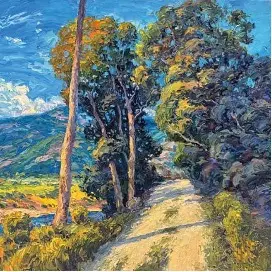
At the heart of this showcase is a compelling piece by acclaimed artist Brad Teare titled Country Lane, an oil-on-canvas work measuring 40 by 40 inches. Teare’s work exemplifies the core mission of the feature: demonstrating how the raw landscapes just beyond our doorsteps continue to ignite boundless artistic inspiration.
The curated selection highlights works that span traditional landscapes, intimate studies of flora, and dynamic depictions of wildlife. Rather than merely recording topographical details, the participating artists translate transient atmospheric conditions, shifting light, and raw textures into permanent visual poetry. Whether working en plein air—painting directly from nature—or synthesizing memory and field sketches back in the studio, these creators embark on what many describe as the ultimate artistic adventure: freezing a fleeting moment of natural wonder onto a static canvas.
Chronology: The Evolution of Outdoor Painting Traditions
To understand the significance of contemporary outdoor and wildlife art, it is essential to trace the historical lineage that paved the way for today’s painters.
Pre-20th Century: The Foundation of Landscape Painting
The Romantic Era: Artists began viewing nature not merely as a backdrop for mythological or historical narratives, but as a sublime, overwhelming force capable of evoking deep emotional responses.
The Barbizon School and Impressionism: In the mid-to-late 19th century, the invention of tube paint revolutionized art. Painters like Claude Monet and the French Barbizon painters walked out of their dark studios and into the sunlight, championing plein air painting to capture the changing effects of natural light.
The American West and Regionalism: As explorers mapped the American frontier, artists accompanied expeditions to document majestic landscapes, eventually leading to conservation movements and the establishment of national parks inspired largely by dramatic visual representations.
The Mid-to-Late 20th Century: Modern Interpretations
As abstract expressionism and modernism swept the globe, traditional landscape painting experienced ebbs and flows. However, regional realism and wildlife art carved out a resilient, dedicated niche, supported by specialized publications and dedicated guilds.
The Present Era: The Digital Age Meets Traditional Craft
Contemporary Integration: Today’s artists operate in a hybrid ecosystem. While modern tools—such as digital photography, drones for aerial perspectives, and advanced travel gear—aid in reference gathering, the fundamental physical act of applying oil or acrylic to canvas remains stubbornly traditional.
The Current Showcase: The unveiling of portfolios featuring works like Brad Teare’s Country Lane marks a contemporary milestone, bridging the gap between historical landscape traditions and modern collectors’ appetites for authentic, tactile depictions of the natural world.
Supporting Data: The Economic and Cultural Impact of Wildlife and Landscape Art
The market for nature-inspired art is both culturally vibrant and economically robust. Industry data, gallery trends, and demographic studies paint a clear picture of why landscape and wildlife art continues to thrive in the 21st century.
Market Resilience and Collector Demand
Sector Stability: According to fine art market reports, traditional and contemporary landscape art consistently ranks among the most stable asset classes for regional galleries, retaining steady demand even during broader economic fluctuations.
The Plein Air Movement Surge: Membership in national outdoor painting organizations—such as Plein Air Painters of America (PAPA) and various regional plein air societies—has seen steady year-over-year growth over the past decade, boasting tens of thousands of active practitioners across North America.
Exhibition Metrics: Special thematic sections focusing on the natural world consistently yield high engagement metrics online, driving traffic to digital galleries and increasing secondary market inquiries for participating artists.
Environmental Demographics
The Conservation-Art Nexus: Studies in cultural economics indicate that buyers of landscape and wildlife art are disproportionately active in environmental conservation, often using their art collections to support land trusts, wildlife sanctuaries, and national park foundations.
Geographic Preferences: While collectors span urban and rural environments alike, the highest concentration of buyers for large-scale landscape oils (such as 40×40-inch formats) reside in metropolitan centers, utilizing these works to bring a sense of expansive spatial freedom into urban living spaces.
Official Perspectives: Insights from Artists and Curators
The creative process behind capturing the wild is rarely straightforward. To understand the dedication required to bring a scene like Country Lane to life, arts administrators, curators, and the artists themselves offer vital perspectives.
The Artist’s Viewpoint: Translating Chaos into Composition
Brad Teare, whose painting anchors the current exhibition, has frequently spoken about the meditative yet rigorous nature of painting landscapes.
"Nature does not organize itself for the convenience of the painter," notes Teare in studio notes accompanying his broader body of work. "When you stand before a country lane, a mountain range, or a dense thicket, you are confronted with visual static—infinite details, conflicting light sources, and overwhelming scale. The job of the artist is not to copy, but to edit, interpret, and find the underlying rhythm. You have to listen to the landscape before you can translate it."
Curator and Critic Perspectives
Art historians and contemporary curators emphasize that landscape painting today is fundamentally different from the documentary photography of the 19th century.
"In an era where high-definition cameras and smartphones can capture a hyper-realistic image of a forest or a sunset in a fraction of a second, the value of painting has shifted," explains an independent fine arts curator specializing in contemporary realism. "Collectors are no longer looking for a substitute for a camera. They are looking for human interpretation, the physical evidence of the brushstroke, the emotional resonance of the artist standing in the wind, feeling the cold air or the harsh sun. Art is about presence, not perfection."
Furthermore, cultural commentators note that special advertising sections and curated showcases play an indispensable role in keeping traditional genres visible in a media landscape dominated by fast-paced digital imagery. By creating dedicated spaces for deep dives into genres like outdoor painting, platforms allow collectors to slow down and appreciate the meticulous craftsmanship involved.
Implications: The Future of Outdoor Art in a Rapidly Changing World
As human expansion, climate shifts, and digital immersion continue to reshape our relationship with the planet, the cultural and psychological implications of landscape and wildlife art become increasingly profound.
1. Reconnecting with the Physical World
In an age where the average individual spends hours daily staring at flat, glowing screens, outdoor art acts as a vital psychological bridge. Large-scale canvases—such as Teare’s 40×40-inch Country Lane—do not merely decorate a wall; they create an optical illusion of depth and space. They invite the viewer to step mentally outside the confines of a room and wander down a sunlit path or beneath a canopy of leaves. This visual escape has been linked by environmental psychologists to reduced stress levels and a renewed appreciation for physical geography.
2. Documenting Endangered Landscapes
While many landscape painters focus on timeless beauty, an increasing number of artists find themselves recording environments under threat. From disappearing rural lanes swallowed by suburban sprawl to shifting coastlines and changing forest ecosystems, painters serve as quiet witnesses to environmental change. Their canvases preserve the character of regions that may look entirely different decades from now, serving as historical records disguised as fine art.
3. Fostering Environmental Stewardship
Art has always been a powerful catalyst for conservation. Historically, paintings and photographs of the American West helped convince lawmakers to preserve national parks. Today, contemporary wildlife and landscape artists continue this legacy. By highlighting the intricate beauty of local ecosystems—the play of morning light across a meadow, the texture of weathered bark, the vast openness of the countryside—these creators cultivate empathy for the natural world. When people learn to see the extraordinary detail in a simple country lane, they are far more likely to advocate for the protection of larger natural habitats.
Conclusion
The enduring appeal of landscape and wildlife art proves that despite technological advancements and urban migration, our primal connection to the earth remains unbroken. Through the dedicated vision of contemporary painters, viewers are granted a renewed invitation to step outside, observe the subtle wonders of the natural world, and experience the profound adventure of translating the wild onto canvas. Whether viewed in a gallery, a special publication, or a private collection, these works remind us that beauty is always just around the corner—waiting to be seen, felt, and remembered.