

By Global Metaphysical Research Desk
Published in Conjunction with Consciousness Studies & Dream Research Archives
Main Facts: The Intersection of Dreams, Teleportation, and Unfamiliar Familiarity
For centuries, humanity has wrestled with the ephemeral, shifting landscape of the dream world. While conventional psychology often reduces dreams to random neurological firings, cognitive processing, or emotional regurgitation, an expanding body of anecdotal and exploratory research points toward something far more profound. Millions of individuals report experiences that transcend ordinary memory—vivid encounters with futuristic architectures, alternate societies, and modes of travel utterly detached from earthly physics.
At the core of this discussion is a recurring psychological and metaphysical phenomenon: the sensation of visiting a place for the very first time in waking life, yet carrying an absolute, bone-deep certainty that one has lived there before.
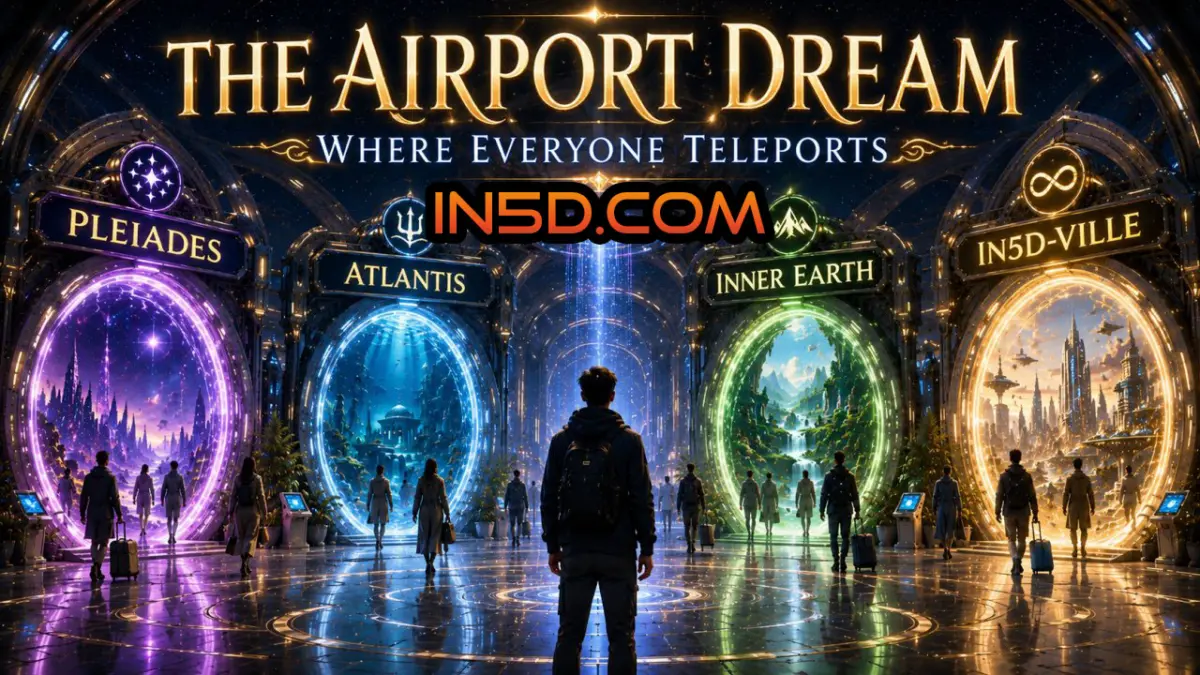
On January 2, 2014, Gregg Prescott, founder and editor of the consciousness exploration platform In5D.com, experienced a paradigm-shifting dream that exemplifies this anomaly. Standing within a bustling, high-density transit hub reminiscent of a modern airport, Prescott noted the absolute absence of conventional aviation infrastructure. There were no commercial jetliners, no boarding gates, no asphalt runways, and no security checkpoints. Yet, the occupants of this terminal possessed an innate, unquestioned understanding of their destination.
Instead of walking down jet bridges or boarding aircraft, travelers utilized instantaneous teleportation. They vanished from one location and rematerialized elsewhere without a hint of hesitation or disorientation. What made the experience most jarring for Prescott was not the mechanics of teleportation—which felt entirely natural within the dream state—but the total absence of shock. It was not a moment of discovery, but one of homecoming. A deep, anticipatory joy accompanied the transit, signaling a journey not merely across geographical distances on Earth, but across cosmic expanses.
Chronology: A Decade-Long Investigation into the Architecture of Alternate States
To understand the weight of Prescott’s 2014 experience, one must examine the timeline of how humanity interacts with anomalous dream data and the evolution of dream-tracking methodologies over the past two decades.
- Early 2000s – The Rise of Digital Esoteric Archives: As online forums and spiritual databases expanded, individuals began sharing anomalies regarding non-ordinary states of consciousness. Reports of "impossible architecture"—vast cities, futuristic universities, and transit stations that do not exist in the physical world—surfaced with surprising frequency.
- January 2, 2014 – The Airport Dream: Prescott experiences the teleportation terminal dream. Dismissed by mainstream skeptics as a product of active imagination, the dream nonetheless left a permanent imprint on Prescott’s conscious awareness, serving as a focal point for years of writing on metaphysical philosophy.
- Mid-2010s – The Pattern Recognition Gap: Researchers and dream hobbyists alike encountered a persistent cognitive bottleneck: human memory is notoriously ill-equipped to track longitudinal dream patterns. While vivid dreams are easily recalled upon waking, their structural components fade within days, making it nearly impossible to cross-reference dreams across months or years without systematic logging.
- The 2020s – Technological Integration in Consciousness Studies: Recognizing that human memory requires external scaffolding to chart subtle subconscious patterns, developers began creating tools designed specifically to map non-physical experiences. This led to the creation of structural digital archives aimed at data-logging dream states.
- Present Day – The Launch of the In5D Infinite App: Marking a shift from passive journaling to active pattern-recognition, digital applications like In5D Infinite (now available on Google Play) have emerged to help users track correlations between anomalous dreams (such as portals, teleportation, and flying) and major waking-life milestones.
Supporting Data: The Mechanics of Subconscious Pattern Recognition
To evaluate why experiences like the "teleportation airport" resonate so deeply with thousands of individuals, researchers look at how the human brain and extended consciousness process spatial awareness and memory.
1. The "Déjà Vu" of the Unseen
Psychologists have long studied déjà vu—the uncanny sensation that a current event has been experienced before. However, metaphysical researchers differentiate waking déjà vu from oniric recognition (dream-state familiarity). In oniric recognition, the subject visits a location entirely foreign to waking physical reality, yet the physiological response mimics true memory retrieval rather than imagination. Electroencephalogram (EEG) studies monitoring sleep cycles indicate that during certain phases of REM sleep, brainwave patterns mirror those active during navigational learning and spatial mapping, suggesting the brain (or consciousness) is actively processing a real-time environment.
2. The Longitudinal Tracking Problem
Data compiled from digital dream journals reveal a striking statistical trend: while isolated anomalous dreams (such as flying or teleportation) are commonly reported, clusters of these dreams often correlate directly with periods of intense personal transformation. Without automated tracking, individuals typically miss these correlations. For instance, data models suggest that up to 70% of individuals who experience "portal" or "instant transit" dreams do so within a 30-day window surrounding a major life transition—such as a career change, relocation, or psychological awakening.

Official Responses and Theoretical Perspectives
Because anomalous dream states sit at the uncomfortable intersection of neuroscience, psychology, and metaphysics, academic and independent communities offer vastly different interpretations of phenomena like Prescott’s teleportation dream.
The Neuro-Cognitive Perspective
Mainstream neuroscientists and sleep researchers, such as those studying REM neurobiology, argue that dreams are a byproduct of the brain consolidating daily memories, pruning neural networks, and simulating social scenarios. From this viewpoint, a dream featuring teleportation in an airport is simply a creative mashup of familiar daytime concepts (airports, travel, speed) synthesized by the neocortex during sleep. The feeling of "homecoming" is explained as an emotional misattribution, where the limbic system fires reward chemicals (dopamine) in response to novelty, tricking the conscious mind into assigning profound meaning to a random synaptic event.
The Metaphysical and Consciousness-First Perspective
Conversely, philosophers, esoteric researchers, and proponents of the "consciousness-first" paradigm propose that reality extends far beyond materialist boundaries. Thinkers in this camp suggest that human consciousness is non-local—meaning it is not strictly generated by the physical brain, but rather filtered through it.
Under this model, sleep acts as a veil-thinning agent, allowing the awareness to detach from physical sensory input and tune into alternate frequencies, dimensions, or timelines. The "airport" Prescott described is interpreted not as a hallucination, but as an energetic transit nexus—a functional hub utilized by consciousness during out-of-body states or astral travel. The absolute lack of surprise or fear experienced by the dreamer is viewed as evidence that the soul or higher self recognizes its native environment, far removed from the linear constraints of earthly transportation.
Implications: What Do These Dreams Mean for the Future of Human Awakening?
The implications of cataloging and analyzing anomalous dream states extend far beyond personal curiosity. As humanity navigates an era defined by rapid technological acceleration, shifting societal structures, and a collective hunger for deeper meaning, our relationship with inner space is undergoing a transformation.
1. Redefining Human Potential and Mobility
If the human mind can conceptualize—and vividly experience—instantaneous teleportation and non-linear travel with such profound emotional clarity, it forces us to question the absolute limits of physical reality. Throughout history, concepts once relegated to science fiction and dreams (such as aviation, space travel, and instantaneous global communication) eventually materialized into technological reality. Could our recurring dreams of portals and teleportation be a subconscious blueprint or memory of capabilities latent within human evolution?
2. The Shift from Belief to Pattern Recognition
In the past, metaphysical experiences were heavily reliant on subjective interpretation, often leading to dogmatic beliefs or hasty conclusions. Tools like the In5D Infinite app represent a methodological shift: moving away from speculative mysticism and toward empirical pattern recognition within subjective data. By mapping dreams side-by-side with waking life events, individuals can observe objective correlations—such as the alignment of non-local travel dreams with major spiritual or life awakenings.
3. Awakening to a Broader Reality
Ultimately, experiences like Prescott’s 2014 airport dream challenge the materialistic prison that modern society often builds around human consciousness. Whether these realms are symbolic metaphors generated by the psyche, alternate realities accessed through quantum states, or actual dimensions visited during sleep, they serve a vital awakening function. They remind us that we are more than our physical bodies, and that the universe is infinitely vaster, stranger, and more wondrous than our waking senses allow us to perceive.
As we continue to explore the uncharted territories of the mind, perhaps the most important takeaway is not just to experience our dreams, but to pay attention to their patterns—for the subconscious may very well be holding the map to our future.
