

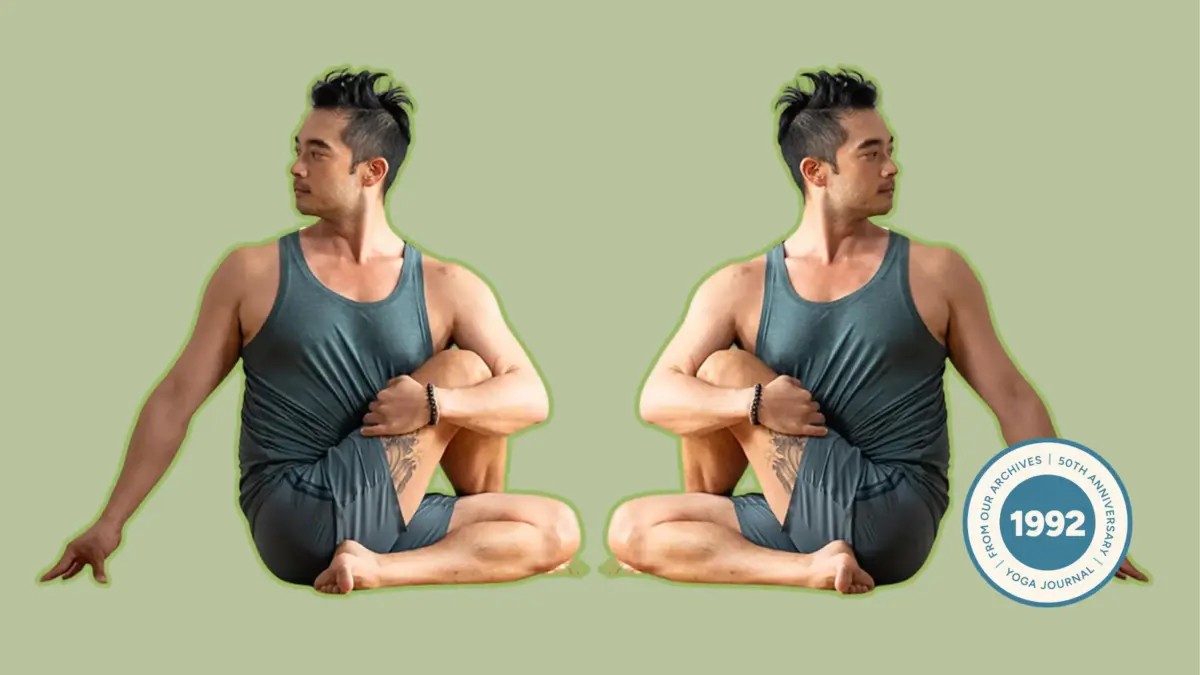
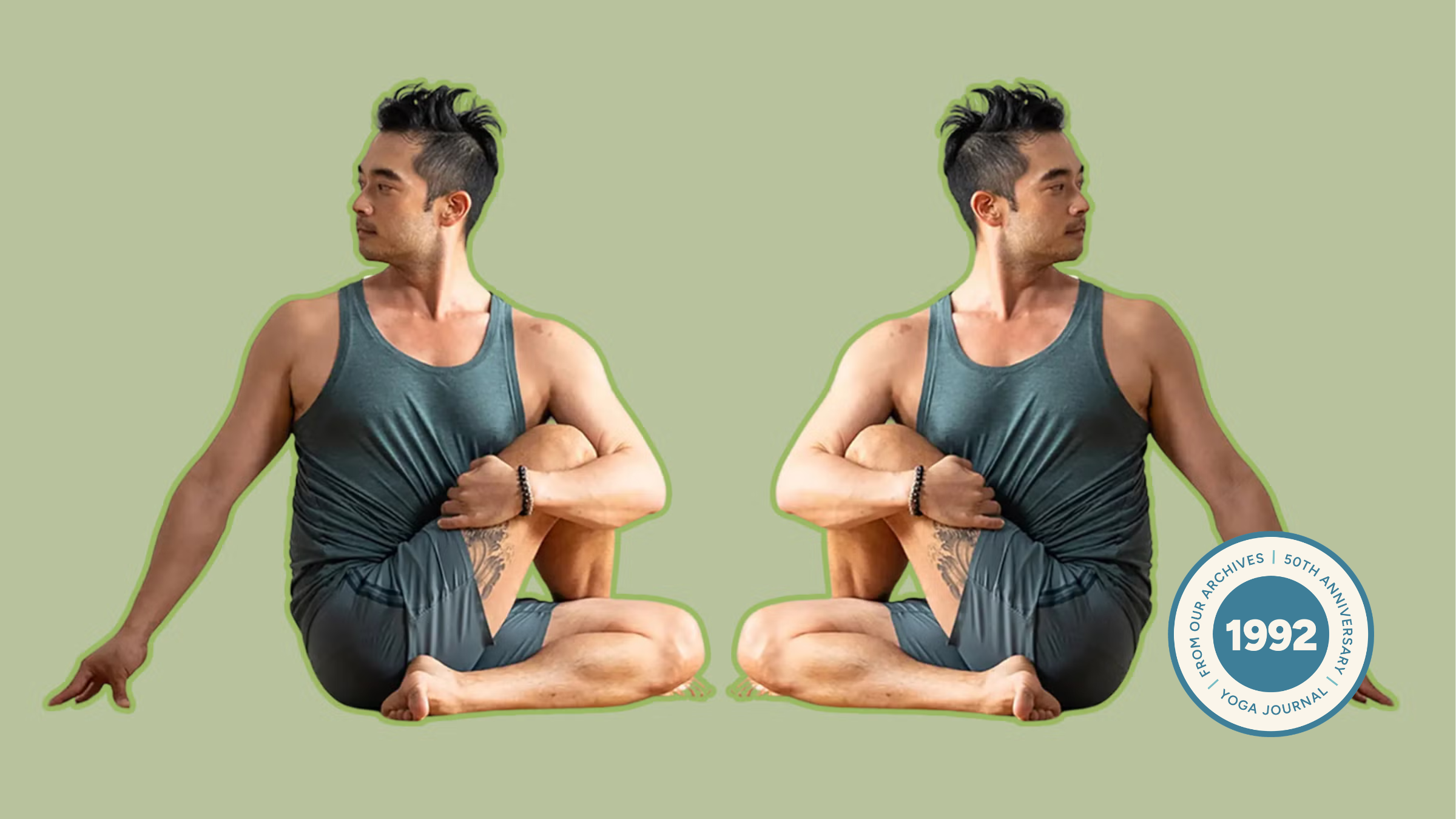
Published August 17, 2026
Curated from the May–June 1992 issue of Yoga Journal, as part of the publication’s ongoing historical archives series exploring foundational hatha yoga practices.
Introduction: The Anatomy of Space and Gravity in Seated Twists
When practitioners approach seated spinal twists—most notably Lord of the Fishes Pose (Ardha Matsyendrasana I)—a common anatomical pitfall frequently undermines the efficacy of the posture. The natural inclination when twisting is to initiate the movement from the upper abdomen, forcing rotation by squeezing the diaphragm and aggressively contracting the rib cage. However, true alignment and energetic flow demand a shift in focus downward, anchoring awareness in the lower abdomen to allow the spine to lengthen organically.
Yoga, at its core, serves as an active exploration of our relationship with unbounded space, both in the external environment and deep within the physical form. In the physical realm, our primary and most constant interaction with the outer world is mediated through the physical effects of gravity.
As pioneering movement therapist Dr. Ida Rolf famously declared, “The gravitational field of the Earth is easily the most potent physical influence in any human life.” Within the practice of hatha yoga, practitioners learn not to be defeated by these relentless downward forces, but instead to harness gravity, making it work for the body in positive, supportive ways. Even when the physical configuration of the body remains identical, shifting its position in space transforms the experience of the posture entirely.
Gravity exerts a unique influence on every individual pose. Not only do muscles stretch in varying directions and intensities, but the practitioner’s physiological and emotional responses shift concurrently. Transitioning from the physical mechanics of outer space to the internal dynamics of the body reveals an entirely different realm of practice. By releasing tension and cultivating interior spaciousness, practitioners tap into an internal energy source that feels simultaneously expansive and entirely self-contained.
Chronology of Practice: Progressive Preparations for Ardha Matsyendrasana
To bypass the habit of upper-body straining, practitioners can utilize a sequence of progressive preparatory exercises. By employing props such as chairs and walls, students learn to broaden the base of the lower abdomen, allowing the spine to elongate from its foundation while keeping the diaphragm soft and wide.
Phase 1: Sage’s Pose with Chair Support (Marichyasana III Variation)
The journey begins by preparing the hips and spine through a modified variation of Sage’s Pose, commonly utilized to prime the body for Lord of the Fishes.
- Setup: Secure the back of a sturdy chair against a wall to prevent slipping. Sit on the floor with the right side of the rib cage gently touching the front edge of the chair seat. Extend the legs forward in Staff Pose (Dandasana), resting the sitting bones on a folded blanket or bolster elevated two to four inches.
- Lower Body Alignment: Bend the right knee, placing the right foot flat on the floor close to the right sitting bone. The outer right leg rests against the chair seat, keeping the right shin strictly vertical. Shorter practitioners may require a higher lift to ensure adequate lateral support.
- Execution: Turn toward the chair, extending the left arm to the back of the seat. Rest the upper left arm against the right knee as close to the back armpit as possible. Grasp the back edge of the chair seat with the left hand while placing the right fingertips on the floor behind you (using a block if rounding occurs).
- Refinement: Lean back as though hanging from the left arm. Release the left shoulder blade away from the spine and lift the lower abdomen out of the pelvic basin. As the chest lifts, roll the right shoulder back, walking the right hand deeper behind you. Exhale to release, then repeat on the opposite side.
Phase 2: Lord of the Fishes with Chair Assistance
Building upon the previous movement, this variation introduces the complex lower-body cross-legged configuration of the full pose with external structural support.
- Setup: Retain the chair-against-the-wall setup and elevate the sitting bones on a 2-to-4-inch blanket. Sit with the right side of the rib cage touching the chair seat and legs in Dandasana.
- Foot Placement: Bend the right knee, placing the foot flat near the right sitting bone. Bend the left leg, drawing the left foot under the buttocks so the sitting bones rest along the inner edge of the left foot. Ideally, the left sitting bone presses the inner left heel, and the right sitting bone meets the base of the left big toe.
- Crossing: Cross the right foot over the left leg, placing it on the floor parallel to the outer left thigh, with the toes aligned with the left knee. The outer right thigh contacts the chair seat (a folded blanket over the chair edge helps maintain a vertical right shin).
- Twisting Action: Extend the left arm to grip the back edge of the chair. Release tension in the left shoulder, letting the torso drop away from the arm. Press the right hand against the chair seat or leg to lift the lower abdomen out of the pelvic basin, keeping the diaphragm broad and breath soft before switching sides.
Phase 3: Lord of the Fishes with Wall Support
The third preparatory step utilizes a wall or structural pillar to anchor the upper body and train the pelvis to remain neutral.
- Setup: Sit 12 to 15 inches away from a wall with your back to it, legs extended in Dandasana on an elevated blanket. Tuck the left foot beneath the sitting bones and cross the right foot over to the outer left leg.
- Adjusting the Hip: Use the left hand to draw the right thigh toward the torso, bringing the shin vertical and planting the sole of the right foot firmly on the floor. If inner groin tension or gripping occurs, place a firmly rolled facecloth deep in the right hip crease to create space and alleviate pressure.
- The Wall Connection: Cross the left arm over the right knee so the back of the arm rests against the outer right thigh near the armpit. Place the right hand on the wall at shoulder height.
- Activation: Press into the wall to lift the spine. Roll the pubic bone down to release the groins, freeing the navel area from behind the right thigh. Inhale to lift out of the pelvis; exhale to deepen the twist, holding for one to two minutes per side.
Phase 4: Full Lord of the Fishes Pose (Ardha Matsyendrasana I)
In the final expression of the posture, external props are removed, and the practitioner relies entirely on internal mechanics and subtle body currents.
- Final Configuration: Sit on the blanket edge with sitting bones on the inner left foot and the right foot flat on the floor. Hook the left arm over the right knee. Press the right hand into a wall or support, shifting weight forward onto the right foot so the upper body balances over the right arch.
- Arm Entwining: Swing the left arm around the right leg and sweep the right arm behind the back in a wide circle. Interlock the hands by grasping the right wrist with the left hand, drawing the forearms down to lift the spine.
- Subtle Movement: With the arms locked, gross outer movements cease. Like a fish navigating water without limbs, the practitioner must move via subtle internal currents. Press the ball of the left big toe back against the right sitting bone and lift the pelvis toward the right thigh. Soften the inner groins, broaden the collarbones, and gaze over the right shoulder.
Supporting Data & Biomechanical Principles
An analysis of historical teaching methods from the 1990s archives highlights several core biomechanical tenets essential for safe spinal rotation:
- Pelvic Stabilization: A common failure mode in seated twists is the dropping of the back hip and subsequent collapse of the sacrum due to excessive pulling of the lower abdominal muscles. Stabilizing the front right hipbone toward the right thigh prevents this collapse.
- Shoulder Joint Integrity: If the head of the upper humerus presses forward in the shoulder joint, range of motion is severely restricted. Easing the head of the upper arm bone back toward the center of the joint lengthens the upper arm toward the elbow, allowing for a deeper, safer grip on the wrist.
- Inner vs. Outer Balance: Aggressive working of the outer body introduces rigidity and risks muscle tearing or joint strain. Conversely, focusing solely on the internal subtle body while ignoring structural alignment invites physiological disturbance. Harmonizing outer stability with inner expansiveness resolves this dichotomy.
Official Insights & Historical Context
The archival perspective preserved from the May–June 1992 issue of Yoga Journal underscores a philosophical shift in American hatha yoga during the late 20th century. As teachers integrated therapeutic applications into traditional Ashtanga and Iyengar-based lineages, props such as chairs, walls, and blankets transitioned from remedial tools for injured students to essential pedagogical instruments for precise anatomical discovery.
Modern movement science validates these early pedagogical choices. By utilizing external structures, practitioners reduce the neural load required to maintain balance, allowing the central nervous system to focus on localized spinal elongation and diaphragmatic release.
Implications for Modern Yoga Practice
The principles outlined in Ardha Matsyendrasana I extend far beyond a single seated posture. They offer a blueprint for safe spinal mechanics applicable to all rotational movements in contemporary yoga and somatic conditioning:
- Mindful Initiation: Movement must originate from deep within the core (the lower abdominal basin) rather than superficial muscular gripping (the diaphragm and rib cage).
- Integration of Gravity: Rather than fighting downward forces, practitioners learn to utilize gravity as a stabilizing partner.
- The Non-Duality of Practice: Achieving the pinnacle of a posture requires an ongoing dialogue between structural support (outer body) and energetic release (inner body), ultimately dissolving the boundary between physical form and inner space.
