

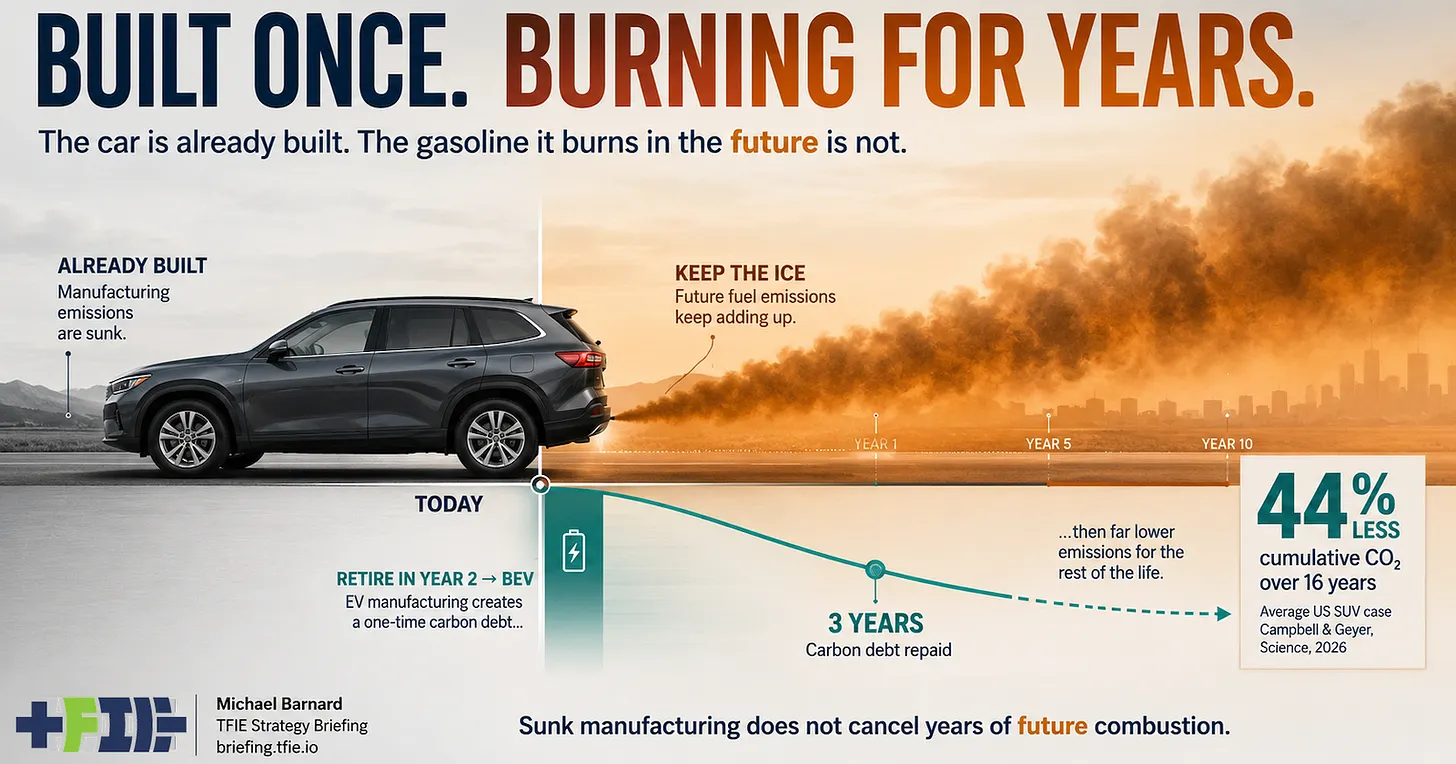
For years, a popular environmental proverb has anchored arguments against accelerating the transition to electric vehicles: "The greenest car is the one already built."
It is an intuitive, emotionally resonant logic. Manufacturing a brand-new vehicle demands a heavy upfront investment of energy and resources, resulting in a measurable manufacturing carbon debt. By contrast, keeping an existing internal combustion engine (ICE) vehicle on the road theoretically avoids the immediate footprint of a secondary production line.
However, this traditional framework relies on a blind spot that quietly treats all the gasoline an existing car will burn over the remainder of its lifespan as entirely emissions-free.
New lifecycle research published in the journal Science by researchers J. Elliott Campbell of UC Santa Cruz and Roland Geyer of UC Santa Barbara shatters this long-held assumption. Their comprehensive analysis demonstrates that replacing a functional gas vehicle with a battery-electric vehicle (BEV) early in its life can deliver substantial cumulative emissions reductions, challenging the conventional wisdom that we should simply drive our current cars "until the wheels fall off."
Main Facts: The Core Findings of the Campbell-Geyer Study
At the heart of the new study is a rigorous, multi-variable lifecycle comparison between keeping functional combustion vehicles running and permanently scrapping them in favor of battery-electric alternatives.
Rather than relying on a single, conveniently optimistic EV scenario, Campbell and Geyer rigorously modeled varying vehicle efficiencies, annual mileages, battery manufacturing footprints, battery capacities, and regional electricity grid mixes.
The results upend conventional environmental thinking. For a representative, production-weighted SUV operating on the average U.S. electricity grid, retiring the combustion vehicle in its second year and replacing it with a BEV reduces cumulative emissions by 44% over a 16-year period.
While building the replacement EV inevitably triggers an upfront carbon spike, the significantly lower operating emissions of the electric powertrain completely repay that manufacturing "debt" in roughly three years. Crucially, retiring the vehicle earlier yielded the largest cumulative climate benefits because it successfully prevented a greater number of years of continuous gasoline combustion.
Key Takeaways at a Glance:
- The Sunk-Cost Reality: Manufacturing emissions for an existing gas car are already atmospheric history; the relevant calculation begins today by contrasting future tailpipe emissions against new manufacturing and grid demands.
- The Power of Sunk vs. Future Emissions: Across 92% of the modeled scenarios, early retirement produced a net emissions reduction.
- Fuel vs. Battery Variance: Variations in battery production emissions shifted net retirement benefits by only 13 percentage points. By contrast, differences in vehicle operating efficiency created more than twice as much variability, proving that fuel consumption—not battery production—is the dominant climate driver.
Chronology: From "Cash for Clunkers" to Rigorous Lifecycle Science
To understand how public policy and scientific consensus arrived at this turning point, it is helpful to look at the timeline of vehicle-retirement debates.
Phase 1: The Era of "Cash for Clunkers"
In the wake of the 2008 financial crisis, the U.S. government introduced the Car Allowance Rebate System—popularly known as "Cash for Clunkers." The program incentivized motorists to trade in older, inefficient vehicles for newer, more efficient ones, destroying the engines in the process. While successful at boosting auto sales and offering a quick economic stimulus, environmental economists later noted that its design was deeply blunt, treating all vehicle replacements equally regardless of actual mileage or localized emissions impacts.
Phase 2: The Rise of the "Keep It Running" Counter-Narrative
As electric vehicles began scaling commercially in the 2010s, critics of rapid fleet turnover popularized the "greenest car is the one already built" mantra. Lacking definitive, large-scale lifecycle models that factored in modern grid decarbonization and shifting battery supply chains, policymakers largely shied away from incentivizing the early retirement of functioning ICE vehicles, fearing that the manufacturing footprint of new EVs would outweigh immediate climate gains.

Phase 3: The 2024–2026 Shift Toward Targeted Scrappage
In 2024, energy analysts began advocating for a modernized, climate-smart version of Cash for Clunkers—one that would explicitly pay motorists to retire high-emitting combustion vehicles early in favor of EVs. Critics immediately raised the lifecycle objection: Isn’t it greener to drive a working gas car until it dies?
That exact question prompted Campbell and Geyer to conduct their landmark Science study. Published in 2026, their work bridges the gap between intuition and empirical reality, proving that while blanket vehicle destruction is poor policy, targeted early retirement of high-emitting vehicles is a vital climate tool.
Supporting Data: When Early Retirement Fails vs. When It Wins
The Science study makes it abundantly clear that early replacement is not a universal panacea. In deliberately extreme cases, early retirement increased emissions by up to 77%. The researchers’ sensitivity analysis highlights strict operational boundaries where keeping a current vehicle on the road remains the environmentally superior choice.
1. Mileage Thresholds
The study established clear annual mileage thresholds below which an EV’s manufacturing emissions cannot be recovered:
- Passenger Cars: ~7,054 kilometers (approx. 4,383 miles) per year.
- SUVs: ~6,837 kilometers (approx. 4,248 miles) per year.
- Trucks: ~10,794 kilometers (approx. 6,707 miles) per year.
For vehicles driven significantly less than these thresholds—far below the U.S. average of roughly 20,000 kilometers annually—the manufacturing debt of a new battery is difficult to justify. These low-mileage, highly efficient vehicles are indeed better left in service.
2. Grid Intensity and Powertrain Nuances
Efficiency also dictates success. The climate advantage of an EV replacement can evaporate entirely when:
- Electricity consumption exceeds roughly 30 kWh per 100 kilometers.
- Regional grid emissions rise above 500 kilograms of CO₂ per megawatt-hour (MWh).
For instance, the study found that replacing a plug-in hybrid electric vehicle (PHEV) car with a battery-electric vehicle actually increased emissions by 11%, while swapping an SUV was roughly neutral. Similarly, efficient hybrids and ultra-clean ICE cars operating on dirty grids make poor targets for the crusher.
Conversely, high-mileage pickup trucks and gas-guzzling SUVs burning thousands of gallons of fuel annually represent premier targets for accelerated phase-out.
Official Responses and Economic Realities: The Used-Car Ladder
While the climate physics modeled by Campbell and Geyer are robust, implementing an early-retirement policy in the United States triggers a massive socioeconomic dilemma.
The U.S. Mobility Landscape
Data from urban researchers Prieto-Curiel and Ospina (The ABC of Mobility) reveal the stark reality of American transportation: 91.9% of trips in their U.S. and Canadian urban sample were conducted by car, compared to just 44.9% in Europe and 18.8% in East Asia. Furthermore, U.S. car dependence barely drops as cities grow larger.
For millions of Americans, private vehicles are not lifestyle accessories; they are essential survival tools for employment, healthcare, and education.

Protecting the Used-Car Market
This dependence intersects directly with how the automotive market functions. According to Federal Reserve survey data:
- Roughly two-thirds of lower-income households that recently acquired a vehicle bought used.
- Approximately 78% of privately purchased used vehicles cost less than $10,000.
New vehicles initially purchased by affluent households, corporate fleets, and rental companies naturally filter down over time to form the foundation of the affordable, secondhand market. Destroying working ICE vehicles prematurely risks cutting off the lower rungs of this "used-car ladder."
If aggressive scrappage policies remove affordable transportation options without ensuring an adequate supply of cheap used EVs, lower-income households will face severe financial strain. Policymakers cannot treat the climate transition and economic equity as mutually exclusive concerns.
Implications: Designing a Smarter Vehicle-Retirement Policy
To reconcile the urgent need to cut transport emissions with the socioeconomic reality of the used-car market, future policy must reject blunt instruments like historical cash-for-clunkers programs in favor of precision tools.
1. Granular Scrappage Incentives
Rather than rewarding vehicle age alone, government incentives should scale based on:
- Fuel Economy & Lifetime Usage: Targeting high-mileage, low-efficiency gas guzzlers (like heavy pickups and large SUVs) while sparing efficient hybrids and low-mileage commuter cars.
- Local Grid Cleanliness: Factoring in regional electricity mixes to ensure replacement EVs charge on increasingly renewable grids.
2. Electrifying Commercial and Fleet Turnover First
Fleets owned by corporations, government agencies, and rental companies rack up massive mileage rapidly. Electrifying these fleets early secures immediate emissions reductions while cycling three-to-five-year-old EVs into the secondhand market much faster. Supported by battery-health certificates and affordable financing, these vehicles can anchor a thriving sub-$15,000 used EV market.
3. Dynamic Market Safeguards
If regional data shows tightening supplies of affordable cars under $10,000, regional retirement incentives can be dynamically scaled back to protect the bottom of the automotive market.
Conclusion
The latest science proves that the old slogan—"The greenest car is the one already built"—is an oversimplification that ignores the heavy toll of continuous tailpipe emissions. Retiring high-polluting, high-mileage combustion vehicles early can unlock profound climate benefits.
However, getting the transition right requires sophistication. By carefully targeting the worst polluters while actively expanding the supply of affordable new and used electric vehicles, policymakers can ensure that the race to decarbonize transport strengthens—rather than undermines—economic mobility for everyone.
