

Main Facts
Germany’s emerging hydrogen economy recently celebrated what appeared to be a major milestone: network operator FNB Gas announced that industrial customers had secured nearly 6 gigawatts (GW) of paid reservations on the country’s burgeoning hydrogen core network. Promoted as a strong signal of gathering commercial momentum, the headline figure was widely circulated across energy sector circles as proof that the grand vision of a hydrogen-powered European industrial powerhouse is steadily materializing.
However, a deeper dive into the numbers reveals a vastly different picture. The headline figure of nearly 6 GW is not a direct measurement of actual hydrogen demand, nor does it represent multi-gigawatt commitments by companies to produce, purchase, or consume clean fuel. Instead, it is an accounting aggregation of various pipeline capacity metrics.
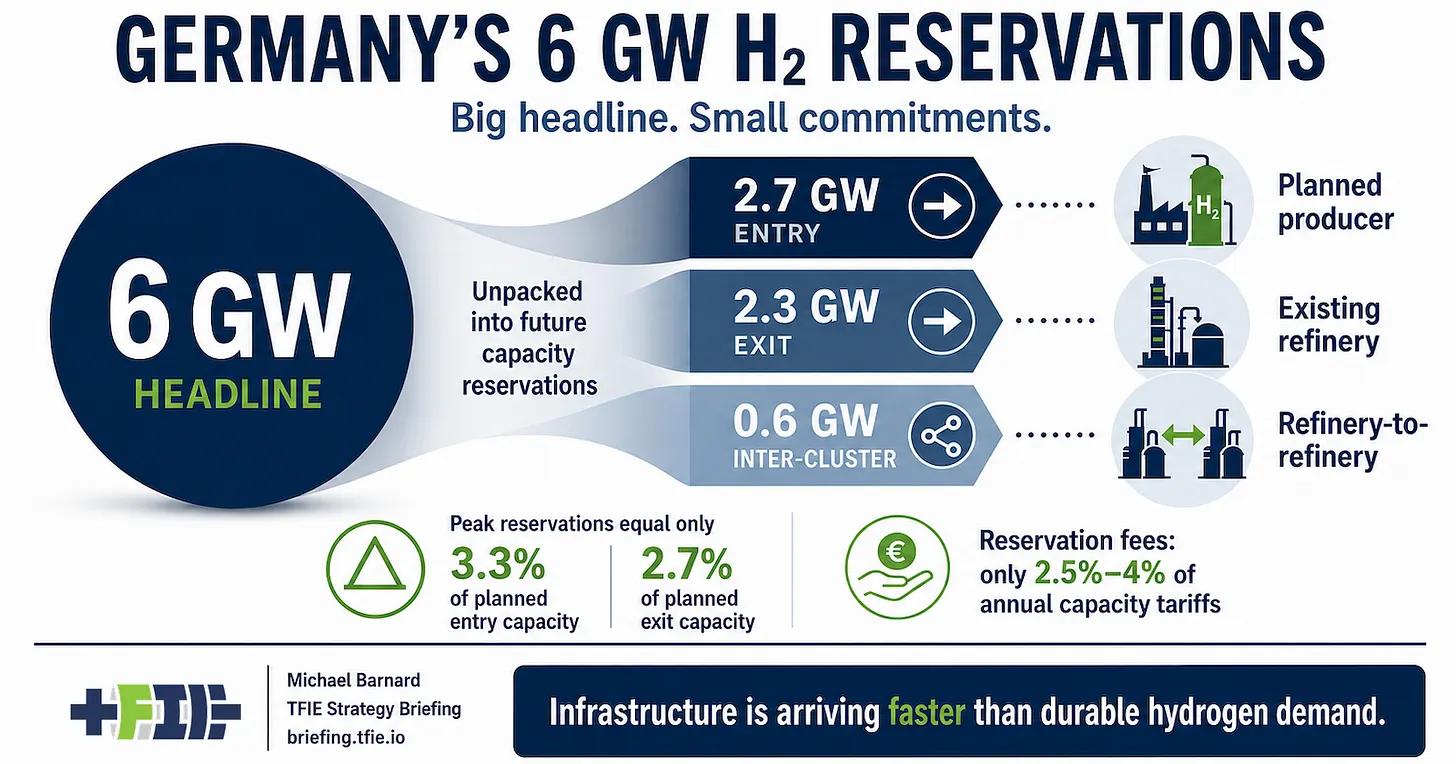
By combining roughly 2.7 GW of entry reservations, 2.3 GW of exit reservations, and approximately 0.5 to 0.6 GW of inter-cluster transport capacity, the headline inflates the appearance of commercial backing. In pipeline network accounting, molecules injected at one point and withdrawn at another are frequently counted twice—once at entry and once at exit.
Furthermore, these reservations are not binding, long-term capacity utilization contracts. Rather, they are inexpensive strategic options. Companies like TotalEnergies—whose Leuna refinery reservation accounts for a staggering 22% of Germany’s total exit reservations around 2030—are paying a fraction of regular capacity tariffs to reserve future access without committing to continuous physical offtake.
When measured against Germany’s approved Hydrogen Core Network—a massive infrastructure project spanning approximately 9,040 kilometers, costing an estimated €18.9 billion, and designed to deliver roughly 101 GW of entry and 87 GW of exit capacity by the early 2030s—the actual peak reservations amount to a meager 3.3% of planned entry capacity and 2.6% of planned exit capacity.
Chronology of Germany’s Hydrogen Infrastructure Push
To understand how Germany arrived at this juncture, it is helpful to trace the timeline of its national hydrogen strategy and infrastructure development:
- June 2020: The German federal government adopts its National Hydrogen Strategy (Nationale Wasserstoffstrategie), laying out ambitious goals to establish clean hydrogen as a cornerstone of its decarbonization framework, targeting broad industrial use, heavy transport, and energy storage.
- 2021–2023: Policymakers and industry groups aggressively promote a comprehensive "hydrogen economy," projecting vast future demand across sectors ranging from residential heating and power generation to long-haul trucking and heavy manufacturing.
- Late 2023–2024: Planning accelerates for the Hydrogen Core Network (Kernnetz). Network operators, coordinated via FNB Gas and individual transmission system operators (TSOs) like ONTRAS and GASCADE, map out a multi-billion-euro pipeline backbone designed to preempt the "chicken-and-egg" problem of energy infrastructure: building pipelines ahead of customer demand.
- 2025–2026: Transmission operators open reservation windows, allowing industrial players to secure future pipeline access ahead of the network’s targeted early-2030s completion date. Operators introduce highly subsidized, low-cost option fees—such as 2.5% to 4% of annual capacity tariffs—to entice hesitant industries.
- Mid-2026: FNB Gas releases the aggregate reservation data, trumpeting the "nearly 6 GW" figure as a testament to the surging momentum of the national hydrogen market, prompting closer scrutiny from energy analysts and strategic briefers.
Supporting Data and Financial Mechanics
A rigorous examination of the data underlying Germany’s hydrogen strategy highlights a profound disconnect between the physical capacity being planned and the actual commercial commitments materializing on the ground.
1. The Composition of the "6 GW" Figure
The headline figure is constructed by summing distinct operational categories:
- Entry Reservations: ~2.7 GW (capacity injected into the network)
- Exit Reservations: ~2.3 GW (capacity withdrawn from the network)
- Inter-Cluster Transport: ~0.5 to 0.6 GW (capacity moved between regional clusters)
Adding entry and exit volumes together violates basic economic accounting principles for commodity demand, effectively double-counting the same underlying gas volumes as they move through the pipeline.

2. Scale of the Infrastructure vs. Real Subscriptions
- Planned Network Length: ~9,040 kilometers
- Estimated Capital Expenditure: €18.9 billion
- Planned Entry Capacity (Early 2030s): ~101 GW
- Planned Exit Capacity (Early 2030s): ~87 GW
- Actual Peak Reservations: ~3.3% of planned entry capacity; ~2.6% of planned exit capacity.
3. The Economics of Options Versus Commitments
The financial mechanism governing these reservations explains why companies are participating without signaling a true revolution in clean energy demand.
Consider the case of TotalEnergies and its Leuna refinery, which has reserved up to 500 MW of hydrogen withdrawal capacity slated for around 2030:
- Full Capacity Cost: Under current regulated hydrogen ramp-up tariffs, booking 500 MW of continuous capacity for a full year would incur roughly €12.5 million in capacity charges.
- Option Cost: By utilizing the flexible reservation framework provided by operators like ONTRAS, TotalEnergies pays roughly €312,500 annually—just 2.5% of the full tariff—to maintain its strategic position. In some cases, these payments can even be credited toward future bookings.
For a multinational energy major, spending roughly €310,000 a year is textbook corporate risk management. It preserves optionality regarding future climate regulations, carbon prices, and hydrogen supply costs. However, equating this low-cost hedge with a binding multi-million-euro long-term commercial commitment to consume 500 MW of continuous hydrogen is misleading. Furthermore, this single refinery reservation accounts for approximately 22% of the nation’s entire 2.3 GW exit reservation pool, demonstrating how heavily skewed the national demand narrative is toward a single pre-existing industrial sector.
Official Responses and Industry Stakeholder Perspectives
The public narrative surrounding the 6 GW figure highlights a sharp contrast between the promotional messaging of network operators and the cautious pragmatism of industrial stakeholders.
Network Operators and Trade Associations
FNB Gas and participating Transmission System Operators (TSOs) have defended the presentation of the data, framing the reservations as a vital psychological and logistical milestone. From their perspective, achieving nearly 6 GW of interest in a network that is still years away from completion proves that industrial actors are actively engaging with the energy transition.
TSO representatives argue that building infrastructure ahead of demand is a necessary policy intervention. Without government-backed core networks, industrial users face crippling uncertainty regarding how clean molecules will reach their facilities. By offering low-cost reservation options, TSOs aim to signal market confidence to regulators, justify multi-billion-euro capital allocations, and stimulate regional supply chains.
Industrial Consumers and Refineries
For the companies making the reservations—predominantly petroleum refineries and legacy chemical producers—the motivation is strategic flexibility rather than an ideological embrace of a broad hydrogen economy.
Refining fossil fuels currently represents the single largest demand sector for hydrogen globally, accounting for roughly 40% of total consumption. For these legacy industrial players, connecting to a centralized pipeline network makes technical and economic sense. It allows them to transition away from captive, on-site fossil hydrogen (grey hydrogen) production toward cleaner alternatives, should regulatory mandates and carbon pricing make doing so economically viable.
Crucially, however, these industrial actors are not the new wave of clean energy pioneers envisioned in early policy drafts. They are the existing hydrogen market, seeking cost-effective ways to manage compliance risks while keeping their options open.

Broader Implications for the Energy Transition
The inflated narrative surrounding Germany’s 6 GW hydrogen reservations carries profound implications for European climate policy, industrial strategy, and public finance.
1. Overbuilding Infrastructure for a Non-Existent Market
Germany’s strategy relies on the classical "Field of Dreams" economic model: build the €18.9 billion pipeline network, and the clean hydrogen economy will miraculously appear. However, the data suggests that the broader industrial use cases used to justify this massive capital expenditure—such as widespread adoption in heavy trucking, residential building heat, grid-scale electricity storage, and general industrial combustion—are failing to materialize at scale.
Instead, the network is being subscribed to by a narrow slice of legacy industrial users who require hydrogen strictly as a chemical feedstock or process input. Constructing an expansive, 9,040-kilometer national backbone for a niche industrial market that utilizes less than 3% of its planned capacity risks creating a massive financial burden for taxpayers and gas network ratepayers alike.
2. The Danger of Headline-Driven Policymaking
When accounting artifacts are dressed up as booming commercial demand, it distorts political accountability. Policymakers relying on optimistic press releases may double down on misguided subsidies or ignore structural bottlenecks—such as the high cost of green hydrogen production, renewable energy deficits, and import infrastructure challenges.
If the underlying economics of green hydrogen do not pencil out for steelmakers, chemical manufacturers, and transport operators, no amount of pipeline capacity will force them to consume it. Pipelines do not create demand; they merely transport molecules where demand already economic viability dictates.
3. A Call for Strategic Realism
Germany’s experience serves as a cautionary tale for other nations racing to subsidize hydrogen backbones. While targeted pipeline infrastructure connecting major industrial clusters (such as existing refineries and chemical hubs) is a rational, incremental step, sprawling national networks designed for a ubiquitous "hydrogen economy" risk becoming stranded assets.
Ultimately, the 6 GW reservation headline is not a sign of failure—industrial actors engaging in low-cost options management is entirely rational corporate behavior. Rather, the failure lies in the interpretation and public presentation of the data. By mistaking inexpensive risk-hedging options for multi-billion-euro commercial commitments, energy planners risk committing Europe’s largest economy to an oversized, underutilized infrastructure experiment that fails to match the physical and economic realities of the energy transition.
