“If you haven’t done anything wrong, you’ve got nothing to worry about.”
It is the timeless mantra trotted out by defenders of ubiquitous security and data collection. In nations like the United Kingdom, where closed-circuit television (CCTV) cameras saturate urban landscapes, citizens have largely acclimated to a life lived under a perpetual lens. Yet, this seamless normalization of surveillance obscures a darker, more intrusive reality.
In the late 18th century, English philosopher Jeremy Bentham conceptualized a revolutionary prison design known as the Panopticon. The architecture was deceptively simple: a circular prison structure with a central guard tower ringed by individual cells. Because the inmates could never see into the darkened tower, they never knew when they were actually being watched. To survive the psychological weight of this uncertainty, prisoners were forced to police their own behavior continuously, allowing the institution to operate efficiently with minimal staffing.
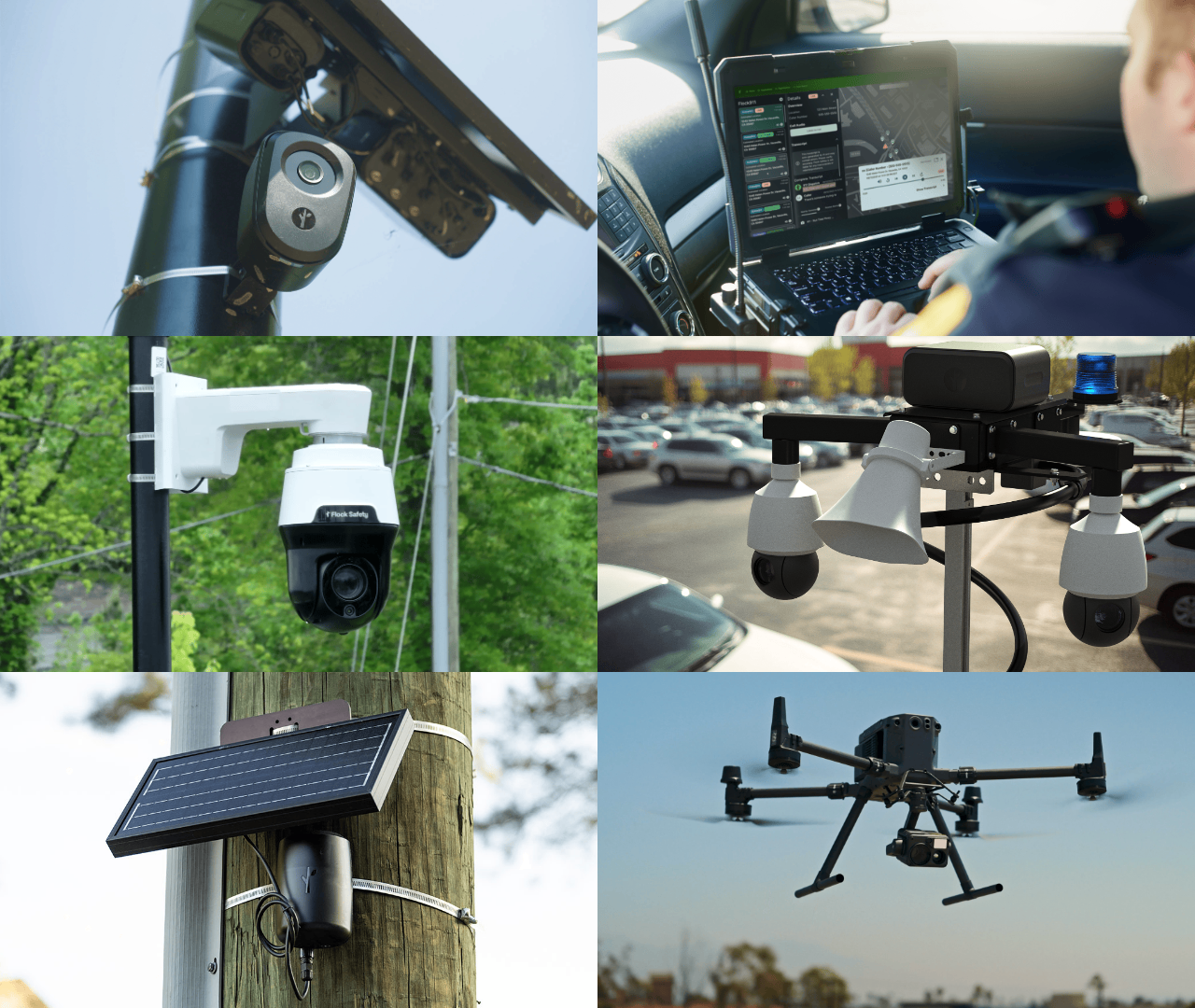
Today, society has unwittingly stepped inside a digital Panopticon. However, the modern iteration does not confine criminals to stone cells; rather, it tracks the daily movements of an entire civilian population through a dense, interconnected web of automated license plate readers (ALPRs). At the center of this modern surveillance apparatus is a rapidly growing technology company: Flock Safety.
Main Facts: The Rise of Flock Safety
Founded in 2020 by Garrett Langley, Flock Safety emerged with a straightforward, highly marketable pitch to law enforcement agencies: install small, solar-powered or battery-operated cameras in neighborhoods and intersections to help police solve property crimes, locate stolen vehicles, and track wanted suspects.
The strategy worked with staggering commercial success. Valued today at over $8 billion, Flock Safety boasts a network of approximately 120,000 cameras installed across the United States. Its technology has been integrated into contracts with roughly 40 percent of all police departments nationwide.
Unlike traditional traffic cameras, Flock units utilize advanced artificial intelligence to capture more than just a passing set of numbers and letters. According to Knox County Mayor Glenn Jacobs, who spoke in an interview with NewsNation, the systems construct a comprehensive "vehicle fingerprint."
"They’re just collecting data as an active surveillance system, and every car that passes through, the data is collected from that car license plate, using AI," Jacobs explained. "They make a vehicle fingerprint of the car that includes distinguishing features, make, model, color, bumper stickers, roof racks, all these different things. They’re just pulling everything in. And then it’s retained for sometimes 30 days or more in a searchable database."
This vast, centralized database allows anyone with system access—ranging from local police officers to federal agencies—to query historical travel patterns, chart personal associations, and track the interstate movements of ordinary citizens without a warrant.
Chronology of Expansion and Backlash
The rapid deployment of automated license plate readers across American infrastructure has triggered a swift and escalating counter-movement among civil rights advocates, lawmakers, and everyday citizens.
2020: Flock Safety launches its commercial operations amidst heightened public concern over urban crime rates, rapidly securing municipal and law enforcement contracts.
2021: Legal scholars begin sounding alarms over the Fourth Amendment implications of continuous, warrantless tracking by private-public corporate partnerships.
2024: Will Freeman founds DeFlock, a grassroots organization dedicated to mapping ALPR locations using crowd-sourced volunteer data and OpenStreetMap, empowering citizens to locate and document cameras in their neighborhoods.
Mid-2024 to 2026: Municipal pushback intensifies. Cities such as Los Angeles and Dayton, Ohio, suspend their Flock contracts over concerns that immigration and federal authorities are siphoning local data. In Dayton, frustrated city officials famously resort to covering cameras with trash bags.
Late 2025 – 2026: Grassroots resistance turns physical. In cities including Houston, Oakland, and Grand Junction, Colorado, local surveillance footage and police reports document instances of cameras being cut down, splattered with paint, or disabled by gunfire. Meanwhile, the American Civil Liberties Union (ACLU) launches its "What The Flock!" campaign to highlight systemic abuses.
Supporting Data and Legal Frameworks
The Fourth Amendment Test
The legal foundation protecting citizens from unwarranted government intrusion rests primarily on the Fourth Amendment of the U.S. Constitution:
"The right of the people to be secure in their persons, houses, papers, and effects, against unreasonable searches and seizures, shall not be violated, and no Warrants shall issue, but upon probable cause, supported by Oath or affirmation, and particularly describing the place to be searched, and the persons or things to be seized."
Determining what constitutes an "unreasonable search" in the digital age remains one of the most contentious battlegrounds in constitutional law. According to federal court guidelines, the legality of a search balances individual privacy rights against legitimate government safety interests, heavily influenced by the location of the search.
However, historical legal precedent offers intriguing hints about how the Supreme Court might eventually view modern tracking tech. In the landmark 2001 case Kyllo v. United States, the Supreme Court ruled that the use of thermal-imaging devices to scan the exterior of a private home for unusually high heat (indicative of indoor marijuana cultivation) constituted a warrantless search in violation of the Fourth Amendment. Notably, the conservative justice Antonin Scalia authored the majority opinion, asserting that law enforcement could not utilize advanced sensing technology to peer into private spaces without a warrant—a ruling that shocked many who expected him to rubber-stamp aggressive police tactics.
The Human Cost of False Positives
Data-driven dragnet systems are only as reliable as their underlying software, and algorithmic errors have severe real-world consequences. The ACLU’s "What The Flock!" campaign catalogs numerous alarming incidents:
Immigration Enforcement: Immigration and Customs Enforcement (ICE) and Customs and Border Protection (CBP) have repeatedly leveraged local ALPR networks to target undocumented immigrants without warrants.
Political Retaliation: Police departments have utilized ALPR databases to track citizens who authored critical op-eds or public commentary regarding municipal governance.
False Accusations: In Colorado, a police officer wrongfully accused an innocent woman of vehicle theft based on a faulty Flock camera match, subsequently refusing to review exonerating evidence. In another harrowing incident, a mother and her young children were held at gunpoint by law enforcement because an ALPR system erroneously flagged their family vehicle as stolen.
Official Responses and Perspectives
The Industry Defense
Defending the creation of his company, Flock Safety CEO Garrett Langley points to systemic failures in traditional crime-solving and a desire to utilize engineering to protect communities. During an April TED talk, Langley reflected on his motivations rooted in his home city of Atlanta:
"Crime felt too easy to get away with," Langley said. "It didn’t make sense that you could steal someone’s car… or you could kill someone and have a 50 percent chance of getting away with it… So I did what engineers do. I built a license plate-reading camera."
Langley acknowledges that the societal balancing act between absolute safety and personal privacy will remain a perpetual debate, suggesting that public consensus must continually adapt as technology evolves.
The Civil Liberties Outcry
Legal experts and privacy advocates warn that the loss of anonymity is a profound psychological blow. Danielle Citron, a professor of law at the University of Virginia, described the emotional impact to the New York Times:
"We all expect and deserve privacy. The problem is that we typically cannot feel, see, or experience the loss as it is happening. Seeing those cameras is a punch in the gut. We see them and it says you have no room to just be, to go about your day feeling lost in the crowd."
When Will Freeman, founder of DeFlock, requested data collected on him by his local Boulder police department using Flock cameras, officials denied the request under the premise that citizens have "no reasonable expectation of privacy on publicly owned streets and sidewalks." Freeman subsequently filed a lawsuit, condemning the infrastructure as a "warrantless surveillance dragnet."
Implications: The Political and Social Horizon
The proliferation of private-public surveillance networks has broken down traditional partisan divides, creating unusual political alliances. In Texas, where over 700 Flock cameras actively monitor roadways, a bipartisan coalition of progressives and conservatives has formed to demand the removal of existing cameras and a moratorium on new installations.
At the federal level, legislative action is beginning to catch up to grassroots concerns. U.S. Representative Keith Self (R-TX) introduced a federal bill designed to require law enforcement agencies to obtain a judicial warrant before querying or accessing data collected by state and local automated surveillance systems.
As the debate intensifies, legal scholars anticipate that the constitutionality of nationwide, warrantless vehicle tracking will ultimately find its way to the U.S. Supreme Court. Until then, society faces a stark choice: whether the promise of algorithmic crime prevention justifies the erosion of the fundamental right to move through the world unobserved.