

Main Facts
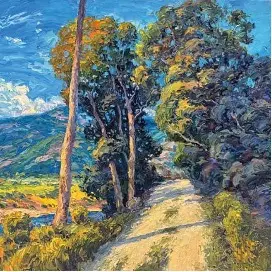
The enduring allure of the natural world continues to serve as the beating heart of contemporary representational and plein air art. A recently unveiled special advertising and editorial showcase highlights the profound connection between artists and the great outdoors, featuring compelling works such as Brad Teare’s striking oil-on-canvas painting, Country Lane.
This curated collection underscores a fundamental truth of the artistic process: the natural environment—spanning from sweeping, untamed wildernesses to quiet rural backroads—acts as an infinite wellspring of inspiration. For generations, creators have stepped beyond the confines of urban life to observe, absorb, and ultimately immortalize the shifting light, rugged textures, and vibrant ecosystems that define our planet.
At the core of this artistic movement is the dual practice of plein air painting (working directly from life outdoors) and studio interpretation. Artists traverse mountains, forests, valleys, and coastlines, seeking out fleeting moments of atmospheric drama. Whether capturing the golden hour spilling across a canopy of autumn leaves or the stark shadows cast by midday sun on a desert canyon, these creators translate ephemeral experiences into permanent visual narratives. The featured works—exemplified by Teare’s 40-by-40-inch canvas—demonstrate the technical mastery and emotional depth required to bridge the gap between raw nature and refined composition.
Chronology of Outdoor and Landscape Art
To understand the weight and significance of contemporary landscape and wildlife art, it is essential to trace the historical lineage that paved the way for today’s painters.
- Pre-19th Century — The Background Landscape: For centuries in Western art, landscape was rarely treated as a subject in its own right. Instead, nature served merely as a decorative backdrop for mythological, religious, or portrait subjects.
- The Mid-19th Century — The Rise of Hudson River School: In the United States, the Hudson River School emerged as the first true native art movement. Painters like Thomas Cole and Frederic Edwin Church ventured into the untamed American wilderness—particularly the Catskills, the Adirondacks, and eventually South America and the Arctic—to capture the sublime majesty of untouched landscapes. Nature was viewed not just as scenery, but as a spiritual mirror and a manifestation of divine creation.
- The Late 19th Century — The Plein Air Revolution: The invention of collapsible tin paint tubes in the 1840s revolutionized how artists worked. Combined with the advent of the Impressionist movement in France, painters left the dark confines of their studios to set up easels in fields, forests, and along riverbanks. Claude Monet, Camille Pissarro, and later American Impressionists championed the direct observation of light and atmosphere.
- The Early to Mid-20th Century — Regionalism and Modernism: Artists began looking inward toward local landscapes. The WPA era encouraged artists to document regional American life and geography, bridging the gap between urban galleries and rural realities. Wildlife art also gained specialized momentum, with illustrators and painters focusing heavily on accurate anatomical representation paired with natural habitats.
- The 21st Century — Digital Era Resurgence and Contemporary Showcases: Today, amidst a hyper-digitalized society where human beings spend an unprecedented amount of time looking at screens, contemporary art platforms and publications actively curate exhibitions and special sections dedicated to the physical outdoors. Collections like the recent Southwest Art special feature act as modern catalysts, connecting contemporary landscape painters with collectors who yearn for a tangible connection to the earth.
Supporting Data and Artistic Insights
The process of translating the great outdoors onto a flat two-dimensional surface involves rigorous scientific observation, meteorological understanding, and technical execution. Industry data and insights from contemporary practitioners reveal the depth of this craft:
- Scale and Impact: Larger formats, such as Brad Teare’s 40 x 40-inch Country Lane, allow artists to envelop the viewer in the scene. Large-scale landscape painting requires an entirely different physical and compositional approach compared to miniature plein air studies, often demanding a balance between broad, expressive brushwork and precise focal points.
- The Plein Air Economy: According to recent cultural arts data, plein air festivals, competitions, and specialized exhibitions generate millions of dollars annually in local tourism and art sales across North America. Events held in scenic regions—such as Jackson Hole, Wyoming; Carmel, California; and Taos, New Mexico—draw thousands of collectors eager to acquire freshly painted impressions of local terrain.
- Material Investment: Outdoor painters contend with extreme environmental variables. The choice of materials—ranging from high-grade lightfast oil pigments that resist fading to specialized portable easel systems (French easels or pochade boxes)—is critical. Artists must master color theory under constantly shifting natural light, where a shadow that is blue at 9:00 AM may turn violet or warm gray by noon.
- Ecological Awareness: Surveys of contemporary nature artists reveal that over 85% consider themselves active conservationists. Their daily immersion in forests, wetlands, and mountain ranges provides firsthand witness to environmental shifts, habitat fragmentation, and climate change, themes that increasingly permeate modern wildlife and landscape portfolios.
Official Responses and Perspectives
Art historians, curators, and the artists themselves offer vital perspectives on why the natural world remains an inexhaustible subject in the modern artistic landscape.
Art historian Dr. Elizabeth Vance notes:
"Throughout history, whenever society has experienced rapid industrialization or technological saturation, there has been a corresponding artistic migration back to nature. We saw it during the Industrial Revolution with the Romantic painters, and we are seeing it again today in the digital age. Landscape art acts as an emotional reset button for civilization."
Brad Teare, whose work Country Lane anchors the recent showcase, discusses his creative philosophy regarding studio versus on-location work:

"When you stand before a landscape, nature overwhelms your senses—the sound of the wind, the smell of damp earth, the blinding glare of the sun. The challenge of the artist isn’t to copy that reality pixel for pixel, but to distill those sensations into a coherent visual language. Whether I am sketching on location or developing a large canvas back in the studio, the goal is to evoke the feeling of being right there on that path."
Gallery owner and curator Marcus Holloway adds:
"Collectors today are seeking authenticity. When someone purchases a landscape or wildlife painting, they aren’t just buying a decorative object for their living room wall; they are acquiring a preserved moment of tranquility, a window into a physical space that grounds them. The artists featured in these specialized collections possess a rare ability to act as translators between the wild and the domestic."
Implications for the Art Market and Society
The sustained popularity of landscape and wildlife art carries profound implications for both the commercial art market and broader cultural attitudes toward the environment.
1. Economic Resilience in the Fine Art Market
While abstract and conceptual art trends fluctuate rapidly with speculative bubbles, representational landscape and wildlife art maintains a remarkably steady, loyal collector base. Because these works appeal to a universal human appreciation for nature, they transcend generational and geographic divides. Galleries specializing in regional, wildlife, and plein air art report resilient sales figures, driven by collectors who value traditional craftsmanship, technical skill, and emotional resonance.
2. Fostering Environmental Stewardship
Art has historically been one of the most powerful tools for environmental advocacy. From the Hudson River School paintings that helped inspire the creation of the U.S. National Park system to contemporary exhibitions showcasing endangered habitats and majestic wildlife, visual storytelling bridges the gap between data and empathy. When viewers gaze upon a meticulously rendered forest path or a sun-drenched valley, they are subconsciously reminded of what is at stake in the face of modern ecological challenges.
3. Combating "Nature-Deficit Disorder"
In an era where modern lifestyles are increasingly sedentary and screen-dependent, art acts as a vital bridge to the outdoors. Specialized features and publications that spotlight landscape art encourage viewers to look up from their devices and re-engage with their local ecosystems. By celebrating the beauty found "just around any corner"—be it a grand national park or a quiet rural country lane—these artists remind the public that wonder is always accessible just outside our doors.
Ultimately, the enduring tradition of capturing the great outdoors on canvas ensures that the wild spaces of our world—both grand and intimate—will continue to inspire, challenge, and captivate generations of artists and art lovers alike.
