

Main Facts
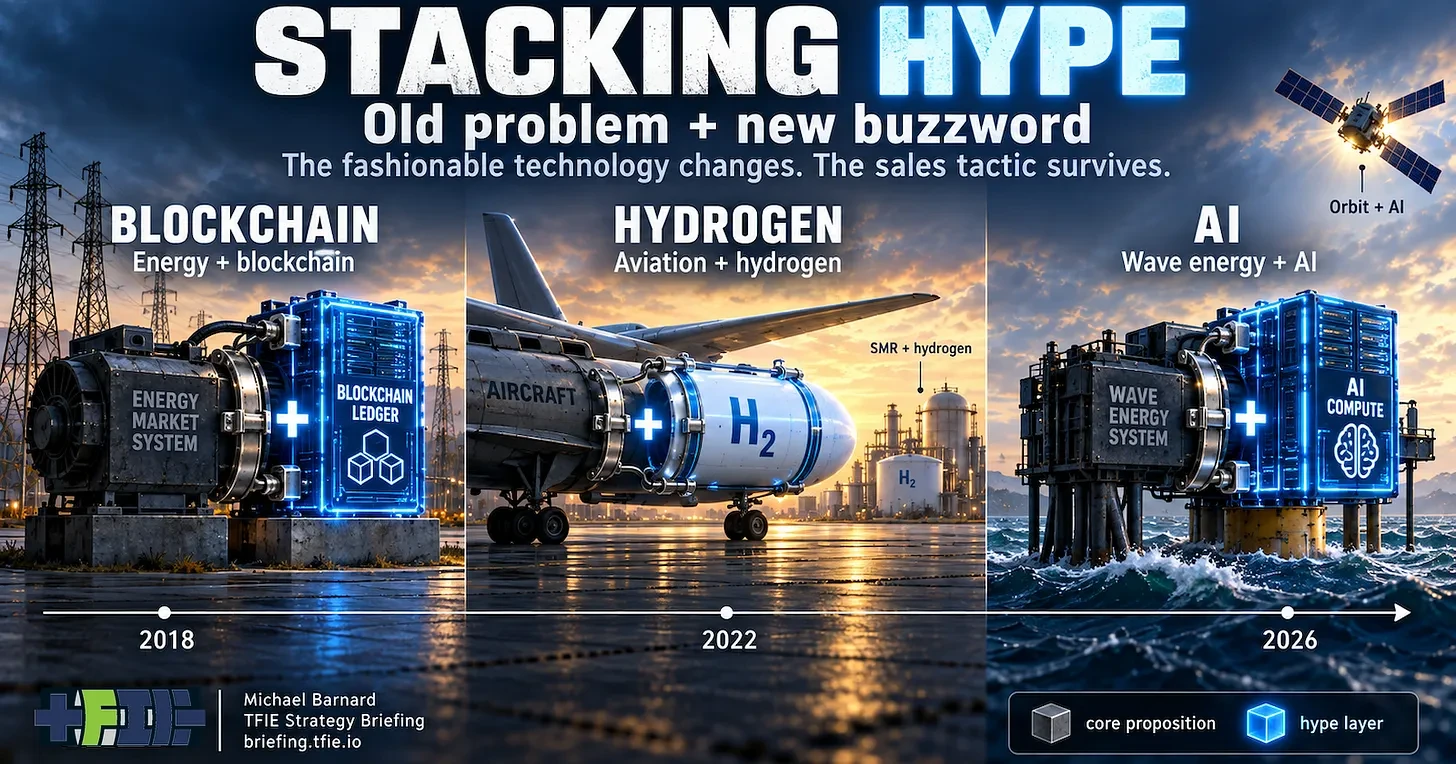
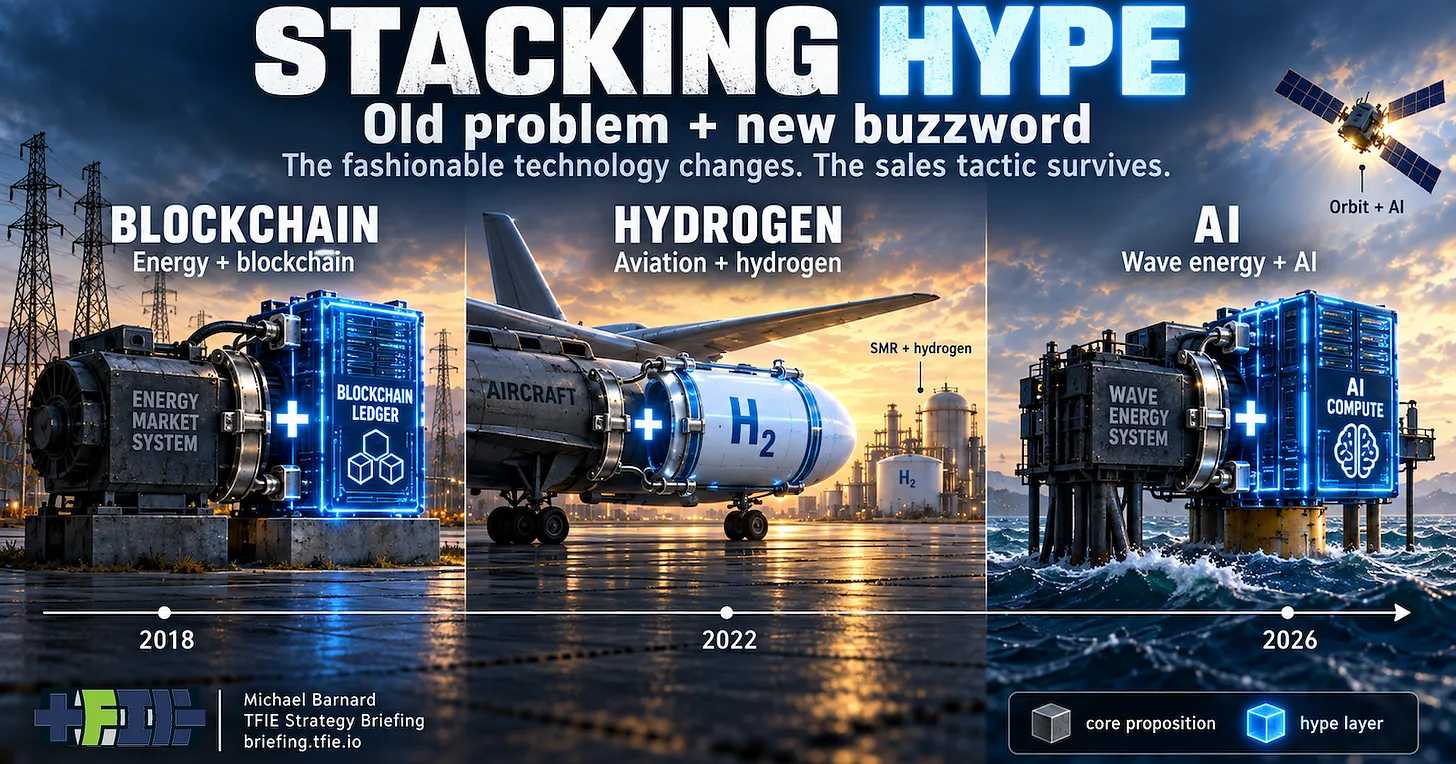
The tech sector operates on a cyclical narrative engine. Whether the fashionable technology of the moment is blockchain, hydrogen, or artificial intelligence, the underlying commercialization tactic remains remarkably consistent: attach a shiny new industry narrative to an fundamentally unresolved engineering proposition before the complete system has ever proven its underlying economics.
This pattern of "hype layering" relies on a psychological and financial sleight of hand. When an initial business model faces stubborn physical or economic barriers—such as the prohibitive transmission costs of wave energy or the immense manufacturing hurdles of unorthodox electric vehicles—founders often introduce a second, highly fashionable technology into the mix. Because buzzwords like artificial intelligence or green hydrogen are genuinely real, highly valuable, and flush with speculative capital, they instantly grant an old, struggling concept a fresh veneer of market relevance.
However, adding a secondary technology does not automatically solve the foundational problems of the primary venture. Instead of removing a material constraint, hype layering typically introduces a fresh stack of dependencies. Rather than simplifying operations, it multiplies failure points, increases capital burn, and delays the inevitable reckoning with basic economic realities.
From ocean-bound AI data centers and orbital computing to solar-integrated cars and hydrogen-powered aviation, the technology changes, but the playbook endures. Industry observers note that while investors, founders, and media outlets are easily captivated by grand visions of multi-technology convergence, the ultimate test of any enterprise remains brutally simple: Does the added layer genuinely reduce operating costs, or is it merely doing the heavy lifting in a pitch deck?
Chronology of an Endless Cycle
To understand how tech trends recycle this commercialization playbook, it is instructive to trace how different buzzwords have been grafted onto unresolved engineering challenges over recent years:
- The Blockchain Era (Circa 2018–2020): Startups attempted to reinvent electricity markets, renewable energy certificates, and peer-to-peer grid trading using distributed ledgers. While blockchain is a functional database architecture, it did nothing to change the physical realities of meters, utility monopolies, regulatory frameworks, or real-time network load balancing.
- The Hydrogen Wave (Circa 2021–2023): Entrepreneurs flooded the market with concepts for hydrogen-powered supersonic passenger jets, hydrogen eVTOLs (electric vertical takeoff and landing aircraft), and underground mine-shaft gravity storage retrofitted with hydrogen containment. Many of these ventures eventually stalled, liquidated, or quietly pivoted away from their original consumer-facing hydrogen visions as the cryogenic and infrastructural hurdles proved insurmountable.
- The AI and Deep-Tech Convergence (2024–Present): With artificial intelligence commanding unprecedented capital inflows, startups have rushed to tether AI compute to remote or unorthodox energy sources. Ocean platforms harvesting wave energy to power localized AI inference at sea, or theoretical data centers in low Earth orbit, represent the latest iterations of the pattern. By positioning themselves as AI infrastructure plays, these companies bypass traditional grid-connection bottlenecks in marketing pitches—even as the physical challenges of marine or space-based engineering remain completely unsolved.
Supporting Data and Case Studies
A closer look at several prominent companies reveals how hype layering plays out in practice across different sectors of the clean technology and advanced engineering landscape.
1. Panthalassa and Ocean-Based AI Compute
Recently, wave-energy startup Panthalassa secured $140 million in funding to construct autonomous ocean platforms designed to generate electricity from waves and power onboard AI inference computing directly at sea. On paper, this circumvents a classic roadblock for marine energy: the high cost and technical difficulty of transmitting electricity back to shore via subsea cables. By placing a high-value, power-hungry computational load right next to the generator, the company avoids the grid-interconnection bottleneck.
Yet, this architecture swaps one severe set of engineering challenges for another. Equipment must still endure the punishing marine environment—surviving saltwater corrosion, violent storms, constant mechanical fatigue, and difficult offshore maintenance—while producing electricity cheaply enough to justify the capital expenditure. Furthermore, placing sensitive electronics, power conditioning systems, and communication hardware into a floating maritime machine introduces an entirely new tier of vulnerability. The relevant economic benchmark is not a fictional land data center stripped of all infrastructure costs, but rather traditional terrestrial compute powered by cheap regional grids, renewables, and batteries.
2. Destinus and the Pivot from Hydrogen Aviation
The trajectory of Destinus offers a textbook example of how underlying capabilities can survive even when a primary hype-driven narrative collapses. Destinus initially captured public attention with grand plans for liquid-hydrogen supersonic passenger aircraft. This vision combined multiple extreme hurdles: commercial aviation certification, cryogenic fuel storage, novel high-speed propulsion, and entirely new airport refueling infrastructure.
Unsurprisingly, building a commercial hydrogen supersonic passenger fleet proved commercially premature. However, Destinus did not simply vanish. Instead, the company recognized that some of its core technological components—such as advanced high-speed propulsion, autonomy, manufacturing capabilities, and complex systems integration—had immediate, paying markets elsewhere. The firm pivoted decisively toward defense, autonomy, and missile systems. In April 2026, Destinus formalized a major joint venture with Rheinmetall to develop advanced missile systems.
This outcome did not validate the economics of hydrogen supersonic passenger flight. Rather, it proved that when underlying engineering capabilities are detached from an impossible stack of dependencies, they can sometimes find viable commercial traction in entirely different sectors.
3. Aptera Motors: Two Decades of Solar-EV Promises
Few companies illustrate the endurance of a marketing narrative quite like Aptera Motors. For roughly twenty years, through various corporate iterations, buyouts, and restructuring efforts, Aptera has promised a revolutionary solar-integrated three-wheeled electric vehicle.
Aptera’s body-integrated solar cells are technologically functional. Under ideal, sun-drenched conditions—such as an unsheltered Southwestern driveway—they can trickle useful amounts of energy into the vehicle’s battery. However, the fundamental commercial challenge remains building, certifying, and selling an unconventional vehicle at scale. According to recent corporate filings, Aptera still requires tens of millions of dollars simply to complete tooling and validation for low-volume production, and vastly more capital to scale up to an output of 20,000 vehicles per year.
Despite having never delivered a single production vehicle to a paying retail customer over two decades, Aptera has continually generated favorable coverage across mainstream financial wires and technology outlets. The company successfully accumulated roughly 50,000 vehicle reservations backed by refundable $100 deposits, netting millions in unearned reservation fees, while raising much larger sums from equity investors lured by priority-delivery promises. Meanwhile, traditional electric vehicle manufacturers continue to improve aerodynamic efficiency, battery density, and charging speeds within conventional, spacious automotive architectures—rendering niche solar-skin designs an expensive distraction from core automotive economics.
4. Gravitricity and the Pitfalls of Subsurface Diversification
Gravitricity initially pursued a straightforward physical concept: suspended heavy weights in deep, abandoned mine shafts to store and discharge energy via gravity. Seeking broader market appeal, the company later expanded its portfolio to include H2FlexiStore, an underground hydrogen-storage concept leveraging the same subsurface engineering expertise.
While both ideas sounded like sensible extensions of geological knowledge, gravity storage and pressurized hydrogen storage require entirely different equipment, supply chains, regulatory approvals, and customer bases. Rather than creating a diversified powerhouse, pursuing multiple capital-intensive development programs simultaneously strained the company’s finite management focus and financial runway. The firm ultimately entered voluntary liquidation in late 2025. The lesson is sobering: adding a fashionable technology like hydrogen during a hype cycle does not magically generate a repeatable commercial business before the capital runs out.

Official Responses and Industry Perspectives
Venture capitalists, strategic analysts, and industry veterans are increasingly pushing back against the uncritical amplification of multi-layered tech narratives. In specialized strategy publications like TFIE Strategy Briefing, analysts emphasize the critical need for a rigorous diligence framework when evaluating climate and deep-tech startups.
The central dividing line, according to industry experts, is not whether technologies like artificial intelligence, hydrogen, solar, or nuclear fission are "real." They are unquestionably real, powerful technologies. The crucial question is deterministic: Does adding a secondary technology remove a material physical or economic constraint, or does it simply pile on another dependency before any genuine customer value can be delivered?
Complex systems in the energy sector—such as modern electrical grids—successfully integrate renewable generation, high-voltage transmission, battery storage, and advanced software controls because each distinct component performs an identifiable, complementary job. Similarly, pairing heat pumps with thermal storage addresses a measurable thermodynamic constraint.
By contrast, hype layering operates by taking an already struggling core proposition and compounding its complexity. Hydrogen-powered aircraft require simultaneous breakthroughs in aircraft manufacturing, cryogenic fuel supply chains, airport infrastructure, and regulatory certification. Offshore AI requires both an experimental marine-energy capture system and high-availability computing to function in tandem. Each added layer introduces a new condition that must be met simultaneously, multiplying failure probabilities and driving up the cost of failure.
Implications for Investors, Founders, and Observers
The persistence of the hype-layering cycle across successive technological waves points to deep-seated structural incentives within the modern innovation ecosystem. This pattern survives not necessarily due to widespread malice or outright fraud—though fraudulent operators certainly exploit the environment—but because the systemic rewards for narrative ambition are immense.
- For Founders: Crafting a pitch that incorporates the dominant technological zeitgeist of the day is often the most efficient way to secure initial meetings, capture media attention, and unlock venture capital funding. An ambitious multi-technology roadmap frequently serves to delay the uncomfortable reckoning with mundane, difficult manufacturing economics.
- For Investors: Portfolio diversification is designed to reduce risk by holding independent assets whose outcomes are imperfectly correlated. However, investing in a single engineered product that requires multiple unproven subsystems to succeed simultaneously achieves the exact opposite. The probabilities of failure multiply exponentially with every added interface.
- For Journalists and Observers: The media naturally gravitates toward novel conceptual integrations over incremental engineering improvements. Uncritical reporting on speculative startups inadvertently helps sustain fundraising cycles for companies that have yet to demonstrate commercial viability.
Conclusion: Returning to the Core Denominator
As the technological landscape continues to evolve past blockchain and hydrogen into the age of ubiquitous artificial intelligence, the appropriate response to bold new startups is not outright cynicism. Rather, it is a disciplined return to first principles.
Whenever a startup proposes a complex technological fusion, stakeholders must ruthlessly interrogate the core denominator: What exact constraint did the added technology remove? How much operating burden or capital cost officially disappeared? And is the resulting integrated system genuinely more competitive than a simpler, conventional alternative?
When those answers can be measured in concrete financial and physical terms, technological integration can be genuinely transformative. When those answers remain vague, masked behind layers of futuristic jargon, the new technological layer is likely doing far more heavy lifting in the pitch deck than it will ever do in the physical world.
