

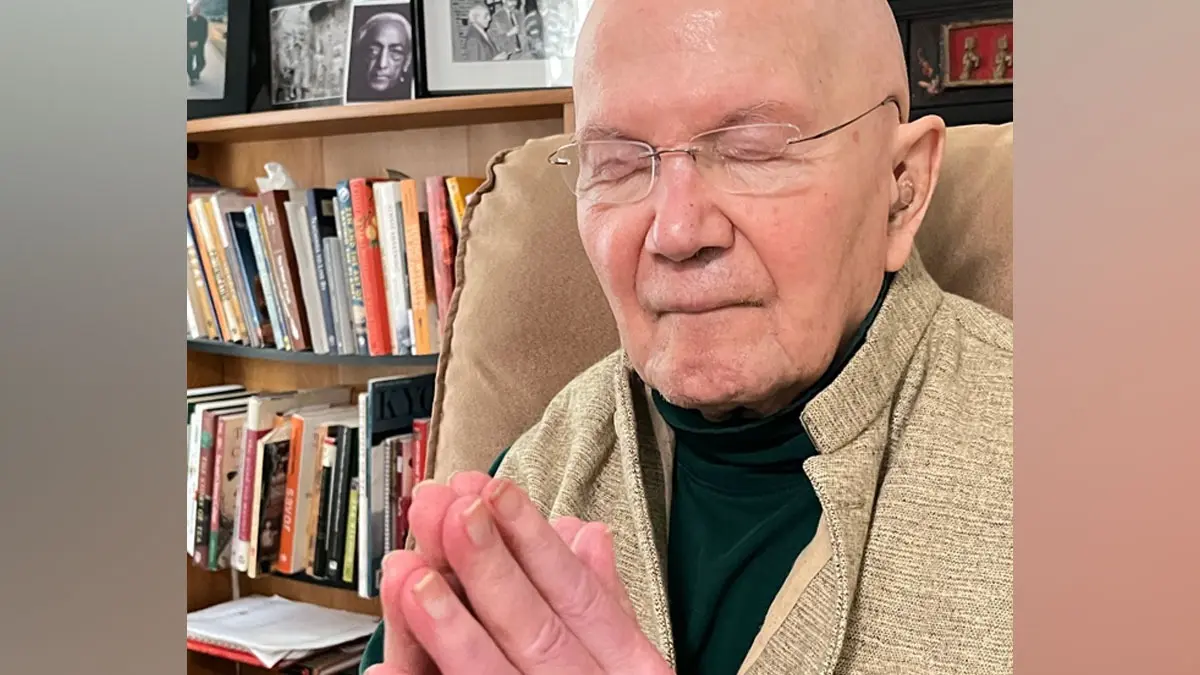
CAMBRIDGE, Mass. — As he approaches his 94th year this December, renowned Buddhist teacher and author Larry Rosenberg is finding that his personal relationship with aging, sickness, and mortality has undergone a profound transformation. Rosenberg, the founder of the Cambridge Insight Meditation Center and author of influential spiritual texts such as Breath by Breath and Living in the Light of Death, recently shared deeply personal insights regarding his physical decline, the limits of meditation, and the ongoing, daily practice of wakefulness.
The reflections, originally published as a September update to supporters contributing to a GoFundMe campaign facilitating at-home healthcare for Rosenberg and his wife, Galina, offer a rare window into the mind of a lifelong spiritual practitioner confronting the ultimate realities of human existence. According to "Team Rosenberg," after a period where the teacher lacked the energy to write, his vitality has briefly resurfaced, allowing him to share these poignant words with his global community of students and followers.
Main Facts: Confronting Mortality at Age 94
For decades, Rosenberg has taught thousands of students the foundational tenets of Buddhist practice, emphasizing awareness, breath, and the liberation from suffering. However, as he navigates advanced age and the compounding impacts of conditions like Parkinson’s disease, Rosenberg is candidly revising common misconceptions about what meditation actually achieves.
Key facts emerging from his recent writings include:
- The Reality of Suffering: Even after decades of intensive practice, physical pain, cognitive friction, and emotional strain do not vanish entirely. Rosenberg notes that even the historical Buddha suffered after attaining enlightenment; the crucial distinction is knowing how to care for that suffering.
- Intensive Mortality Training: Rosenberg’s lack of fear is not accidental. His preparation included extreme forms of maranasati (death awareness), such as spending an entire night observing a decomposing corpse in Mexico and months meditating on physical decline under the guidance of master Ajahn Suwat.
- The Daily Cycle of Awareness: Rosenberg describes his current mental state as a continuous loop of "waking up, going to sleep, waking up, going to sleep," where conditioned fear periodically creeps in before being dissolved by mindful observation.
- The Call to Action: He urges younger practitioners to build mental stability now, arguing that spiritual training is not just a tool for the present moment, but a necessary foundation for the inevitable physical and emotional trials of old age.
Chronology: A Lifetime Dedicated to the Dharma and the Art of Dying
To understand the weight of Rosenberg’s current reflections, it is helpful to trace the trajectory of his life and his deep engagement with the topic of mortality.
Early Years and the Path to Insight
Long before founding the Cambridge Insight Meditation Center in Massachusetts in 1985, Rosenberg immersed himself in various psychological and spiritual disciplines. Influenced by early encounters with prominent spiritual figures—including a memorable exchange where he asked the philosopher J. Krishnamurti if he was awake all the time, to which Krishnamurti replied, "Of course not. I’m still human"—Rosenberg recognized that spiritual mastery does not exempt one from the human condition.
Decades of Rigorous Practice
Rosenberg’s pursuit of fearlessness regarding death was deliberate and uncompromising. Eschewing purely academic theories of mortality, he sought out visceral, direct encounters with impermanence:
- The Mexican Retreat: In a training designed to shatter deep-seated cultural and personal aversions to death, Rosenberg spent an entire night in Mexico closely observing a human corpse as it underwent natural decomposition.
- Guidance Under Ajahn Suwat: During visits to America by the revered Thai forest master Ajahn Suwat, Rosenberg spent months meditating intensively on the inevitability of physical decay.
These rigorous encounters ultimately formed the bedrock of his acclaimed 2001 book, Living in the Light of Death, establishing him as a leading voice on mindful approaches to mortality in the West.
The Present Era: Navigating Advanced Age
Now, in the autumn of 2020s, theory has met absolute reality. Confined primarily to his home and requiring specialized support managed through community fundraising efforts, Rosenberg faces the daily indignities and physical limitations of Parkinson’s disease. Rather than viewing this phase as a failure of his practice, he treats it as a living laboratory—the ultimate testing ground for the teachings he has shared for over half a century.
Supporting Data and Personal Insights: The Mechanics of "Waking Up"
Rosenberg’s recent update demystifies the lived experience of an advanced meditator. Rather than portraying enlightenment as an unbroken state of blissful transcendence, he paints a picture of constant, gentle vigilance.
The Myth of Absolute Freedom from Pain
When people read about the life of the Buddha, Rosenberg notes, they often harbor the misconception that meditation offers an absolute escape hatch from all forms of suffering. He counters this directly, citing the late Zen master Thich Nhat Hanh:
"Even after he attained enlightenment, the Buddha suffered. But the difference is, the Buddha knew how to take care of his suffering."
Most individuals, Rosenberg explains, never fully learn how to care for their suffering, compounding psychological anguish on top of physical pain. Even with his extensive background, Rosenberg admits that suffering has not vanished. Instead, his relationship to it has changed.
The Cycle of Conditioned Fear
Describing his current daily reality, Rosenberg details the vulnerability that accompanies new and worsening physical ailments:
- “How much worse will my Parkinson’s get?”
- “The disability today is worse than yesterday.”
- “Will I ever be able to walk again?”
- “Oh no, a new ailment!”
These thoughts, he explains, represent moments of falling "back to sleep"—getting caught up in a past that is finished or a future that may never materialize. However, the fruit of decades of practice lies in the speed of recognition. As soon as he notices the fear creeping in, the act of seeing it causes the mental construct to dissipate.
"Suddenly I’m back to being wakeful again—and okay. There’s no fear in it," Rosenberg writes.
Official Responses and Community Support
The dissemination of Rosenberg’s latest reflections has elicited a powerful wave of emotion, gratitude, and solidarity across the international Buddhist community.
Team Rosenberg, the collective of family, caregivers, and close students overseeing his care and public communications, emphasized the significance of these writings. In a statement accompanying the GoFundMe update, they noted:
"After a period when Larry was simply not feeling up to it, his energy seems to have improved and we’re thrilled to offer new words here that Larry wishes to share with the sangha. They provide a window into how he’s been feeling this summer along with reflections on using his practice to face his challenges."
The fundraising campaign itself, established to cover the rising costs of around-the-clock at-home healthcare for Rosenberg and his wife Galina, has served as a testament to the profound impact his decades of teaching have had on students worldwide. Practitioners from the Cambridge Insight Meditation Center and beyond have responded not only with financial contributions, but with messages of deep reverence for a teacher who continues to model authenticity, vulnerability, and grace as he faces the final chapter of his life.
Implications: A Lesson for Practitioners of All Ages
Larry Rosenberg’s candid documentation of his 94th year carries profound implications for the broader mindfulness and Buddhist movements, as well as for contemporary attitudes toward aging and healthcare.
1. Re-evaluating Spiritual Goals
In a modern wellness culture that often markets meditation as a stress-reduction tool or a fast track to perpetual happiness, Rosenberg’s message serves as a necessary correctives. Spiritual practice, in his view, is not designed to shield a person from the biological realities of aging, disease, and death. Rather, it equips them with the psychological and emotional tools to inhabit those realities without panic or helplessness.
2. The Urgency of Early Training
One of Rosenberg’s most impassioned pleas is directed at younger practitioners. He stresses that building mental stability cannot be postponed until old age arrives.
"Those of you practicing, especially when you’re young, please… do it now! Keep at it! Because it’s not just about now. When you take care of now, you take care of the future."
By cultivating awareness during periods of health and vitality, individuals lay down neural and psychological pathways that will sustain them when their physical faculties inevitably begin to fade.
3. Redefining Death as a "Final Graduation"
Rather than viewing death as an absolute tragedy to be fought off at all costs, Rosenberg frames it with a quiet, pragmatic curiosity. Noting that his impending end will be "the true test… maybe my final graduation," he models an alternative to the cultural terror surrounding mortality.
Ultimately, Rosenberg concludes that being awake remains the singular path forward. Armed with decades of practice, he does not feel helpless in the face of his disabilities. Instead, he maintains a steadfast belief that the peace he has found—rooted in radical presence and self-care—remains accessible to anyone willing to put in the quiet, daily work of waking up.
