Every November, major fine art auction houses across the United States host specialized sales dedicated to Western, California, and Native American artwork. These high-stakes events draw passionate collectors from around the globe who participate in-house, online, and via telephone, waiting anxiously to hear the auctioneer declare a lot “SOLD!” accompanied by the sharp strike of the gavel.
As distinct subsections of the broader American art market, these genres enjoy a dedicated, highly engaged base of patrons. Their enduring enthusiasm continues to establish new auction records and focus unprecedented international attention on regional American art movements.
Main Facts: A Thriving Niche Takes Center Stage
The autumn fine art market is defined by several high-profile auctions that highlight the rich cultural narratives of the American West, the Pacific coast, and Indigenous communities. Recent sales demonstrate that these categories are not merely surviving but thriving, driven by strategic single-owner capsules, institutional retrospectives, and an expanding appreciation for contemporary Indigenous creators.
Major market drivers include:
Bonhams: Continuing a strong run of single-owner capsules, Bonhams successfully managed The Gene Hackman Collection: A Life in Art, alongside prominent White-Glove sales like Diane Keaton: The Architecture of an Icon.
Heritage Auctions: Emerging and regionally celebrated artists are rapidly achieving national recognition, broadening the geographical reach and cultural relevance of Western art.
Santa Fe Art Auction (SFAA): Contemporary and 20th-century Native American works now account for more than 50 percent of total sales, reflecting a massive shift in collector demand toward post-war modern Indigenous art.
John Moran Auctioneers: Regional California landscapes and historic American figurative paintings continue to resonate deeply with collectors who possess a personal connection to the Golden State.
Chronology of the Season: Upcoming Fall and Winter Sales
The market calendar builds momentum through a rapid succession of major sales throughout November, offering collectors a diverse array of masterworks, rare prints, and contemporary pieces.
November 5: Western Art Signature Auction – Heritage Auctions (Dallas, TX)
Kicking off the heavy November schedule, Heritage Auctions presents more than 100 fine paintings and sculptures. Highlighting the event is Clark Hulings’s 1993 dynamic oil-on-canvas Street Vendors (est. $40,000–$60,000), alongside atmospheric cityscapes by G. Harvey, such as Raindrops and Puddles (est. $30,000–$50,000). Additional offerings include works by Earl Biss, Charles Schreyvogel, and E. Martin Hennings.
November 6–7: The Signature Sale – Santa Fe Art Auction (Santa Fe, NM)
SFAA hosts its flagship two-day event featuring paintings, mixed media, and sculptures. The catalog showcases contemporary Indigenous art by Steven Yazzie and Malcolm Furlow, Pueblo pottery by Lisa Holt and Harlan Reano, and significant prints by Jaune Quick-to-See Smith. A major focal point is Rebecca Salsbury James’s rare reverse-painted glass masterwork, White Roses at Twilight (est. $200,000–$300,000).
November 11: California & Western Art – Bonhams (Los Angeles, CA)
Bonhams presents over 125 lots representing movements such as the Society of Six, the Taos Society of Artists, and the Cowboy Artists of America. Notable lots include Amédée Joullin’s 1897 historical canvas The Passing of the Wampum Belt (est. $12,000–$18,000) and Edgar Payne’s quintessential Western landscape Riders on the Mesa (Indian Riders) (est. $100,000–$150,000). The sale also includes a prominent collection from the estate of Ed and Bonnie Harvey.
November 17: California & American Fine Art – John Moran Auctioneers (Monrovia, CA)
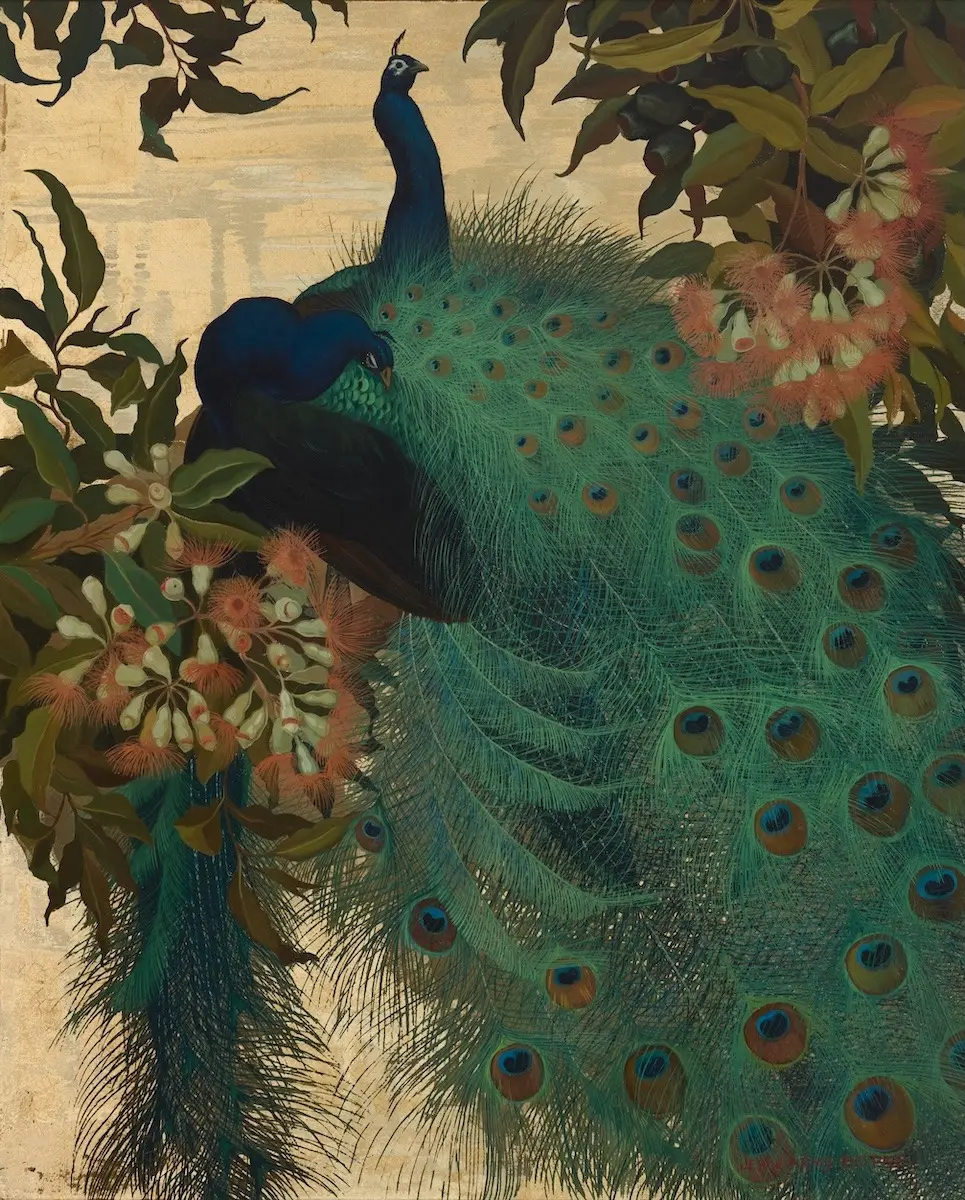
Wrapping up the major November circuit, John Moran Auctioneers brings approximately 250 lots to the block. Sourced largely from prominent local estates—including the Montecito collection of Sybil Rosen and Robert Fisher and the Saperstein Collection of Oakland—the sale features masterworks like Daniel Ridgway Knight’s A Trysting Place (est. $20,000–$30,000) and Jessie Arms Botke’s opulent gold-leaf composition Black Peacocks (est. $50,000–$70,000).
Supporting Data: Market Performance and Lot Highlights
Recent sales figures underscore the robust financial health of the Western and regional art sectors. Single-owner collections continue to outperform expectations, proving that provenance and narrative depth are major selling points for savvy investors.
The Gene Hackman Collection (Bonhams): Fritz Scholder’s Dancer exceeded its presale estimate to fetch $152,900, while Nicolai Fechin’s charcoal drawing Carmen (Head of a Girl) brought in $23,040.
Diane Keaton Sale (Bonhams): Maynard Dixon’s 1941 nocturne Train on the Desert realized $35,840, and Ed Mell’s 1992 landscape Light in the Valley achieved $40,960.
Ed Mell’s Market Trajectory: Following the artist’s passing in 2024, demand for Mell’s modernist Southwestern style has accelerated nationally, with his works consistently outperforming high presale estimates. His 1997 oil painting View from Ward Terrace is slated at Bonhams with an estimate of $60,000–$90,000.
Jessie Arms Botke: Known for her exquisite draftsmanship and ornithological precision, Botke’s Black Peacocks commands a high estimate of $50,000–$70,000 at John Moran Auctioneers.
Official Responses and Expert Perspectives
Industry leaders and fine art directors point to shifting demographics, institutional validation, and a broader reevaluation of art history as the primary catalysts for current market trends.
Aaron Bastian, Director of Fine Arts at Bonhams San Francisco:
"Contemporary Western art continues to capture the attention of new and returning bidders, with works by artists like Ed Mell exceeding their high estimates… [Edgar Payne’s] Riders on the Mesa continues to resonate with collectors as a quintessential expression of the American West."
Alissa Ford, Vice President of American and Western Art at Heritage Auctions:
"Collectors of Western art champion not only established artists but also emerging artists or those who are lesser known around the country. As a result, artists who once appealed primarily to regional audiences, such as Ed Mell, have achieved national recognition, reflecting the expanding reach, relevance and appeal of Western art across the broader collecting landscape."
Describing Clark Hulings’s Street Vendors, Ford adds:
"It is dynamic and complex with its panoply of vibrant colors, graphic array of shapes, lifelike fruit and vegetables, and multitude of figures, each going about a different activity as if caught in a candid moment of everyday market life."
Katherine Halligan, Director of Fine Art at John Moran Auctioneers:
"The collecting audience tends to have some sort of personal connection to the Golden State whether they reside in California or in other states. Within the American paintings category itself, collectors do look to our California artists’ non-California subjects with greater interest."
Gillian Blitch, President and CEO of Santa Fe Art Auction:
"Contemporary Indigenous art has certainly become one of the most exciting collecting areas in recent times, particularly mid- to late-20th-century pieces that cross collecting categories into post-war modern art."
Regarding the surging demand for masterworks by female modernists historically overshadowed by male peers, Blitch notes of Rebecca Salsbury James:
"Like many women modernists, James’s work has been historically overshadowed by her more famous counterparts such as Georgia O’Keeffe and Paul Strand, but there has been recent momentum in her market and a push to reposition her work. James worked slowly and meticulously in the difficult, exacting medium of reverse-painted glass, so her pieces are quite rare and sought-after."
Implications for the Broader Art Market
The vibrant health of the Western, California, and Native American art markets carries significant implications for the wider art economy:
Geographic Decentralization: The rising national prominence of regionally focused artists—such as Ed Mell and Maynard Dixon—proves that modern collectors are increasingly looking beyond traditional coastal art hubs (New York and London) to find high-value, culturally rich investments.
Institutional Validation Drives Commercial Success: Major museum retrospectives, such as recent exhibitions celebrating Jaune Quick-to-See Smith at the Whitney Museum of American Art, directly correlate with surging market demand, higher auction estimates, and broader institutional acquisition of Indigenous art.
Correction of Historical Oversight: The conscious effort by auction houses and galleries to spotlight overlooked figures—particularly female modernists like Rebecca Salsbury James—is reshaping art history textbooks while unlocking lucrative, previously undervalued asset classes for collectors.
Cross-Category Collecting: Contemporary Native American and Indigenous pieces are successfully bridging the gap between traditional craft, regional Western art, and post-war modernism. This crossover appeal attracts a younger, more diverse demographic of collectors who view these works through a contemporary global lens rather than a strictly regional one.
As these upcoming November sales demonstrate, the market for Western, California, and Native American art is not merely preserving the past—it is actively redefining the future of American art collecting.