

Introduction
California continues to cement its status as the vanguard of America’s green energy transition. Driven by aggressive legislative mandates, falling technology costs, and an unyielding commitment to reducing greenhouse gas emissions, the Golden State is setting new benchmarks in renewable energy generation. From expansive utility-scale solar arrays scattered across the Mojave Desert to ubiquitous rooftop photovoltaic (PV) systems lining suburban neighborhoods, the state’s capacity to harness nature’s elements is expanding at a historic pace.
At the heart of tracking this monumental shift is Dr. Mark Z. Jacobson, a prominent professor of Civil and Environmental Engineering and Director of the Atmosphere/Energy Program at Stanford University. For years, Jacobson has championed the "WWS" framework—Wind, Water, and Solar—as the definitive triad required to transition societies away from fossil fuels entirely. By closely monitoring California’s energy landscape, Jacobson provides critical insights into how the state’s infrastructure is adapting to meet aggressive 100% clean energy targets. Recent data highlights extraordinary achievements in capacity and utilization, proving that a major, highly industrialized economy can successfully pivot toward a sustainable grid.
Main Facts
The ongoing expansion of California’s renewable energy portfolio is characterized by several core developments that underline the state’s transition away from carbon-intensive power generation:
- Unprecedented Capacity Additions: California continues to install record-shattering volumes of wind, hydroelectric, and solar power facilities, alongside massive battery energy storage systems (BESS) that stabilize the grid after sundown.
- The WWS Paradigm: Stanford Professor Mark Z. Jacobson’s ongoing analysis utilizes the Wind, Water, Solar (WWS) metrics to evaluate the real-world performance, scalability, and integration of renewables within the state’s power markets.
- Distributed Generation Dominance: Beyond massive utility-scale installations, residential and commercial rooftop solar arrays continue to proliferate, turning millions of Californians into active energy producers rather than passive consumers.
- Grid Reliability Improvements: Despite concerns regarding intermittency, the rapid deployment of utility-scale battery storage has allowed California to routinely meet massive evening demand peaks using purely stored renewable energy.
- Continued National Leadership: California remains the undisputed leader in the United States for total non-hydroelectric renewable generation, setting a regulatory and technological blueprint that other states and federal agencies watch closely.
Chronology of the Transition
To understand how California arrived at its current renewable energy milestones, it is helpful to look back at the legislative and technological timeline that laid the groundwork for this ongoing success:
The Early Foundation (2002–2010)
California’s modern renewable push began in earnest with the establishment of the Renewable Portfolio Standard (RPS) in 2002, which initially mandated that 20% of the state’s electricity retail sales come from renewable sources by 2017. This target was accelerated in subsequent years. During this period, early pioneers invested heavily in preliminary geothermal, wind, and concentrated solar power (CSP) projects, proving the viability of large-scale green energy in the American West.
The Legislative Acceleration (2015–2018)
As solar panel manufacturing costs plummeted globally, California experienced a massive boom in both utility-scale and rooftop solar installations. In 2015, Senate Bill 350 raised the RPS target to 50% by 2030. Shortly after, in 2018, Governor Jerry Brown signed Senate Bill 100, establishing a landmark policy committing the state to achieve 100% zero-carbon electricity by 2045, with interim milestones along the way. Academic researchers, including Professor Mark Z. Jacobson, began mapping out detailed roadmaps demonstrating how wind, water, and solar could reliably power every sector of the state’s economy—including transportation and heating.
The Storage Revolution and Modern Milestones (2020–Present)
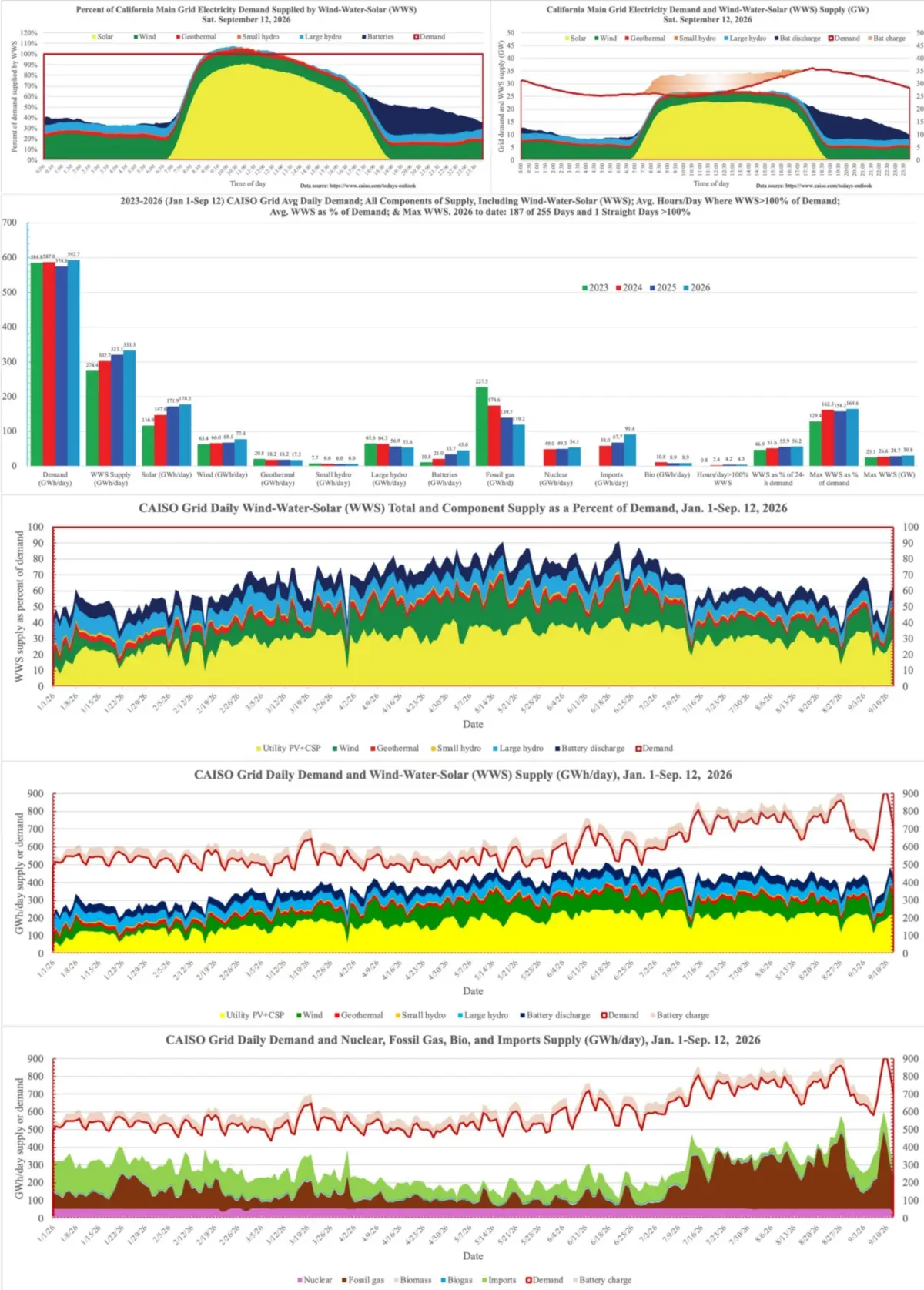
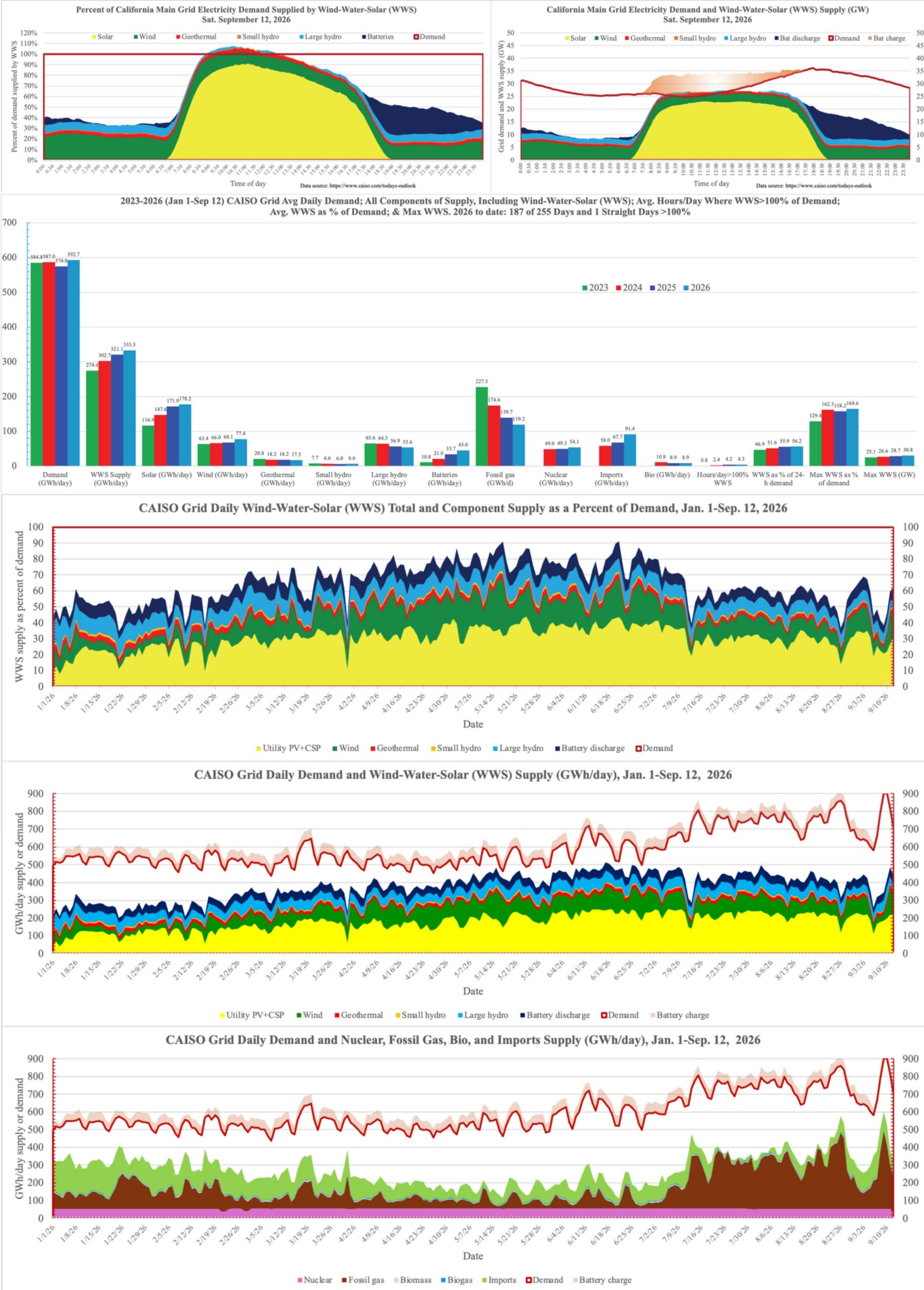
While generation capacity grew exponentially, the state faced critical grid reliability challenges, famously highlighted by rolling blackouts in August 2020. This catalyzed an unprecedented buildout of lithium-ion battery storage systems. Within a span of just a few years, California transformed from a vulnerable grid reliant on out-of-state fossil gas during peak hours into a global powerhouse of energy storage. Today, storage additions measure in the gigawatts, allowing the state to routinely shatter previous records for instantaneous renewable energy penetration, where WWS sources occasionally supply 100% or more of the state’s immediate demand for brief periods.
Supporting Data and Metrics
The transition taking place in California is not merely theoretical; it is backed by hard numerical evidence regarding capacity, generation, and storage deployment.
Solar and Wind Expansion
California’s installed solar capacity (both utility-scale and distributed) has grown from a few hundred megawatts in the mid-2000s to tens of gigawatts today. Solar power routinely dictates the shape of the infamous "duck curve," where midday electricity generation drastically outpaces demand, necessitating either storage charging or exportation to neighboring states. Meanwhile, onshore wind farms—predominantly located in high-resource areas like the Tehachapi Pass, San Gorgonio Pass, and the Altamont Pass—continue to provide steady, complementary generation, often peaking when solar output wanes in the late afternoon and evening.
Battery Storage Integration
The missing link in renewable integration has always been storage. According to state energy agencies and independent trackers like Jacobson, California’s operational battery storage capacity has scaled from virtually zero a decade ago to over 10 gigawatts. This rapid deployment has fundamentally altered evening grid dynamics, absorbing excess midday solar energy and dispatching it seamlessly during peak demand windows between 6:00 PM and 9:00 PM.

Hydroelectric Contributions
Water power remains a critical, albeit variable, component of the WWS triad in California. During wet winters, large hydroelectric reservoirs in the Sierra Nevada mountains provide immense flexible generation capacity, helping balance the intermitted nature of wind and solar. Even in drier years, pumped-storage hydroelectric facilities play an essential role in load balancing and grid stabilization.
Official Responses and Expert Perspectives
The milestones achieved by California have drawn commentary from policymakers, academic leaders, and industry insiders alike, underscoring the collaborative effort required to reshape a state grid of this magnitude.
Academic voices like Dr. Mark Z. Jacobson have continually emphasized that technological barriers to a 100% renewable grid have largely been solved. According to Jacobson’s research, the primary hurdles are no longer economic or technical, but rather related to permitting, transmission line buildout speed, and political will. By highlighting California’s ongoing milestones, Jacobson aims to demonstrate to other states and nations that rapid decarbonization is entirely feasible with existing WWS technologies.
State regulators, including representatives from the California Energy Commission (CEC) and the California Public Utilities Commission (CPUC), have praised the resilience of the local energy market. Officials note that while the integration process has presented complex operational challenges—such as managing wholesale electricity price volatility and avoiding curtailment of excess solar—the state’s proactive investments in transmission infrastructure and energy storage have paid off dramatically.
Furthermore, industry associations representing solar contractors, wind developers, and energy storage operators have lauded California’s regulatory environment. Despite ongoing debates regarding net metering policy adjustments for rooftop solar, the overarching consensus within the private sector is that California remains the premier market for clean technology innovation and deployment in North America.

Implications for the Future
The implications of California’s ongoing renewable energy achievements extend far beyond its borders, offering lessons, challenges, and inspiration for the rest of the world.
A Blueprint for National and Global Decimation
As the world’s fifth-largest economy, California’s success in scaling WWS technologies serves as a real-world stress test for the global energy transition. If a diverse, highly populated, and industrialized region can successfully manage high penetrations of variable renewable energy without sacrificing grid reliability, it provides a replicable roadmap for other nations striving to meet Paris Agreement targets.
The Need for Transmission and Interconnection Reform
Despite these incredible milestones, California’s clean energy march faces a persistent bottleneck: transmission infrastructure. Bringing new utility-scale wind and solar projects online from remote desert and mountainous regions requires extensive high-voltage transmission lines. Streamlining the federal and state environmental review processes for transmission corridors will be the defining challenge for the state’s energy sector over the next decade.
Electrification of All Sectors
Generating clean electricity is only half the battle. The milestones tracked by experts like Jacobson underscore the importance of utilizing this green power to electrify downstream sectors, notably transportation (via electric vehicles and heavy-duty trucks) and building heating (via heat pumps). As California’s grid becomes increasingly saturated with cheap, clean WWS energy, the economic and environmental case for economy-wide electrification becomes overwhelmingly compelling.
Conclusion
California’s renewable energy journey is a testament to what can be achieved through visionary policy, scientific rigor, and relentless industry execution. While today’s milestones are cause for celebration, the dynamic nature of the clean tech sector ensures that yesterday’s records will quickly become tomorrow’s baseline. As researchers like Mark Z. Jacobson continue to monitor the landscape, California stands proudly at the forefront of the global movement toward a sustainable, wind-, water-, and solar-powered future.
