

By CleanTechnica Reporting
Main Facts
The landscape of Philippine public transportation is standing at a historic crossroads. At the Sustainability Expo 2026 in Manila, the ElectroMobility Research and Development Center (EMRDC) of Cagayan State University (CSU) officially made its locally developed electric vehicle (EV) prototypes available to commercial investors. This bold step bridges the gap between academic innovation and the commercial marketplace, aiming to boost domestic manufacturing, slash carbon emissions, and insulate the country’s public transport sector from global petroleum price volatility.
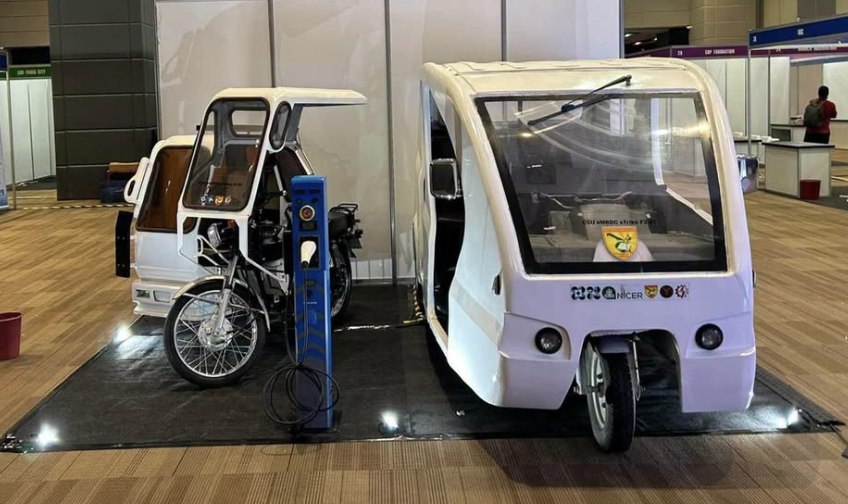
The centerpiece of CSU’s showcase included a custom-built, seven-seater electric tricycle and an innovative retrofit system that converts conventional gas-powered tricycles into modern, efficient electric units. Developed with backing from the Department of Science and Technology (DOST) and academic collaboration from the University of the Philippines Diliman (UP Diliman), these clean-transportation solutions offer a practical blueprint for the electrification of the nation’s ubiquitous urban utility vehicles.
By signing technology licensing agreements with private-sector partners for commercial fabrication, assembly, and distribution, CSU is proving that localized engineering can successfully address the unique socio-economic and logistical realities of the Philippines.
Chronology of Innovation: From Lab Bench to Market
The journey toward localized electric mobility in the Philippines has been methodical, driven by institutional research, state funding, and rigorous real-world testing.
Phase 1: Research, Development, and the C-Trike
Years prior to the Sustainability Expo 2026, CSU’s research team recognized that traditional internal combustion engine (ICE) tricycles—the lifeblood of Philippine short-distance transit—were major contributors to urban air pollution and vulnerable to fluctuating global oil prices. This realization sparked the creation of the C-Trike conversion system, an affordable technological package designed to transform standard gasoline tricycles into battery-electric units.
Phase 2: State Funding and Institutional Collaboration
The initiative gained serious momentum under the Philippine government’s Science for Change Program. The project secured a state funding injection exceeding 51 million pesos ($884,000 USD). Recognizing the scale of the challenge, CSU joined forces with UP Diliman, specifically tapping its renowned Power Electronics Laboratory to engineer robust, high-efficiency electrical and power-management systems suited for local operating conditions.
Phase 3: Prototyping and Field Testing
With funding and collaborative tech in place, the partnership produced five pilot units. These vehicles were deployed across several diverse provinces for exhaustive field testing. Subsequent performance studies—published in the Philippine Journal of Science—analyzed critical operational metrics, including energy efficiency, battery depletion rates, and climbing capacity over steep, uneven terrain. These trials confirmed the mechanical viability of the prototypes while highlighting areas for financial optimization, particularly concerning high initial acquisition costs.
Phase 4: Commercialization at Sustainability Expo 2026
The culmination of years of research arrived at the Sustainability Expo 2026 in Manila. Rather than keeping these blueprints confined to academic journals, CSU transitioned into a commercialization phase. By introducing a custom seven-seater people-carrier and opening the technologies to private investors, the university signaled a shift from theoretical research to mass deployment.
Supporting Data and Technical Specifications
Translating academic prototypes into commercial realities requires careful cost accounting and thoughtful engineering. The technical and financial data behind CSU’s electric vehicle initiatives reveal a clear path toward market viability:
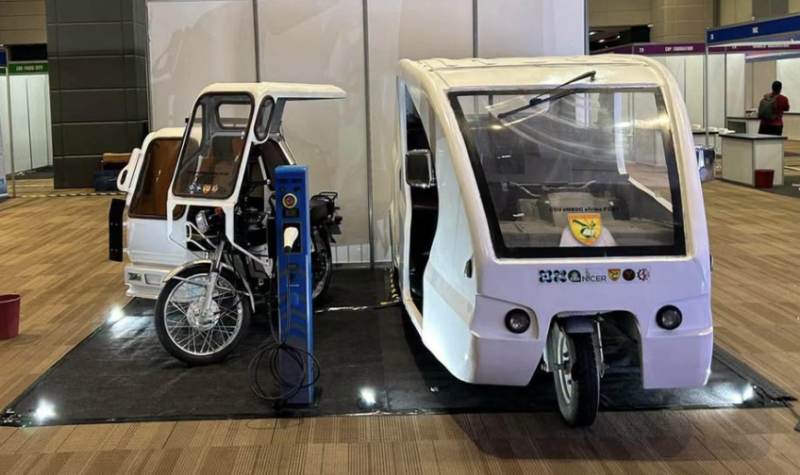
- Custom Seven-Seater Prototype Build Cost: Approximately 600,000 pesos (~$10,400 USD) for initial fabrication.
- C-Trike Conversion System Cost: Roughly 120,000 pesos (~$2,080 USD), offering fleet operators a low-barrier transition to electrification without purchasing entirely new vehicles.
- State Grant Funding: Over 51 million pesos (~$884,000 USD) channeled through the government’s Science for Change Program.
- Infrastructure Solution: Integration of a standardized, compatible battery-swapping architecture that allows drivers to exchange depleted energy packs for fully charged ones in a matter of minutes, effectively eliminating charging downtime.
- Operational Parameters: Designed specifically for high urban density, fixed daily routes, and depot-based overnight or quick-swap charging models.
According to government officials, the initial high price tags associated with custom builds are temporary artifacts of low-volume prototyping. Once commercial-scale manufacturing and mechanization take over, material and labor costs are projected to drop precipitously.
Official Responses and Policy Alignment
The rollout of CSU’s electric vehicles has garnered enthusiastic support from top government officials, aligning directly with broader national economic and environmental agendas.
DOST Leadership
During the exhibition, Department of Science and Technology (DOST) Secretary Renato Solidum Jr. addressed the economics of the new fleet. He emphasized that the initial 600,000-peso price tag for the seven-seater prototype reflects research and development overhead rather than true mass-production costs.
"Commercial production will remove upfront research expenses," Secretary Solidum noted. "Scaling production and increasing mechanization are expected to lower material and labor costs significantly, making these units exceptionally competitive against imported alternatives."
National Policy Support
This academic-industrial partnership fits squarely into the economic policies championed by President Ferdinand Marcos Jr., who has continuously advocated for localized clean vehicle manufacturing. By fostering domestic production, the Marcos administration aims to protect the Philippine public transport sector from the perpetual shockwaves of global petroleum price hikes, ensuring greater national energy security.

Furthermore, the DOST continues to fund parallel electric mobility efforts across the archipelago. These include a solar-powered boat initiative developed alongside Mapua University and an electric ferry project in partnership with the University of the Philippines—all pointing toward a holistic, multi-modal transition to clean transportation.
Implications for the Philippine Transport Sector
While the unveiling of CSU’s electric tricycles marks a monumental triumph for Filipino engineering, the long-term success of these vehicles will depend on navigating complex economic, operational, and supply-chain realities.
Total Cost of Ownership (TCO)
For everyday transport operators and fleet managers, environmental altruism takes a backseat to economics. Long-term viability will hinge on a favorable Total Cost of Ownership. Operators must carefully weigh:
- Electricity Rates: Ensuring that grid power costs remain lower than equivalent gasoline expenses.
- Financing Terms: Access to low-interest green loans or micro-financing schemes to cushion initial acquisition costs.
- Maintenance Overhead: Benefiting from fewer moving parts compared to internal combustion engines, which naturally lowers long-term repair bills.
- Battery Replacement Cycles: Managing the lifecycle costs of lithium-ion or alternative chemistry battery packs.
Supply Chain Localization
To maximize the domestic economic value of this transition, Philippine industries must establish dependable local supply chains. Relying entirely on imported battery cells, specialized motors, and power electronics could expose local manufacturers to international supply bottlenecks. Developing local manufacturing capabilities for these core components will be critical to keeping consumer prices low and ensuring self-sufficiency.
The Role of Private Investment
Ultimately, the bridge between a brilliant university prototype and nationwide adoption rests in the hands of private sector investors. Whether these locally engineered platforms can achieve the necessary scale and price parity to completely transform Philippine public transport will be decided in the marketplace.

By taking the initiative to license its technology to commercial partners, Cagayan State University has provided the spark. Now, it is up to private enterprise, forward-thinking investors, and supportive government policy to fan that spark into a nationwide clean-energy revolution.
