

By Karen Greenspan
Main Facts: The Embodied Architecture of Vajrayana Practice
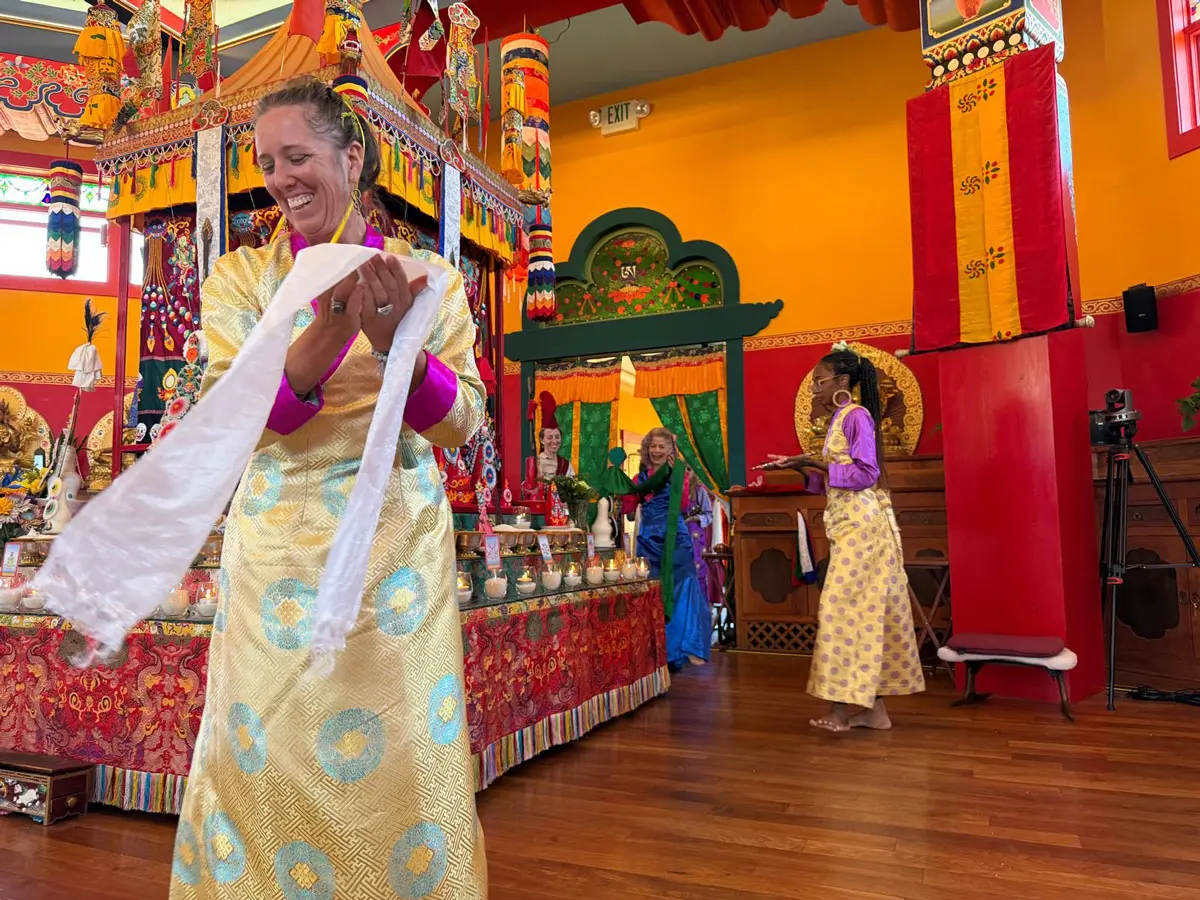
In prayer halls spanning from the high-altitude monasteries of the Himalayas to dharma centers in the West, a profound transformation occurs through movement. Dancers weave graceful grapevine steps, holding symbolic objects of enjoyment mounted on colorful ceremonial scarves—musical instruments, flowers, perfume. Clad in long, luminous silk Tibetan gowns of vibrant hues, practitioners circle ritual mandalas in a sacred choreography of offering.
This living tradition is known broadly as cham (sacred dance) and inner offering forms like Chötreng (Garland of Offerings). Performed during communal rituals of accomplishment—such as the White Dakini Drupchen—these movements are far more than cultural pageantry. They are an elaborate evocation of generosity, sung by chant masters and congregation alike while participants perform intricate mudras (hand choreography). Together, they visualize offering and receiving sixteen splendid gifts, multiplied and delivered across realms by celestial Wisdom Goddesses.
As a Bhutanese cham master once articulated to observers: "Everyone—gods and humans alike—love dance, just as they love flowers. No one can resist the beauty."
In the Vajrayana Buddhist tradition, dance serves as an invocatory power capable of calling divine qualities into active presence. As the late Nyingma master Thinley Norbu Rinpoche (1931–2011) observed, "In the precious Vajrayana tradition, in which the offering of dance is practiced, everything is turned into virtue, including all movement." By engaging body, speech, and mind—the three doors of expression—practitioners utilize visualization to amplify merit, cultivate the transcendent quality of generosity (paramita), and elevate the energetic frequency of sacred spaces.
Chronology: From Vedic Roots to Modern Global Transmission
To understand the sophisticated choreography of modern Himalayan monastic dance, one must trace its historical lineage across millennia, moving from ancient South Asian foundations to contemporary cross-cultural settings.
The Vedic Era (c. 1500–1200 BCE)
Vedic wisdom and practice laid the earliest conceptual frameworks for ritual performance. Early Hindu texts, including the Yajur Veda, established a cultural context wherein rhythmic recitation, musical accompaniment, and bodily gestures were inextricably bound to cosmic understanding and spiritual contemplation.
The Rise of Vajrayana Deity Yoga (c. 700 CE)
As tantric Buddhism systematized in India, these indigenous performance elements were integrated into sophisticated visualization frameworks. Practitioners adopted Sanskrit offering chants coupled with symbolic mudras, inviting deities into presence through embodied action.
The Introduction to the Himalayas (8th Century CE)
Guru Padmasambhava (Guru Rinpoche), the Indian tantric master, brought Vajrayana Buddhism to Tibet and Bhutan. He introduced foundational rituals, liturgical dance texts, and contemplative practices that would define Himalayan spiritual life for centuries. Over subsequent generations, treasure revealers (tertons) like Chokyi Wangchuk (1212–1270) unearthed hidden texts that expanded the sacred dance canon.
The Newar Tradition of the Kathmandu Valley
For at least a thousand years, the non-monastic vajracharya priests of Nepal’s Kathmandu Valley have preserved charya nritya ("dance as a spiritual discipline"). Featuring the Sodasha Lasya (sixteen expressions of grace), this yogic dance tradition physicalizes the offering of celestial attributes through precise mime and movement.
The Contemporary Era (Late 20th – 21st Century)
Historically, sacred cham was performed almost exclusively by male monastics within Himalayan institutions. However, the last two decades have marked a significant demographic and institutional shift. Female practitioners, nuns, and lay practitioners in both Eastern nunneries and Western dharma centers—such as Tara Mandala in the United States—have been invited to perform complex dakini dances, ensuring the tradition evolves while retaining its ancient integrity.
Supporting Data: Typology of Himalayan Sacred Dance
Sacred dance in Vajrayana Buddhism is systematically categorized by function, ritual context, and lineage. The following data outlines the primary genres shaping this vibrant performance ecosystem:
- Escort Dances (Jipai Pawo Cham): Performed by two to four pawo (heroes) flanking lamas, kings, or visiting dignitaries with joyful bounds and damaru drum rolls. They transition from peaceful to wrathful movements as ritual libations (serkyem) are offered.
- Invocation Dances (Zheng Zhik Pema): Utilized during Tsechu celebrations to summon Guru Padmasambhava. Costumed dakas and dakinis spin and jump, sounding hand-drums to a declaimed liturgy attributed to Yeshe Tsogyal.
- Longevity Ritual Dances (Khandro Tenzhug / Khandro Denga Cham): Designed to remove obstacles to the long lives of great teachers by appeasing celestial dakinis who might otherwise summon them to higher realms.
- Songs of Realization (Gurma): Folksy, uplifting choreographies paired with verses of spiritual insight. Performed by Drukpa Kagyu monks and nuns to celebrate the return of retreatants, temple consecrations, and lineage anniversaries.
- Auspiciousness Dispensations (Tashi Cham): Concluding ceremonies featuring monastics wearing the white repa sash of tantric yogis. Holding five-colored streamers, they stamp out negativity and whirl joyfully to distribute blessings of the Five Wisdom Buddhas to all sentient beings.
Official Perspectives and Institutional Insights
The preservation and performance of sacred dance are treated with rigorous monastic discipline. Far from being viewed as secular entertainment or theatrical performance, cham is guarded as a precise technology of transformation.
Senior lineage holders emphasize that the efficacy of a ritual depends entirely on the internal state of the practitioner. According to teachings within the Drukpa Kagyu and Nyingma traditions, physical movement must be anchored in samadhi (meditative absorption) and pure perception. When nuns at Druk Amitabha Mountain in Kathmandu or monks in Trongsa, Bhutan, execute complex choreographies—such as theAvalokiteshvara Drupchen or welcoming dances for yogis exiting years of solitary retreat—they operate under the strict guidance of chant masters and dance masters (chamspons).
Institutional leaders note that the integration of dance into major prayer cycles serves a dual purpose: it acts as an outward expression of profound inner devotion and functions as a stabilizing social anchor for Himalayan communities. By witnessing these physicalizations of compassion, generosity, and wisdom, lay audiences absorb core Buddhist values through sensory engagement. Furthermore, the intentional opening of these once-restricted dances to female monastics reflects a progressive institutional acknowledgment of women’s vital role in sustaining Vajrayana lineages globally.
Implications: Preserving Intangible Cultural Heritage in a Modern World
The flourishing of Himalayan sacred dance across international dharma centers carries profound cultural, spiritual, and sociological implications.
Safeguarding Intangible Heritage
As globalization and modernization pressure indigenous traditions across South Asia, the institutionalized transmission of cham acts as a bulwark against cultural erosion. Documenting and performing dances like the Rigma Chudruk Cham (Dance of the Sixteen Wisdom Goddesses) ensures that ancient iconographic knowledge is preserved not merely in texts, but in living bodies.
Cross-Cultural Bridges in the West
The integration of practices like Chötreng at Western centers such as Tara Mandala demonstrates that complex Vajrayana technologies can cross linguistic and cultural barriers. When Western practitioners engage in embodied visualization through dance, they bridge ancient Himalayan cosmology with contemporary somatic modalities, fostering a deeper, experiential understanding of Buddhist philosophy.
Redefining Gender Roles in Monastic Arts
The breaking of historical taboos allowing female monastics to perform advanced dakini dances marks a historic turning point. By stepping into roles previously reserved for monks, Himalayan nuns are redefining religious authority and demonstrating that spiritual accomplishment transcends gender binaries.
Ultimately, whether performed on dusty monastery courtyards during a Tsechu festival or inside carpeted Western prayer halls, sacred Himalayan dance remains an unyielding testament to the Vajrayana vision: a world where movement is liberated from confusion, where every gesture generates boundless merit, and where beauty itself becomes an act of boundless generosity.
