

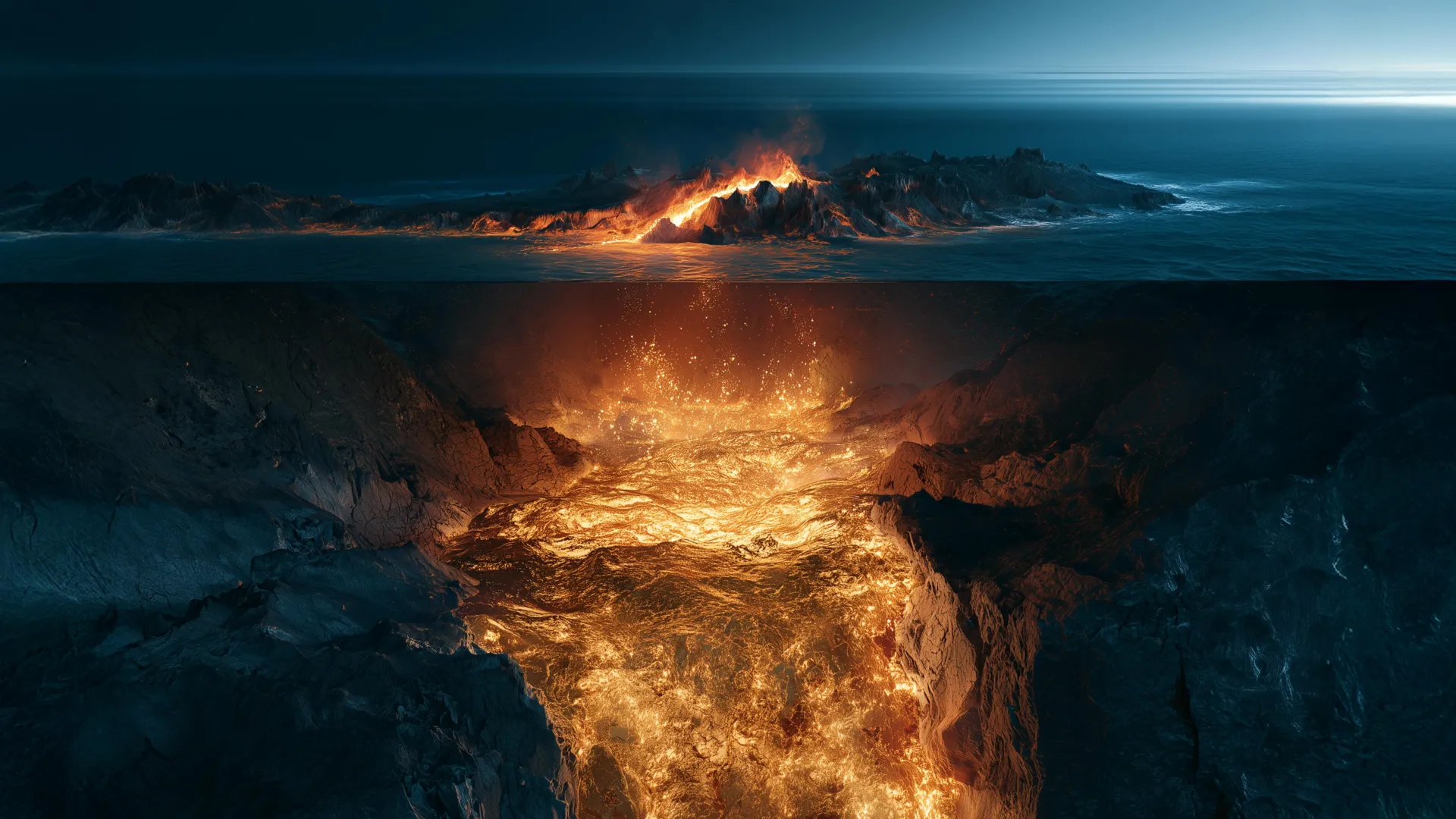
GELL, GERMANY — Deep beneath the rolling, remote blue expanses of the world’s oceans lies a geological engine of staggering proportions—a subterranean "gold kitchen" where precious metals are progressively concentrated, cooked, and prepared for their long journey to the Earth’s crust.
For decades, geoscientists have been captivated by a persistent geological mystery: why certain island arcs—spectacular, crescent-shaped chains of volcanoes that develop above subduction zones where one tectonic plate dives beneath another—are so anomalously rich in gold. While these deep-sea systems have long been suspected of harboring immense mineral wealth, the exact chemical and thermodynamic mechanisms driving this enrichment remained elusive.
Now, a groundbreaking study led by Dr. Christian Timm, a marine geologist at the GEOMAR Helmholtz Centre for Ocean Research Kiel, has shattered previous assumptions. Published by an international team of researchers, the study reveals that the mantle beneath these island arcs acts as a sophisticated, multi-stage melting apparatus. Driven by water and intense heat, this subterranean system progressively liberates and concentrates gold long before the magma ever reaches the ocean floor.
Main Facts: Decoding the Deep-Sea Gold Factory
The new research centers on the mechanics of subduction zones—regions of the Earth where titanic tectonic plates collide. As an oceanic plate descends into the hot mantle, it triggers a cascade of chemical and physical reactions. Island arcs, such as the Kermadec Arc stretching northeast of New Zealand, form directly above these churning zones of subduction.
Key findings from the GEOMAR-led study include:
- The Multi-Stage Melting Process: Gold enrichment in these zones is not the result of a single, isolated volcanic event. Instead, it requires high-degree, repeated melting of a mantle source that has already been depleted by earlier geological cycles.
- The Role of Water: While scientists initially hypothesized that water released directly from the descending tectonic plate acted as a chemical carrier for gold, the new data proves otherwise. Water primarily acts as a thermal and physical catalyst, facilitating extensive mantle melting.
- The Destruction of Sulfides: In the Earth’s mantle, gold is predominantly locked away inside microscopic sulfide minerals. When mantle melting reaches high enough temperatures and intensities, these sulfide minerals break down completely, releasing their trapped gold payloads into the rising magma.
- Pristine Volcanic Glass Records: The team analyzed 66 primitive volcanic glass samples dredged from the seafloor. These samples, which cooled instantaneously upon contact with cold ocean water, trapped and preserved the unadulterated chemical signatures of ancient, deep-seated magmas.
Despite the elevated gold concentrations discovered in these samples—reaching up to six nanograms per gram of rock—the researchers emphasize that these rocks are far from being commercially viable. The concentrations are still several orders of magnitude too low for industrial mining. However, they represent the critical foundational step—the "first draft"—in the life cycle of world-class gold deposits.
Chronology: The Detective Work Behind the Discovery
Unraveling the chemical history of magma locked miles beneath the ocean floor required a meticulous, multi-step scientific campaign. The timeline of this discovery bridges remote maritime expeditions with high-precision laboratory analysis.
Step 1: Sampling the Seafloor (The Kermadec Arc Expedition)
The journey began at sea. Researchers targeted the Kermadec island arc and the adjacent Havre Trough, a geologically active submarine region north of New Zealand characterized by intense underwater volcanism. Using specialized marine geological equipment, the team collected 66 volcanic glass samples from the steep flanks of submarine volcanoes.
Volcanic glass forms when molten lava erupts into the freezing depths of the ocean and quenches instantly. This rapid thermal shock prevents the magma from crystallizing, effectively freezing its chemical composition in time.
Step 2: Isolating Primitive Magmas
Back in the laboratory, the researchers sorted through the collection to identify the most scientifically valuable specimens: primitive glasses. Unlike evolved magmas—which have undergone prolonged crystallization, mixing, and alteration as they stagnate in shallow crustal chambers—primitive glasses preserve the direct chemical signature of the deep mantle source from which they originated.
Step 3: Trace Element Geochemistry
Using state-of-the-art analytical instrumentation, the team measured gold concentrations at extraordinarily low detection limits (parts per billion and trillion ranges). They did not look at gold in isolation; instead, they cross-referenced gold levels with a suite of other chalcophile ("sulfur-loving") elements, including silver, copper, selenium, and platinum. Because these elements behave predictably in relation to one another during melting events, their ratios act as a chemical fingerprint of mantle processes.
Step 4: Thermodynamic Modeling
By feeding the analytical data into geochemical models, Dr. Timm and his colleagues reconstructed the temperature, pressure, and fluid conditions required to produce the unique chemical signatures observed in the primitive glasses. The results pointed definitively toward a complex, multi-stage melting history.
Supporting Data: What the Numbers Tell Us
The analytical data gathered from the Kermadec arc and Havre Trough samples provided striking contrasts when compared against normal mid-ocean ridge basalts (MORB)—the standard baseline for typical oceanic crust formation.
- Elevated Gold Baselines: The primitive glasses analyzed in the study exhibited gold concentrations several times higher than comparable magmas originating from mid-ocean ridges.
- Specific Concentration Metrics: The team detected original gold concentrations reaching up to six nanograms per gram of rock. While six billionths of a gram sounds negligible, it is an unusually rich concentration for mantle-derived magma.
- Distinct Metal Ratios: The samples revealed gold-to-copper ratios significantly higher than those measured in fertile mantle rock and primitive mid-ocean ridge basalts. Crucially, the silver-to-copper ratios mirrored those typically found in the unmodified mantle, indicating that sulfur-bearing phases played a dominant role during the melting sequence.
- The Threshold of Melting: The chemical patterns confirmed that the mantle beneath the Kermadec arc underwent melting at relatively high temperatures—specifically, above the sulfide liquidus. This thermal threshold is the exact point where sulfide minerals destabilize and dissolve, liberating their precious metal cargo into the surrounding melt.
Official Responses and Expert Insights
Dr. Christian Timm, the lead author of the study and a prominent marine geologist at GEOMAR, has shared detailed insights into how these findings reshape our understanding of planetary geochemistry.
"Our research shows that hydrous mantle melting beneath island arcs is a key driver of gold enrichment," Dr. Timm explains. "In these settings, the mantle behaves like a multi-stage melting system that progressively concentrates gold."
Addressing the initial misconceptions surrounding the role of water in subduction zones, Dr. Timm notes a significant shift in perspective:
"We initially assumed that water released from the subduction zone directly controlled gold enrichment. However, our data show that water mainly facilitates mantle melting. The key factor for high gold concentrations is the high—and in part repeated—degree of melting."
Elucidating the physical fate of the precious metal within the Earth’s interior, Timm points to the behavior of sulfides:
"Gold in the mantle is commonly bound in sulfide minerals. At high degrees of melting, these minerals break down, releasing their gold completely into the melt. Our results demonstrate that gold enrichment is not the result of a single melting event, but of multiple stages. Only repeated melting allows gold to become strongly concentrated in the magma."
Summarizing the overarching significance of the study, Timm paints a vivid picture of the planet’s internal chemistry:
"We are effectively looking at the first step in the life cycle of gold. It begins with the transfer of gold from the mantle into a melt that eventually forms volcanoes. The alchemy starts long before the metal reaches the surface."
Implications: Tracing the Life Cycle of Gold
The implications of Dr. Timm’s research extend far beyond academic geology, offering profound insights into ore genesis, hydrothermal systems, and the global distribution of mineral resources.
Rethinking Submarine Hydrothermal Systems
Along submarine island arcs, hydrothermal vents—often referred to as "black smokers"—circulate superheated, mineral-rich water through fractured volcanic rock. These systems are known to precipitate massive sulfide deposits on the ocean floor that contain striking concentrations of copper, zinc, lead, and gold.
Until now, the exact provenance of the surplus gold in these hydrothermal fields was poorly understood. By demonstrating that the deep mantle beneath subduction zones is pre-conditioned by multi-stage melting to release high baseline amounts of gold, this study provides a missing link. The hydrothermal systems may simply be scavenging and further concentrating a metal load that was already anomalously high due to mantle-level alchemy.
Moving Ore Genesis Deeper into the Earth
For generations, economic geologists focused primarily on shallow crustal processes—such as the boiling of hydrothermal fluids, fractional crystallization, and interaction with wall rocks—to explain why certain regions become rich in mineral deposits.
This new research shifts the paradigm. While surface-level and crustal processes remain vital for determining whether commercially viable deposits ultimately form, the foundational chemical history is established deep within the mantle long before the magma begins its ascent. The mantle acts as the primary filter and concentrator.
Future Research Frontiers
Dr. Timm and his research team emphasize that while the initial link between multi-stage melting and mantle gold enrichment has been established, much work remains. Future investigations will need to test whether this multi-stage melting mechanism applies universally to all intra-oceanic island arcs across the globe, or if regional tectonic variations create distinct geochemical signatures.
Furthermore, researchers hope to trace the subsequent steps in the journey: following the gold-rich magma as it ascends through the Earth’s crust, interacts with shallow plumbing systems, and ultimately discharges into hydrothermal vents on the ocean floor.
As science continues to probe the dark, crushing pressures beneath the world’s oceans, the hidden "gold kitchens" of the deep Earth are slowly giving up their secrets, proving that the legendary alchemy of turning base elements into treasure is, in reality, a masterclass performed daily by the dynamic machinery of our living planet.
