

Updated September 7, 2026
(From Yoga Journal’s Archives series, revisiting classical insights originally published in the March–April 1979 issue.)
Main Facts: The Anatomy and Philosophy of a Foundational Fold
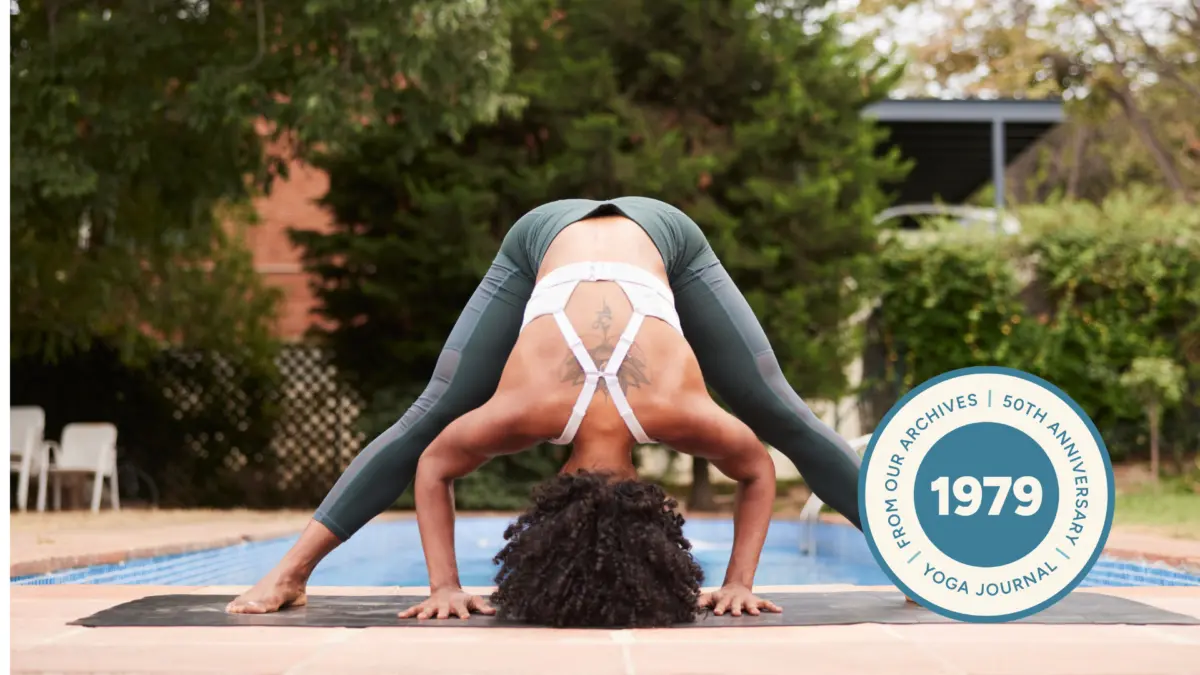
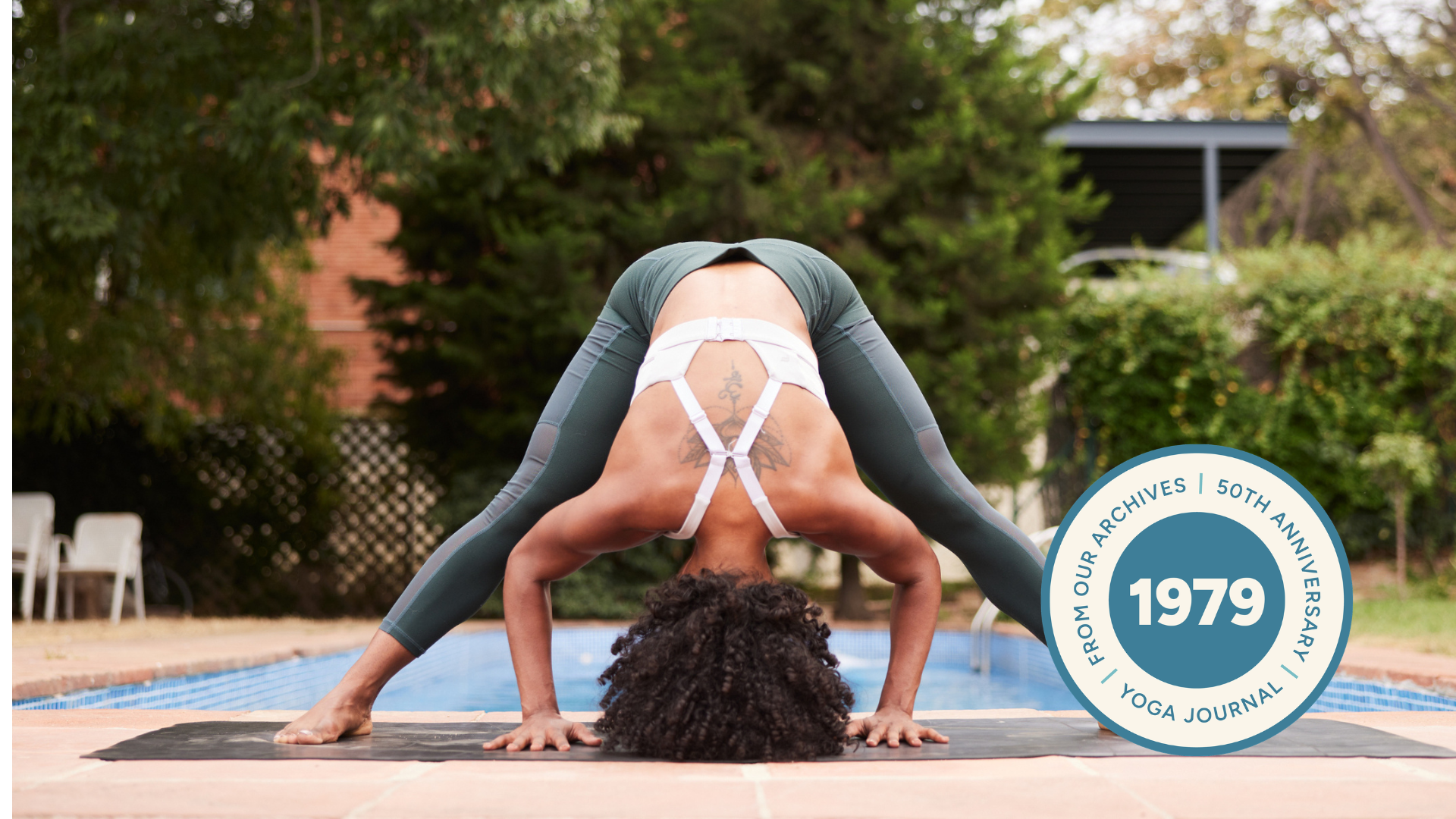
In the vast landscape of hatha yoga, few postures bridge the gap between physical alignment and deep psychological surrender quite like Prasarita Padottanasana, commonly known as the Wide-Legged Standing Forward Fold. While often categorized as a standard standing posture, this dynamic asana functions simultaneously as a transitional bridge to inversions, a blueprint for safe spinal mechanics, and a profound psychological mirror.
According to classical yoga philosophy, Patanjali—author of the foundational Yoga Sutras—outlines five major afflictions, or klesas, that cloud mental equanimity and obstruct spiritual growth. One of these is dvesa, the deeply ingrained psychological impulse of aversion. On the physical mat, dvesa frequently materializes as an instinctive resistance to forward-bending postures. Practitioners prone to this aversion often resist both the physical hamstring stretch and the mental vulnerability required to fold inward.
As scholar Mircea Eliade famously observed, an asana operates as a "single, archetypal, iconographic posture" that temporarily freezes the fluid process of the body-mind into a cohesive "totalization." In Prasarita Padottanasana, consciousness is not manufactured; rather, it is magnified and articulated with crystal clarity through the architecture of the pose.
The name itself reflects this structural integrity: Prasarita translates to "extended," and pada means "foot." By extending the base and folding forward—much like an individual dropping their head in prayer—the practitioner cultivates an attitude of reverence, humility, and release. When the powerful muscles of the legs are systematically relaxed, the resultant freedom unlocks an inner strength that coexists harmoniously with outer flexibility.
Chronology: Tracing the Evolution of the Pose Through Hatha Yoga Tradition
The transmission of Prasarita Padottanasana spans centuries of oral and written tradition, moving from ancient ascetic practices to modern postural yoga popularized in the West during the mid-to-late 20th century.
- Ancient Roots: The philosophical underpinnings of klesas and dvesa originated centuries prior in Vedic and classical philosophical texts, framing the physical body as an instrument for mental liberation.
- Mid-20th Century Revival (The Iyengar Influence): Master yogi B.K.S. Iyengar codified the precise biomechanics of Prasarita Padottanasana in landmark instructional literature such as Light on Yoga. Iyengar highlighted the pose not merely as a hamstring stretch, but as a crucial spinal stabilizer. He specifically recommended it as a therapeutic alternative for practitioners unable to perform headstands (Sirsasana).
- March–April 1979 (Yoga Journal Archives): A seminal instructional essay published in Yoga Journal formally synthesized the psychological experience of dvesa with the physical execution of the wide-legged fold. This writing established a framework for viewing physical tightness not as a personal failure, but as a physical manifestation of karma and mental resistance.
- Contemporary Practice (2026 and Beyond): Modern biomechanics and trauma-informed movement modalities continue to validate the 1979 insights, emphasizing how slow, mindful transitions into forward folds regulate the nervous system and build structural joint resilience.
Supporting Data: Biomechanics, Spinal Health, and Structural Stability
To appreciate the physiological value of Prasarita Padottanasana, one must examine the mechanics of the human spine and hip joints.
Spinal Integrity and Facet Joints
The movement of the vertebral column is governed largely by facet joints—the flattened articular surfaces situated between adjacent vertebrae. The spinal column achieves maximum stability when these facets remain in a congruent, balanced relationship.
- The Danger of Over-Arching: Excessive lordosis (arching) in the lumbar region, or chronic slouching that collapses the front rib cage, strips these facets of their congruence, leaving the spine vulnerable to injury.
- The Daily Struggle: Modern sedentary lifestyles force individuals into chronic, unstable, round-backed postures, particularly when leaning over to lift objects from the floor.
- The Yogic Correction: Prasarita Padottanasana actively retrains the body to keep the vertebral column straight while preserving its natural physiological curves. Hatha yoga instructs practitioners from day one to draw the spinal column inward toward the front of the body, preventing upward spinal bulging and preparing the body safely for advanced backbends.
Hip and Thigh Mechanics
- Hip Joints: The pose facilitates a deep, clean stretch of the hip joints by pivoting the concave surface of the pelvis smoothly over the stabilized, convex femoral head.
- Muscular Engagement: The inner adductors and posterior hamstrings undergo an intense lengthening phase when holding the pose. Conversely, these same muscles actively contract and strengthen to lift the torso back to an upright position.
Official Perspectives: Personality Typologies and the Balance of Opposites
Observing diverse student populations practice hatha yoga reveals a fascinating behavioral trend: most individuals exhibit a distinct preference for either forward bends or backbends. According to classical pedagogical theory, these preferences serve as behavioral mirrors of personality.
"Perhaps one who prefers forward bends is drawn more easily to surrender and compliance and needs the balance of backbends to help create more extroversion, assertion and confidence. Conversely, one who is drawn to backbends may achieve greater balance through practice of forward bends."
When the psycho-physical-spiritual triad aligns correctly through asana practice, energetic blockages clear, allowing prana to flow freely. This restores a natural equilibrium to the dynamic stillness of the posture. Achieving this requires total surrender—not just of the leg muscles, but of the ego, letting go of mental resistance and defiance. In this surrender, practitioners discover true fortitude.
Implications: Navigating Common Pitfalls, Props, and Karma
Technical Pitfalls to Avoid
While Prasarita Padottanasana is accessible, common execution errors can compromise its benefits:
- Exaggerating the Lumbar Curve: Arching or rounding the lower back excessively while entering or exiting the pose.
- Asymmetrical Weight Distribution: Shifting body weight predominantly to one side, causing one hip or buttock to lift higher than the other.
- Foot Tension: Tensing the feet rather than maintaining fluid, grounded awareness throughout the foundation of the posture.
- Breath Disruption: Violating the golden rule of yogic breathing—that the breath should never disturb the pose, and the pose should never disturb the breath. Inhales symbolize gathering strength during preparation, while exhales mirror the surrender executed during the descent.
Utilizing Props and Modifications
Practitioners experiencing physical limitations can leverage supportive tools to master the posture:
- Blocks or Books: Placing a firm prop under the hands prevents the practitioner from violently rounding the back if tight hamstrings prevent floor contact.
- Toe Inward Rotation: Angling the toes slightly inward reduces excessive stress on the outer ankles and mitigates sciatic nerve irritation.
- Wall Support: Practicing with the back positioned against a wall helps teach the spine how to straighten evenly without external guesswork.
- Advanced Variations: As flexibility increases, practitioners can narrow their stance or clasp their hands behind their back in a namaste (prayer) mudra.
The Philosophical Takeaway: Karma on the Mat
Ultimately, the physical friction encountered in Prasarita Padottanasana serves a higher philosophical purpose. The tightness felt in the legs is often likened to physical karma—the direct result of habitual movement patterns, such as prolonged sitting.
Yoga teaches that asanas do not manufacture discomfort; rather, they illuminate the discomfort that already exists, bringing it to the surface so it can be released. By confronting these physical and mental limitations with patience, breath, and awareness, the practitioner achieves true liberation—both on and off the mat.
The insights in this retrospective are gratefully anchored in the classical teachings of B.K.S. Iyengar’s seminal work, Light on Yoga, and the enduring archival legacy of Yoga Journal.
