

Main Facts
Methane thermolysis—frequently referred to as methane pyrolysis—has emerged as one of the most promising technological pathways in the clean hydrogen sector. By applying indirect thermal energy rather than an open flame, the process splits natural gas (methane) into its foundational elements: clean hydrogen gas and solid carbon, usually in the form of high-purity thermolysis graphite or carbon black.
Unlike conventional steam methane reforming (SMR) or "blue hydrogen" proposals, methane thermolysis bypasses the complex, energy-intensive, and capital-heavy carbon capture, compression, transportation, and geological-storage (CCS) infrastructure. Because the carbon is captured instantly as a solid at the point of production, the greenhouse gas is essentially immobilized without the need for underground reservoirs. Pioneers in the field, such as the Hazer Group—which has advanced its proprietary catalytic technology from laboratory chemistry to an operating demonstration plant and commercial-scale engineering partnerships with firms like KBR—have proven that the chemical reactions are entirely viable at scale.
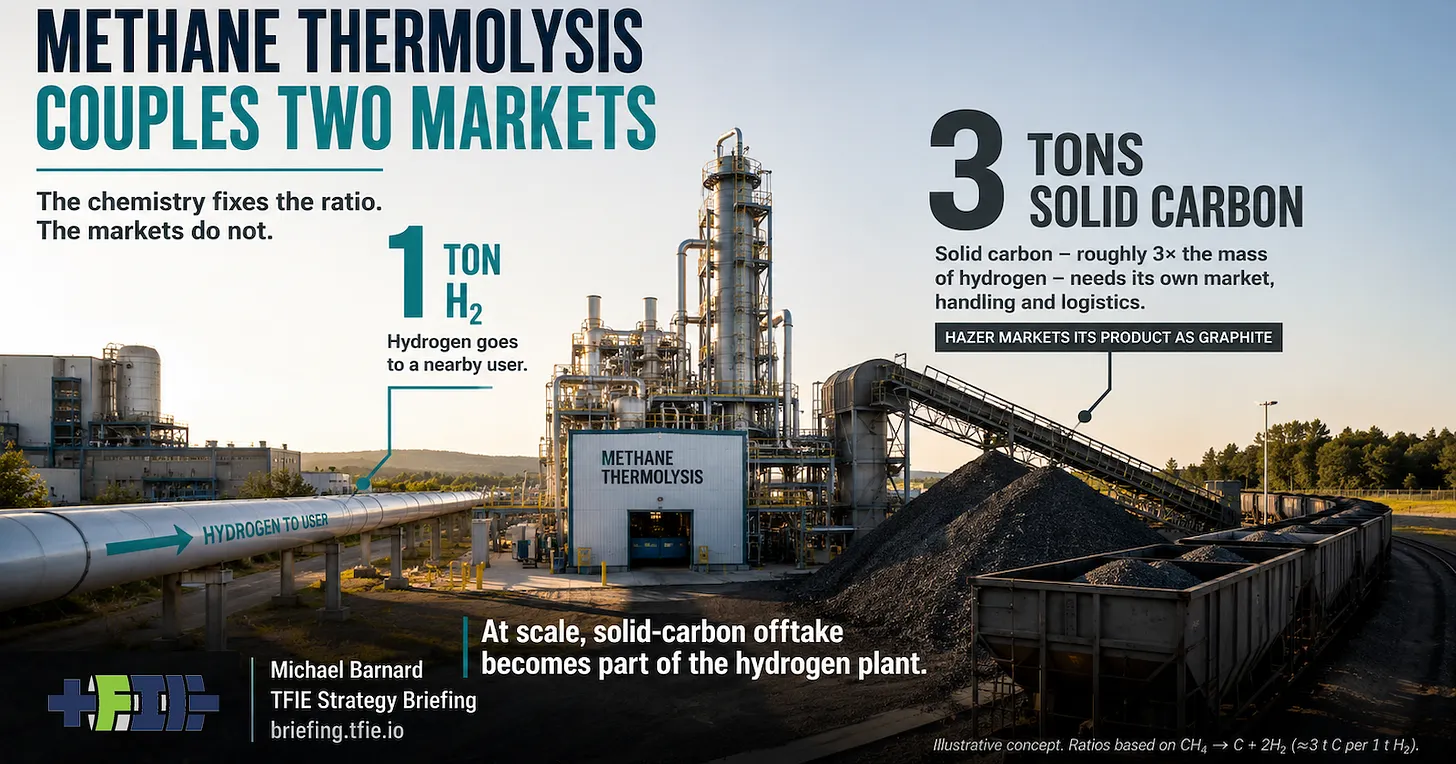
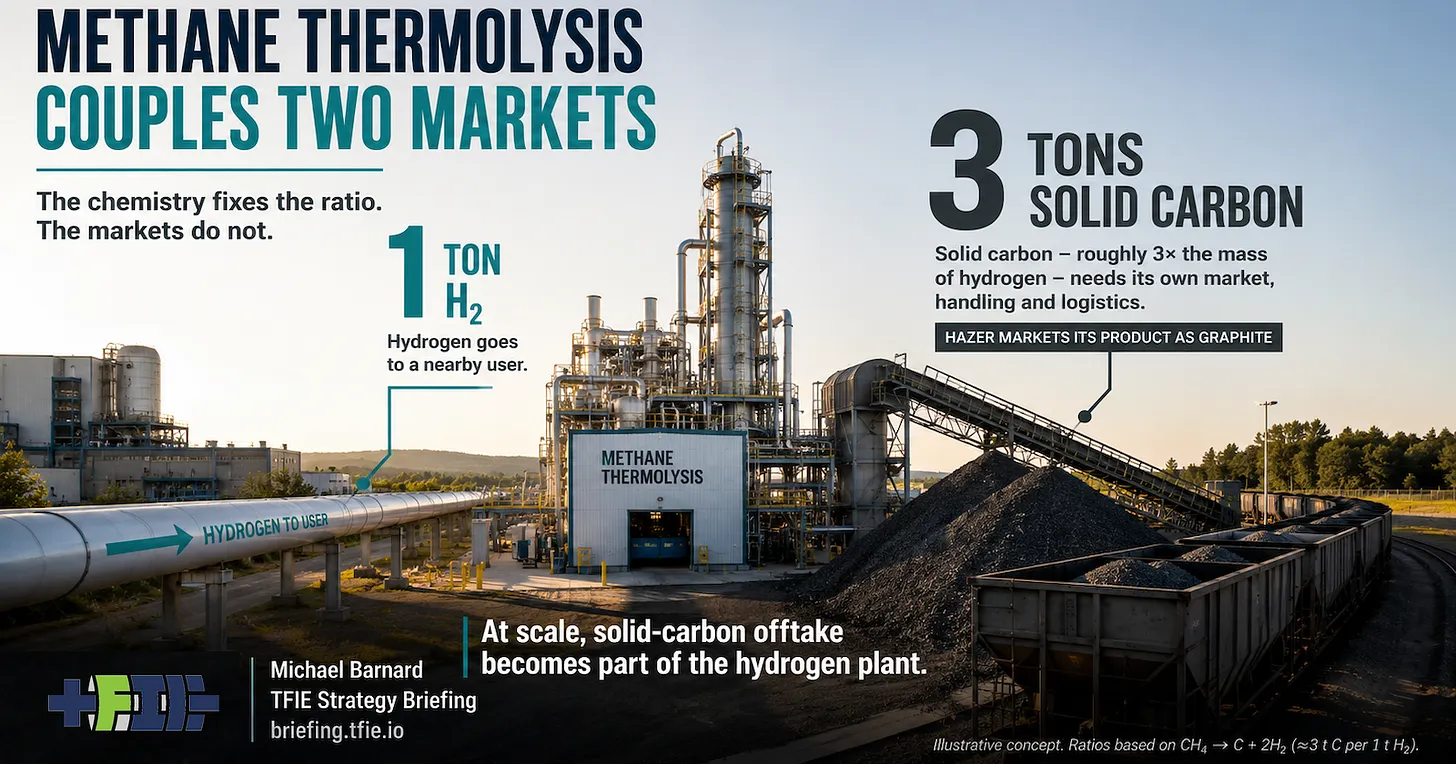
However, a fundamental law of chemistry introduces a formidable industrial bottleneck: the mass balance. For every single tonne of hydrogen produced via methane thermolysis, roughly three tonnes of solid carbon are simultaneously generated.
When projected onto an industrial scale, this ratio presents a staggering logistical and economic challenge. A single plant yielding 300,000 tonnes of hydrogen annually will inevitably churn out approximately 900,000 tonnes of solid carbon—amounting to roughly 2,500 tonnes every single day. While companies like Hazer are actively researching pathways to integrate this graphitic material into steel manufacturing, lithium-ion batteries, asphalt, and concrete, the sheer volume of the coproduct threatens to overwhelm these target industries. Even under the most favorable theoretical conditions—such as pairing a thermolysis plant directly with a massive green steelworks—consuming factories can only absorb a fraction of the output, leaving 80% to 90% of the thermolysis graphite stranded without a viable market.
Chronology of Technological Evolution and Market Realization
1. From Laboratory Curiosity to Industrial Reality
For decades, methane cracking was viewed primarily as a niche chemical process or a laboratory curiosity. Early iterations suffered from catalyst deactivation, excessive energy requirements, and difficulties in separating the solid carbon byproduct from the active reactor surfaces without shutting down operations.
2. The Commercialization Wave (2020–Present)
Over the past five years, private capital and government grants have propelled methane thermolysis into the spotlight. Companies like the Hazer Group transitioned from bench-scale testing to operational pilot facilities. By partnering with global engineering giants such as KBR, these firms shifted the narrative from "can we physically split methane?" to "how do we run this as a profitable, continuous industrial enterprise?"
3. The Denominator Reality Check
As engineering blueprints grew from kilotonne pilots to commercial megatonne plants, industry strategists began rigorously mapping the mass-balance equations. Analysts and market observers realized that treating the solid carbon stream as an afterthought or a "free bonus revenue" fundamentally misunderstood the industrial realities of bulk commodity markets. Recent strategic analyses—such as those published via the TFIE Strategy Briefing—have forced a reassessment, calculating that the secondary carbon market must expand or adapt at an unprecedented rate to keep pace with the energy sector’s appetite for clean hydrogen.
Supporting Data and Mass-Balance Calculations
To understand the scale of the carbon surplus, one must examine the raw numbers governing a commercial-scale operation.
- The Hydrogen-to-Carbon Ratio: Stoichiometrically, the splitting of methane ($textCH_4$) into hydrogen ($2textH_2$) and solid carbon ($textC$) yields a strict weight ratio where three parts carbon are produced for every one part hydrogen.
- The Megatonne Plant Baseline: Consider an industrial facility designed to produce 300,000 tonnes of hydrogen per year to feed heavy industry or regional distribution networks. The corresponding output demands the handling, processing, and off-take of 900,000 tonnes of solid carbon annually—or roughly 2,500 tonnes per day.
- The Steelworks Stress Test: Steel production is widely considered the strongest potential symbiotic market for thermolysis outputs because hydrogen can fuel Direct Reduction of Iron (DRI), while graphitic carbon can be utilized downstream in Electric Arc Furnaces (EAF) for scrap adjustments, foaming slags, and process energy.
When tested against a massive, Stegra-scale hydrogen-DRI steelworks producing 2.5 million tonnes of steel annually:
- The facility requires a significant volume of hydrogen, which via thermolysis would simultaneously generate 340,000 to 365,000 tonnes of graphite per year.
- However, the actual operational consumption of carbon within a steelworks of that magnitude sits between 45,000 and 63,000 tonnes annually.
- The Deficit: Even in this idealized pairing—where the consumer is specifically engineered to utilize both outputs—roughly 80% to 90% of the generated graphite is left without an immediate buyer inside the plant gates.
Official Responses and Industry Perspectives
The Technology Providers: Optimism and Diversification
Proponents of methane thermolysis argue that dismissing the solid carbon output underestimates the versatility of graphitic materials. Hazer Group and other industry developers emphasize that their output is not low-value, messy carbon black, but rather structured graphitic carbon. Executives maintain that targeted processing can upgrade this material to compete directly in high-value sectors, including synthetic graphite for lithium-ion battery anodes, conductive additives for advanced concrete, and structural enhancements for asphalt.
Furthermore, developers point out that replacing emissions-intensive petroleum coke or synthetic graphite derived from fossil fuels provides an independent environmental benefit. If thermolysis carbon can legally and technically displace incumbent materials, it creates a dual-decarbonization mechanism: clean hydrogen on one side, and low-carbon industrial materials on the other.
The Market Analysts: The "Reverse-Demand" Problem
Independent energy and materials analysts offer a more cautionary perspective, highlighting what they term the "denominator problem." In conventional supply chains, carbon producers increase or decrease their manufacturing output in direct response to the market demand for carbon.
Methane thermolysis, however, inverts this economic logic entirely: hydrogen demand dictates carbon production.
Because hydrogen is notoriously expensive and complex to transport over long distances, economic imperatives dictate that thermolysis plants must be constructed close to hydrogen consumers (such as chemical plants, refineries, or steel mills). Consequently, the location of the hydrogen consumer dictates where millions of tonnes of solid carbon suddenly appear. The facility operator is instantly transformed from a clean energy producer into a massive bulk-materials logistics and marketing conglomerate, tasked with shipping hundreds of thousands of tonnes of carbon to disparate external buyers without crashing local market prices.
Implications for Investors, Policymakers, and the Clean Energy Transition
The structural realities of methane thermolysis carry profound implications for how capital is allocated across the clean technology landscape:
1. Re-Evaluating Coproduct Revenue Models
Investors should exercise extreme caution when evaluating financial models that treat the solid carbon stream as an automatic, high-margin revenue offset for hydrogen production. Achieving financial viability requires treating the carbon output as an independent business line subject to strict market qualification, grade specifications, incumbent competition, storage costs, and eventual market saturation. If local markets become saturated, the cost of storing or disposing of surplus carbon could rapidly erode project margins.
2. Strategic Site Selection and Industrial Ecosystems
For policymakers and regional planners, methane thermolysis cannot be deployed as a plug-and-play solution. Successful projects will likely be restricted to tightly integrated industrial clusters where multiple independent off-takers—spanning battery manufacturing, metallurgy, and advanced construction materials—co-locate alongside the hydrogen production facility.
3. A Niche, Not a Universal Silver Bullet
Ultimately, methane thermolysis remains a compelling and elegant chemical pathway that avoids the geologic liabilities of carbon capture and storage. However, it is not a universal replacement for all clean hydrogen pathways. It is best understood as a sophisticated, context-dependent niche solution. Where local biogas supplies meet localized industrial hydrogen demand and hungry carbon markets align, thermolysis can thrive. Where it is treated merely as a cheap hydrogen trick without accounting for the mountain of carbon left behind, the mass balance will inevitably catch up to the balance sheet.
