

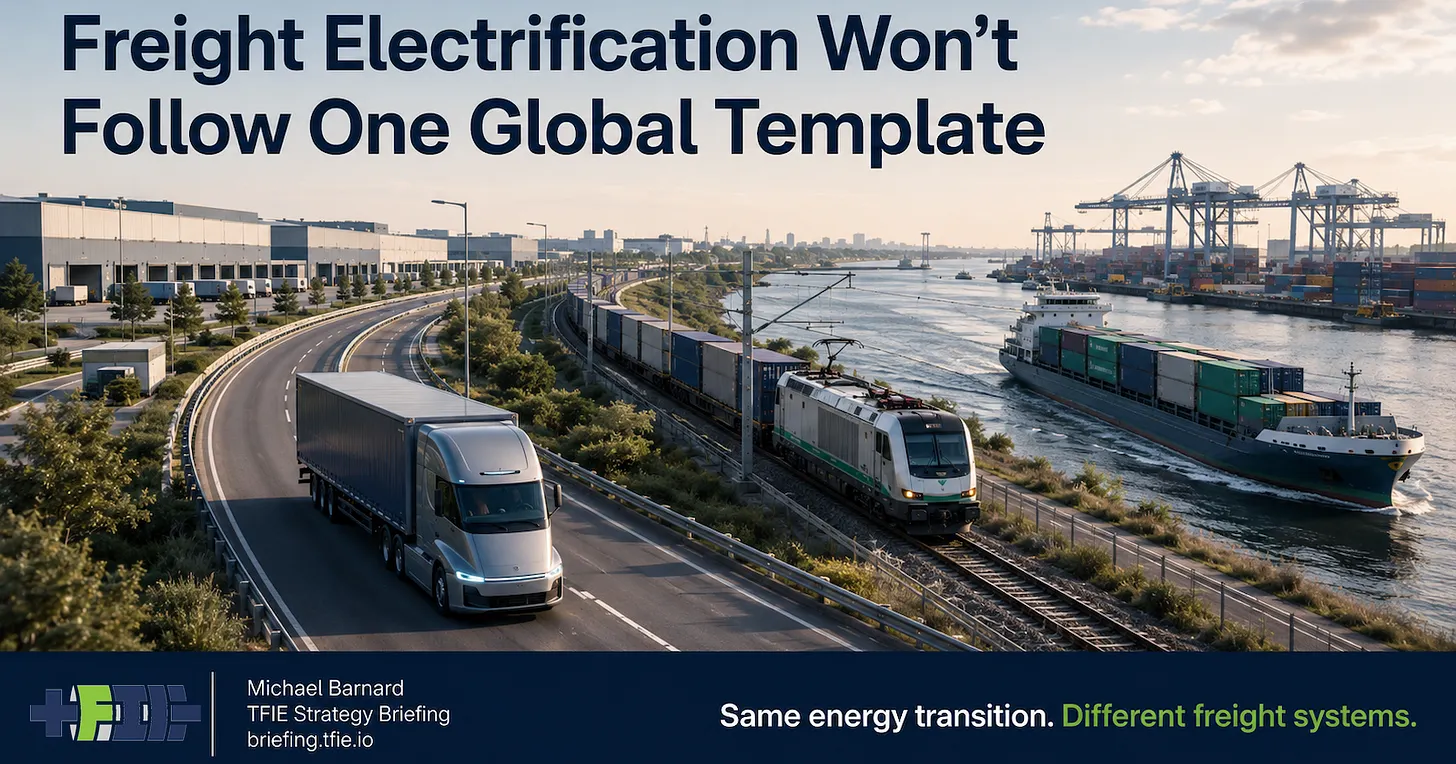
GLOBAL — Plummeting battery costs are universally pushing the freight sector toward electrification, but the transition will not follow a single, standardized blueprint. Instead, the pace, capital decisions, and technological adoption rates of the green logistics revolution are being dictated by inherited national infrastructure.
According to recent industry analysis, how major economies move domestic cargo—the delicate, often century-old balance between road, rail, and water systems—will fundamentally shape how and where electricity enters the freight system through the 2030s.
Main Facts
The foundational driver of the global freight transition is the steep, continuous decline in lithium-ion and alternative battery production costs. However, freight transportation does not begin from a universal starting point. China, India, Europe, and the United States move domestic cargo through vastly divergent infrastructural mixes. Consequently, identical battery-cost curves will trigger entirely different capital investment decisions across these regions.
- China leads the world in industrial-scale adoption of electric heavy-duty transport, supported by a balanced modal split of roughly 44% road, 20% rail, and 36% domestic water.
- India relies heavily on road transport (69%), complemented by 23% rail and 8% water, while aggressively expanding its electrified Dedicated Freight Corridors (DFCs).
- Europe maintains a modal split of approximately 54% road, 12% rail, and 34% inland water freight. Despite having an expansive rail network, road freight has paradoxically gained ground over the last decade.
- The United States features a split of roughly 53% road, 36% rail, and 10% water. It boasts a commercially vital, highly efficient freight rail network that remains overwhelmingly powered by diesel.
While the overarching direction is absolute—fossil fuels are systematically leaving road, rail, and domestic waterways—the mechanics of how electricity replaces them vary profoundly based on local geography.
Chronology of the Freight Transition
The global transition toward electrified cargo transport is unfolding through distinct regional timelines, driven by policy targets, infrastructure milestones, and market readiness.
2014–2024: Europe’s Road Dominance Despite Rail Infrastructure
Over the decade leading up to the mid-2020s, the European Union maintained more than 200,000 kilometers of rail lines, much of it electrified. However, structural and market pressures caused road transport to capture an additional 3.3 percentage points of inland freight share, illustrating that physical infrastructure alone does not guarantee modal preference.
2023–2026: India’s Dedicated Freight Corridor Expansion
India accelerated its logistics overhaul by completing approximately 2,800 kilometers of Dedicated Freight Corridors (DFCs). By early 2026, these high-capacity corridors were handling roughly 480 freight trains per day, leveraging the country’s nearly 100% electrified broad-gauge railway network to improve logistical competitiveness against trucking.
2026: China’s Industrial-Scale Leap in New-Energy Trucks
China’s transition shifted into high gear during the first half of 2026, recording sales of approximately 140,000 new-energy heavy trucks—a staggering 78.6% increase year-over-year. This surge demonstrated that industrial adoption is no longer theoretical but a deployed commercial reality, backed by aggressive state targets aiming for 40% new-energy heavy truck sales by 2030.
2025–2035: The U.S. Tipping Point and Total Cost of Ownership Parity
In the United States, the timeline is defined by long-duration capital planning. While freight rail has historically dominated long-distance, dense-cargo hauling, emerging data from the National Renewable Energy Laboratory (NREL) projects that zero-emission battery-electric trucks will achieve total-cost-of-driving (TCD) parity across key market segments by 2035, forcing a re-evaluation of long-haul logistics.
Supporting Data: Comparative Modal Splits and Market Metrics
To understand why different regions are taking disparate routes to electrification, analysts rely on modal split data—the percentage of domestic freight work divided between road, rail, and water.

Regional Modal Splits (Estimates & Harmonized Datasets)
- China (2025 Estimates):
- Road: 44%
- Rail: 20%
- Domestic Water: 36%
- European Union (EU-27 Recombined Datasets):
- Road: 54%
- Rail: 12%
- Internal Water: 34%
- India (NITI Aayog Modeling Baseline):
- Road: 69%
- Rail: 23%
- Water: 8%
- United States (Reconstructed Comparison – Lower Confidence):
- Road: 53%
- Rail: 36%
- Water: 10%
Key Performance Indicators Across Markets
- China Heavy-Duty Market: ~140,000 new-energy heavy trucks sold in H1 2026 (a 78.6% year-over-year increase). The national target is set at 40% new-energy heavy truck sales annually by 2030, supported by widespread battery-swapping and fast-charging corridors.
- India Rail Capacity: ~2,800 km of DFCs operational by 2026, processing ~480 freight trains daily to relieve congested mixed-traffic lines.
- European Union Registration: Electrically chargeable trucks above 3.5 tonnes captured 4.2% of total EU registrations in 2025, signaling the nascent stages of heavy commercial EV adoption.
Official Responses and Strategic Perspectives
Logistics experts, policy modelers, and industrial strategists emphasize that battery costs are global, but freight geography is profoundly local.
Industry analysts tracking the logistics transition note that China possesses a distinct structural advantage: it can aggressively electrify its massive truck fleet while simultaneously utilizing its robust rail and inland water networks to shift heavy, long-distance bulk.
In India, government-backed think tanks like NITI Aayog view electrification as a dual challenge. While the nation’s broad-gauge railway network is nearly completely electrified, electrification alone does not naturally pull cargo off the highways. Indian policymakers stress that structural interventions—such as dedicated freight corridors, higher axle loads, and guaranteed schedules—are mandatory to make rail a commercially viable alternative to road transport.
In Europe, transportation authorities face a unique paradox. Despite housing an extensive, interconnected rail grid spanning hundreds of thousands of kilometers, economic and operational realities have favored road transport expansion. Consequently, European strategy documents underscore a dual mandate: the EU must simultaneously optimize and modernize its existing electric rail network while aggressively deploying megawatt-scale charging infrastructure for the road freight sector, which cannot be entirely replaced by rail.
Meanwhile, in the United States, freight rail operators and energy modelers are locked in a strategic debate. U.S. freight rail has historically enjoyed immense advantages in labor productivity, fuel efficiency, and long-haul movement of dense commodities. However, as NREL modeling suggests, battery-electric trucks are closing the operating-cost gap. Rail operators are increasingly pressed to explore battery-electric and hydrogen locomotive technologies rather than keeping rail technology static while road competitors rapidly decarbonize.
Implications for the 2030s and Beyond
The convergence of falling battery prices and climate mandates guarantees that the global logistics sector will shed fossil fuels. However, the downstream implications of this transition will reshape international trade competitiveness, infrastructure spending, and energy grid demands over the coming decade.
1. Divergent Capital Expenditure Requirements
Regions with high rail and waterway shares (like China) can distribute the electrification burden across multiple transport modes, potentially reducing the strain on highway charging grids. Conversely, road-heavy regions (such as India and the United States) must invest heavily in roadside megawatt-charging stations, high-capacity grid connections, and local microgrids to support continuous fleets of heavy electric trucks.
2. The Rail Dilemma
For rail-dominant systems like those in the United States, the rise of cost-competitive electric trucking poses a long-term competitive threat. If Class I railroads fail to adopt alternative propulsion technologies (such as battery-tender cars or overhead catenary lines where economically viable), they risk losing high-value intermodal freight to the expanding electric trucking corridor ecosystem.
3. Infrastructure as Destiny
Ultimately, the thesis emerging from global logistics data is clear: infrastructure is destiny. While global supply chains benefit from universally cheaper energy storage, regional topography, population distribution, and historical investments will dictate whether electricity enters the freight system primarily via highway chargers, overhead rail wires, or electrified inland waterways.
As the world marches toward 2030, the race to decarbonize freight will not be won in battery laboratories alone, but on the asphalt, steel, and water routes where the rubber meets the rail.
