

By Karen Greenspan
Main Facts: The Embodied Practice of Vajrayana Sacred Dance
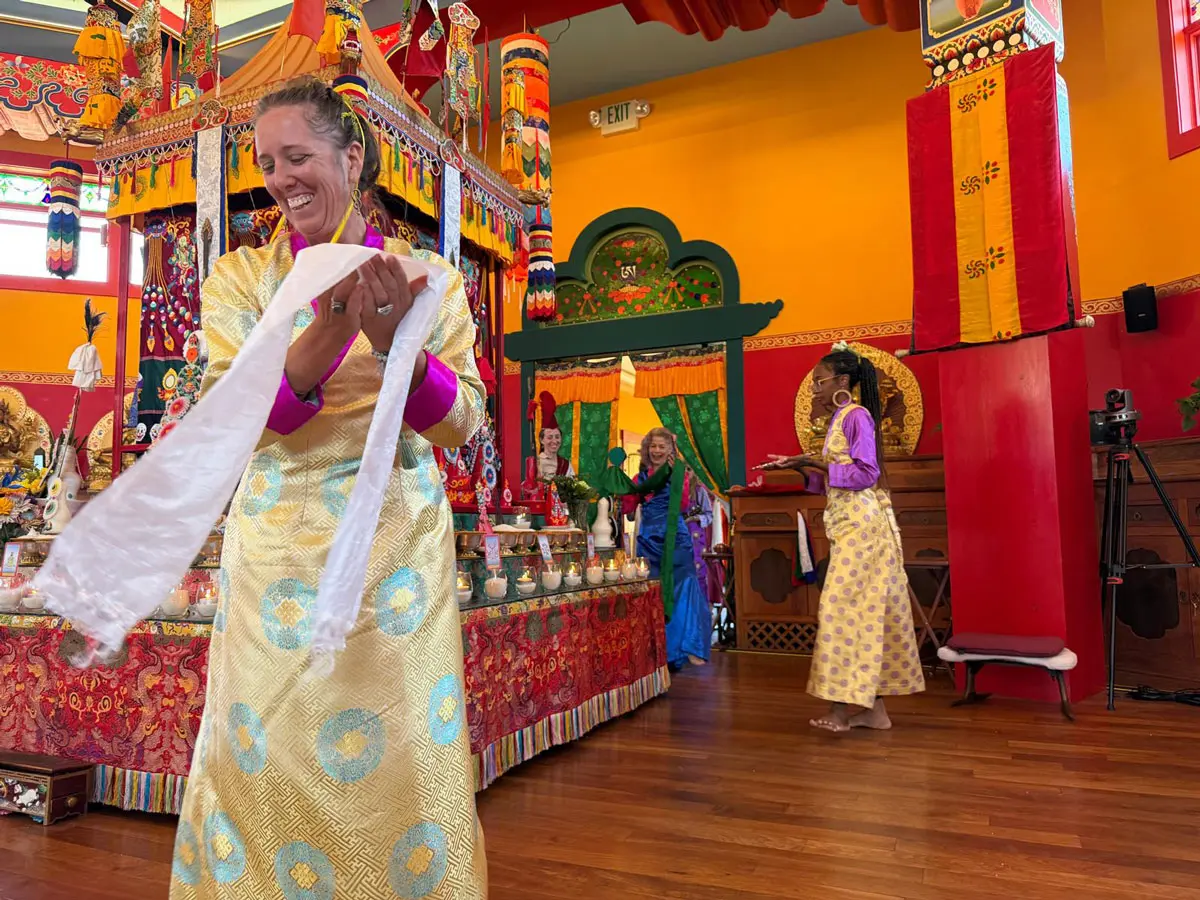
In prayer halls and monasteries stretching from the snow-capped peaks of the Himalayas to Western dharma centers, a vibrant and ancient tradition is unfolding. Dancers weave a graceful grapevine step, holding objects of enjoyment mounted on colorful ceremonial scarves—musical instruments, flowers, and perfume. Adorned in long, bright silk Tibetan gowns, practitioners circle ritual mandalas in a mesmerizing physical expression known as inner offering.
This sacred choreography forms a core component of rituals such as the "Chotreng" (Garland of Offerings), performed during communal periods of spiritual accomplishment like the White Dakini Drupchen. Through synchronized hand mudras, sung liturgy, and dynamic movement, practitioners visualize offering and receiving sixteen splendid gifts. Multiplied through the agency of Wisdom Goddesses, these gestures transform physical motion into a vehicle for cultivating generosity—one of the six transcendent qualities, or paramitas, of Vajrayana Buddhism.
Far from being mere cultural performance, sacred dance (cham in Tibetan, or charya nritya in Newar traditions) is a foundational technology of the sacred. As the Nyingma master Thinley Norbu Rinpoche (1931–2011) famously observed, "In the precious Vajrayana tradition, in which the offering of dance is practiced, everything is turned into virtue, including all movement."
Chronology and Historical Roots: From Vedic Rituals to Himalayan Monasteries
To understand the evolution of sacred dance, one must look far back into antiquity, tracing a developmental arc that bridges ancient South Asian traditions with modern Buddhist practice.
The Vedic and Early Foundations (c. 1500 BCE – 700 CE)
Vedic wisdom and practice provided the foundational architecture for ritual conventions that were later absorbed into early Buddhism. The Vedas—sacred philosophical texts composed between 1500 and 1200 BCE—attest to a pre-Buddhist cultural context where music, dance, and spiritual contemplation were inextricably linked. The Yajur Veda, a compilation of rituals and offering formulas, highlights the rhythmic recitation of mantras. By 700 CE, Indian commentators had systematized Vajrayana deity yoga, incorporating physical mudras and Sanskrit recitations into visualization techniques designed to invite divine presence.
The 8th Century: Introduction to the Himalayas
The spiritual lineage took deep root in the Himalayas during the mid-8th century, when the Indian tantric master Guru Padmasambhava (Guru Rinpoche) brought Buddhism to Tibet and Bhutan. Guru Rinpoche established the ritual framework that continues to inspire celebratory dances like "Zheng Zhik Pema," invocations designed to summon divine presence and evoke the pure realms of the Glorious Copper-Colored Mountain Paradise.
The Medieval Era and Newar Traditions (11th – 13th Century)
In the Kathmandu Valley of Nepal, Newar vajracharyas (non-monastic priests) preserved a yogic dance tradition known as charya nritya, or "dance as a spiritual discipline," for over a thousand years. Concurrently, lineage holders like the 11th-century yogi-poet Milarepa and 13th-century treasure revealers like Chokyi Wangchuk (1212–1270) unearthed texts (termas) that integrated spontaneous songs of realization (gurma) and gratitude dances into monastic calendars.
The Modern Era: Democratization and Global Reach (20th Century – Present)
For centuries, sacred cham was performed exclusively by male monastics. However, over the past twenty years, a profound shift has occurred. Female practitioners and nuns in both Himalayan nunneries and Western dharma centers have been invited to perform complex wisdom-goddess dances, marking a historic turning point in the accessibility and execution of these sacred arts.
Supporting Data and Regional Traditions
The execution of sacred dance varies across regions, serving distinct ritual functions depending on whether the goal is welcoming dignitaries, amplifying auspiciousness, or requesting a master’s longevity.
1. Welcoming the Sacred: Jipai Pawo Cham
In Bhutan, lamas, royalty, and high-ranking guests are welcomed through an escort dance called the "Majestic Hero’s Dance" (Jipai Pawo Cham). Performed by two to four pawo (heroes) flanking the honored guest, the performance features bounding movements and the rattling of damaru drums. Upon arrival, the dancers execute peaceful, semi-wrathful, and wrathful sections as a ritual libation (serkyem) is offered.
2. Amplifying Auspiciousness: The Drukpa Kagyu Nuns
Under the leadership of His Holiness the Twelfth Gyalwang Drukpa, monastic communities—most notably the Drukpa Kagyu nuns at Druk Amitabha Mountain in Kathmandu—frequently integrate dramatic cham into events like the nine-day Avalokiteshvara Drupchen. Beyond formal rituals, these nuns perform gurma (songs of realization) twice a month during feast days, celebrating occasions such as temple consecrations and the completion of long-term retreats.
3. Longevity Rituals: Khandro Tenzhug
To combat the spiritual belief that celestial beings constantly summon great teachers to higher realms, practitioners perform the "Khandro Tenzhug" (Long Life Prayer to the Dakinis). This intricate dance-prayer acts as an offering to allay the celestial call, removing obstacles to ensure the longevity of spiritual masters for the benefit of all sentient beings.
4. The Sixteen Wisdom Goddesses: Rigma Chudruk Cham
Whether manifested as charya nritya in Oregon’s Dance Mandal Temple or the Chotreng at Tara Mandala in Colorado, the "Dance of the Sixteen Wisdom Goddesses" (Rigma Chudruk Cham) unites practitioners in elaborate silk brocade robes and bone ornaments. Performers mime the playing of lutes, flutes, and drums, offering sensual and spiritual delights to the mandala.
Official Perspectives and Institutional Insights
Eminent teachers and scholars emphasize that sacred dance is not performance art in the secular sense; it is an exact science of mind transformation.
A Bhutanese cham master once explained the invocatory power of the tradition to researchers: "Everyone — gods and humans alike — love dance — just as they love flowers. No one can resist the beauty." This aesthetic allure serves a higher purpose: dissolving ego-fixation and cultivating altruistic generosity.
Furthermore, contemporary institutional leaders have intentionally expanded access to these traditions. By empowering female monastics to master and perform dances historically restricted to male orders, modern nunneries—such as Karma Drubdey Nunnery in Bhutan and Druk Amitabha Mountain in Nepal—have reinforced the egalitarian potential of Vajrayana practice. These communities demonstrate that the integration of body, speech, and mind required in sacred dance is universally accessible to all sincere practitioners, regardless of gender.
Implications: Integrating Body, Speech, and Mind for Global Wellbeing
The resurgence and globalization of Himalayan sacred dance carry profound implications for contemporary spiritual practitioners, cultural preservationists, and mental health advocates alike.
Preservation of Endangered Intangible Heritage
As modernization and globalization threaten indigenous traditions across South Asia, the documentation and active practice of cham and charya nritya serve as crucial bulwarks for cultural survival. By training younger generations of monks, nuns, and lay practitioners—both in Himalayan monastic enclaves and Western urban centers—lineage holders ensure that centuries-old choreography, musical scores, and symbolic iconography are not lost to history.
The Somatic Turn in Modern Spirituality
In an era where Western wellness culture increasingly turns toward somatic therapies and mindfulness, Himalayan sacred dance offers a sophisticated blueprint for embodied spirituality. By uniting physical movement, vocal liturgy, and internal visualization, practitioners bypass intellectual rumination, engaging the nervous system directly. The tradition posits that physical movement, when yoked to altruistic intent, can actively dismantle internal negativity and cultivate lasting psychological resilience.
Culmination of Auspiciousness: The Tashi Cham
Ultimately, these traditions find their emotional and spiritual crescendo in dances like the Tashi Cham. Performed by monastics wielding five-colored streamers that represent the natural elements and wisdoms, dancers stomp to crush negativity while swirling their arms to stir up collective joy.
Delivered through body, speech, and mind—the three doors of human expression—these dances conclude with a resounding message of goodwill. As monastics sing of the Five Wisdom Buddhas bringing fortune to all sentient beings, echoing the refrain "How delightful and joyful!", the underlying philosophy becomes clear: just as generosity is a transcendent virtue, the dances that deliver its boundless goodness are offerings of peace for a troubled world.
