

Main Facts
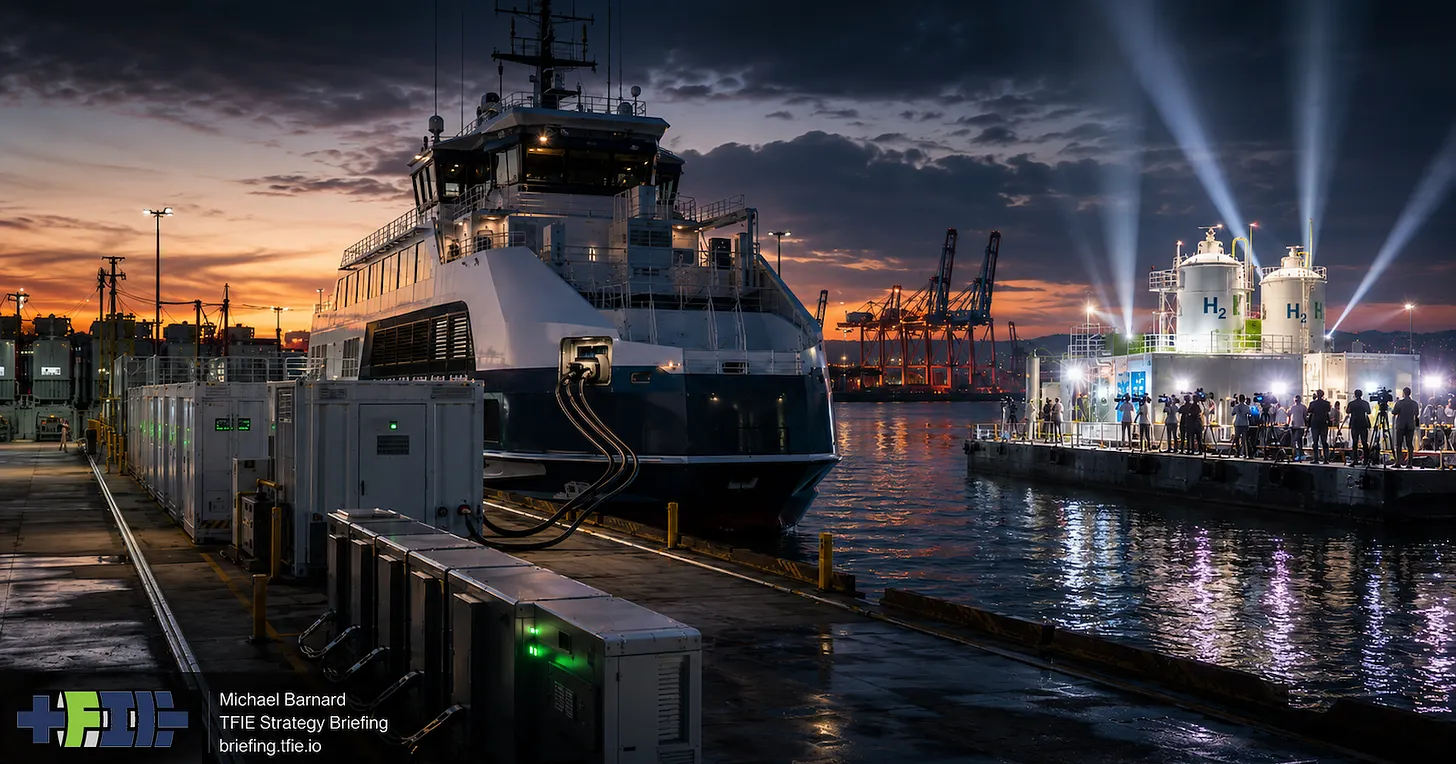
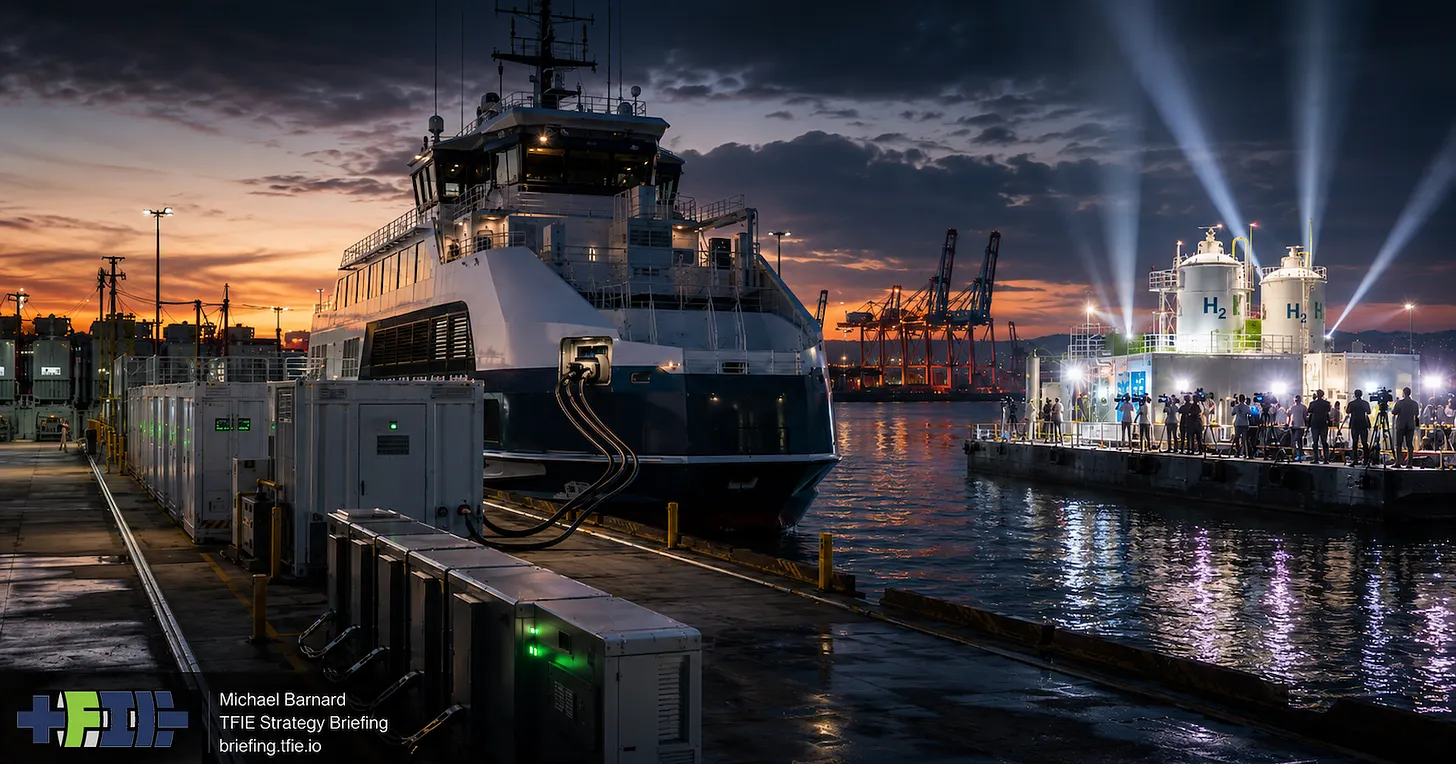
The maritime decarbonization sector is currently caught in a tug-of-war between high-profile technological spectacles and unglamorous, scalable engineering. Recently, at the Port of Tilbury on the River Thames, clean-energy firm GeoPura staged a striking demonstration: they placed a hydrogen power unit (HPU) atop a floating platform to charge a commercial electric vessel. Featuring five Ballard fuel cells delivering a steady 300 kW, the setup was visually captivating. It brought together a barge, specialized hydrogen equipment, and an operational ship, effortlessly generating photographs, press releases, and industry headlines.
However, a closer look reveals a critical nuance: the vessel being charged was not hydrogen-powered. It was a battery-electric ship.
GeoPura’s demonstration proved a well-established scientific principle—that hydrogen can be converted into electricity and fed through a charger into a battery. Yet, it highlights a more pressing, pragmatic question for the maritime industry: why insert an inefficient hydrogen loop into a process that can be achieved more directly?
While hydrogen fuel cells have undeniable utility in remote off-grid locations, construction sites, and emergency backup scenarios where grid access is entirely absent, their deployment at port berths introduces severe thermodynamic penalties. Converting renewable electricity into hydrogen, storing it, transporting it, running it through a fuel cell to turn it back into electricity, and then conditioning it for a ship’s battery results in a massive efficiency loss. According to industry metrics, generating green hydrogen via electrolysis and converting it back to usable power through a fuel cell incurs an efficiency rate where roughly 3.1 MWh of input electricity yields only about 1 MWh of usable electricity.
In contrast, scalable maritime decarbonization increasingly relies on the quieter, less photogenic infrastructure of local grids, stationary storage batteries, power electronics, and routine charging schedules. While transformers and battery banks behind a quay lack the marketing appeal of a hydrogen barge, they represent the actual backbone of the future zero-emission port.
Chronology
To understand how the maritime sector arrived at this crossroads between hydrogen flash and battery substance, it is helpful to look at the timeline of port electrification and alternative fuel trials:
- The Early 2010s – The Rise of Shore Power (Cold Ironing): Ports began seriously adopting "cold ironing," allowing berthed ships to plug into local municipal grids to shut down their auxiliary diesel engines. However, as electric vessels with larger battery packs entered the market, these legacy grid connections quickly proved insufficient.
- The Mid-2010s – The Hydrogen Boom: Fueled by massive investments and government subsidies aimed at heavy transport, the hydrogen economy expanded rapidly. Proponents championed hydrogen and ammonia as the ultimate panaceas for shipping, driving companies to seek out maritime applications for fuel cells, often regardless of whether molecules or electrons were the most efficient energy carrier for the specific task.
- The Late 2010s to 2020s – The Battery Revolution in Short-Sea Shipping: Ferries, tugboats, and harbor craft rapidly adopted direct battery-electric propulsion due to predictable routes and rapid turnaround requirements. This surge exposed a new bottleneck: port-side grid constraints. Berth demands for hundreds of kilowatts or megawatts routinely outstripped local distribution capabilities.
- The Recent Tilbury Demonstration: GeoPura deployed its hydrogen power unit on a floating platform at the Port of Tilbury on the Thames, successfully utilizing five Ballard fuel cells to deliver 300 kW of charging power to a commercial electric vessel via a barge setup.
- Present Day – The Reality Check: Industry analysts and strategy briefings (such as the TFIE Strategy Briefing) have begun pushing back against "demonstration fatigue." Experts are increasingly demanding a pivot away from isolated technological firsts toward repeatable, highly efficient, and economically viable grid and battery infrastructures.
Supporting Data
The debate between hydrogen and direct battery electrification ultimately hinges on hard data, thermodynamics, and the harsh economic realities of port operations.
1. The Efficiency Penalty
- Direct Electrification (Grid-to-Battery): Transmitting electricity from the grid directly through a charger into a vessel’s battery is exceptionally efficient, typically retaining 70% to 90% of the original energy depending on transmission and inverter losses.
- The Hydrogen Loop: The energy chain for hydrogen is vastly more loss-prone. Producing green hydrogen via water electrolysis, compressing or liquefying it for transport, storing it, and then passing it back through a fuel cell yields an end-to-end efficiency of roughly 30%. As noted in technical assessments, it takes approximately 3.1 MWh of initial electricity input to produce just 1 MWh of usable electricity at the final stage.
2. Port Power Constraints and the Peak Load Problem
- Ports face a distinct structural challenge: a single berthed ship may demand several hundred kilowatts or multiple megawatts for a short window during turnaround.
- Local electrical distribution grids are rarely sized to handle these instantaneous, massive spikes without multi-million-dollar infrastructure upgrades that can take years to permit and construct.
- The Battery Buffer Solution: A stationary megawatt-scale battery system at the berth can slowly draw power from a modest, existing grid connection over many hours. When a ship docks, the stationary battery discharges at high C-rates, satisfying the ship’s rapid charging needs without stressing local transformers.
3. Deployment Economics
- A scalable maritime charging network depends on high utilization, predictable tariffs, and infrastructure that compounds in value as more vessels plug in.
- Grids, substations, and buffering batteries are versatile: they can simultaneously charge electric harbor trucks, power refrigerated container racks, supply shore-side buildings, and service electric vessels. Hydrogen fueling infrastructure, by contrast, remains heavily siloed and capital-intensive, requiring dedicated supply chains, high-purity storage vessels, and specialized safety protocols.
Official Responses
Industry stakeholders, clean energy analysts, and infrastructure developers have offered starkly contrasting perspectives on the proper role of hydrogen versus batteries in the maritime transition.
Proponents of mobile hydrogen units, like GeoPura, defend their technology by emphasizing its immediate deployability in areas where the electrical grid simply does not reach. In scenarios involving temporary construction projects, remote off-grid industrial sites, or emergency disaster relief, replacing noisy, polluting diesel generators with zero-emission hydrogen power units provides a genuine, localized environmental benefit.
However, energy economists and infrastructure analysts argue that applying this logic to a commercial port berth is a misallocation of resources. Commenting on the realities of port electrification, transition experts point out that while a hydrogen barge makes for a compelling photo-op, it obfuscates the unglamorous economic truth:
"Tilbury proved that hydrogen can charge an electric ship. Commercial significance will begin when operators can show how many vessels use the system, how many megawatt-hours it supplies, what the delivered electricity costs and whether another port buys one after seeing the numbers."
Furthermore, analysts stress the danger of "demonstration fatigue"—a phenomenon where the industry celebrates endless technological "firsts" while failing to achieve the hard, repetitive deployment numbers required to drive down costs. Without second, third, and hundredth commercial deployments, a string of isolated prototypes ceases to look like innovation and instead signals commercial weakness.

Implications
The lessons learned from the Port of Tilbury and the broader port electrification landscape carry profound implications for the future of global logistics and maritime decarbonization.
Shifting Focus from "Firsts" to Scale
The era of novelty announcements in clean tech is rapidly drawing to a close. Investors, port authorities, and regulatory bodies are increasingly demanding rigorous operational metrics over marketing spectacles. For maritime electrification to succeed, the transition must abandon its reliance on high-cost, low-efficiency loops like green hydrogen when direct alternatives exist. Instead, success will look remarkably ordinary: ships arriving, plugging into robust grid-tied or battery-buffered charging stations, recharging safely, and departing precisely on schedule.
The True Role of Hydrogen in Shipping
This does not mean hydrogen has no place in the maritime sector. While hydrogen is inefficient and economically unviable for short-sea and regional port-side charging where batteries reign supreme, molecules like hydrogen and its derivatives (such as green ammonia or e-methanol) will likely retain a vital role in long-haul, deep-sea shipping. On transoceanic voyages where current battery chemistries are far too heavy and energy-dense alternatives are required, hydrogen-derived fuels remain strong contenders. The error lies in misapplying hydrogen to shoreside operations where direct electrons and stationary batteries can do the job faster, cheaper, and with three times the energy efficiency.
Infrastructure as an Invisible Asset
Ultimately, the future of the zero-emission port will be built on invisible infrastructure. Substations, trench-laid cables, automated plug-in robotics, and behind-the-meter containerized batteries will not win design awards or dominate social media feeds. Yet, they will quietly enable the decarbonization of global trade. As the maritime sector matures, the ultimate metric of success will not be how many headlines a technology generates, but how seamlessly and cost-effectively it keeps the world’s fleets moving.
