

Main Facts
Poland has long been cited by advocates of the clean energy transition as a model for how governments should foster a nascent hydrogen economy. For years, the prevailing wisdom from industry proponents has been that demand creation is the ultimate catalyst: if governments can subsidize the purchase of fuel-cell vehicles and back the development of local refueling infrastructure, a self-sustaining market will naturally follow.
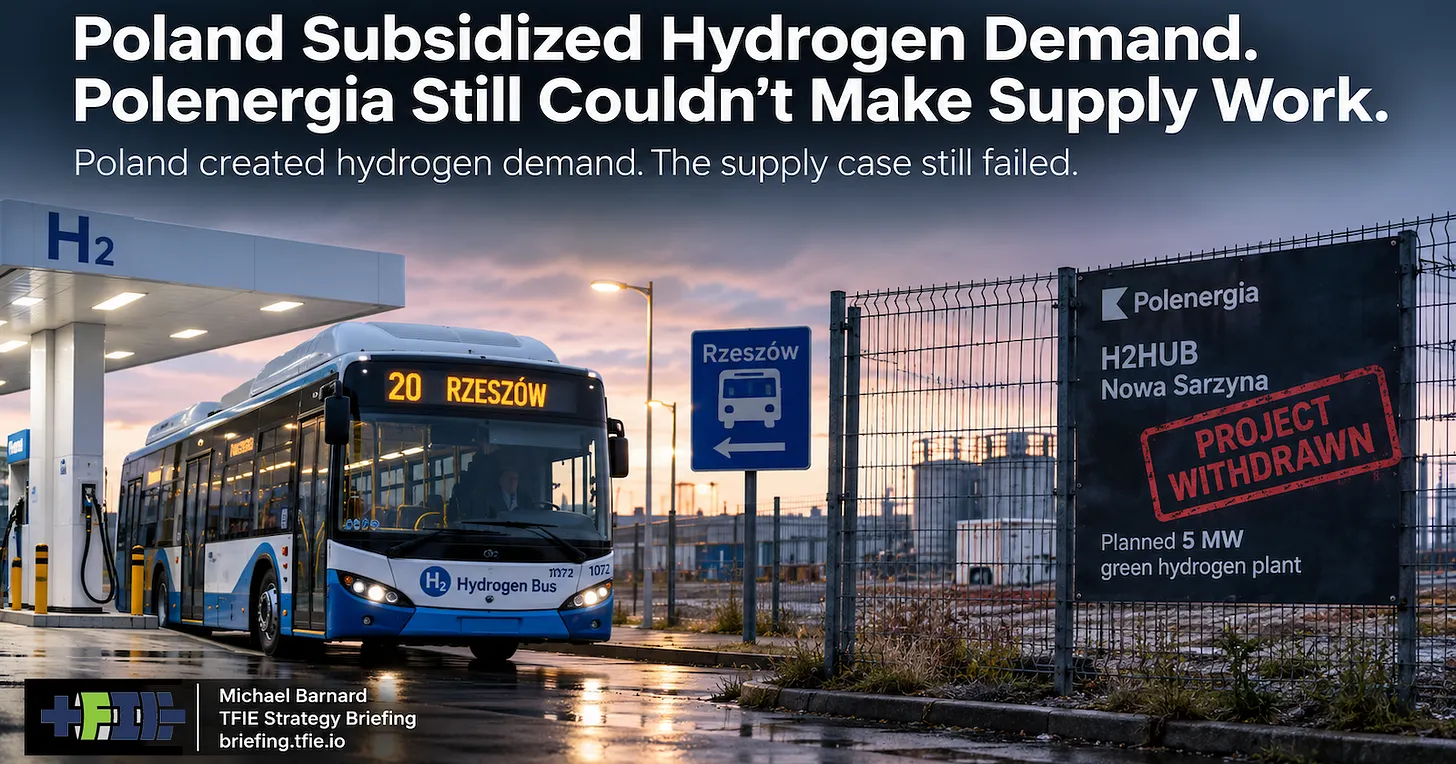
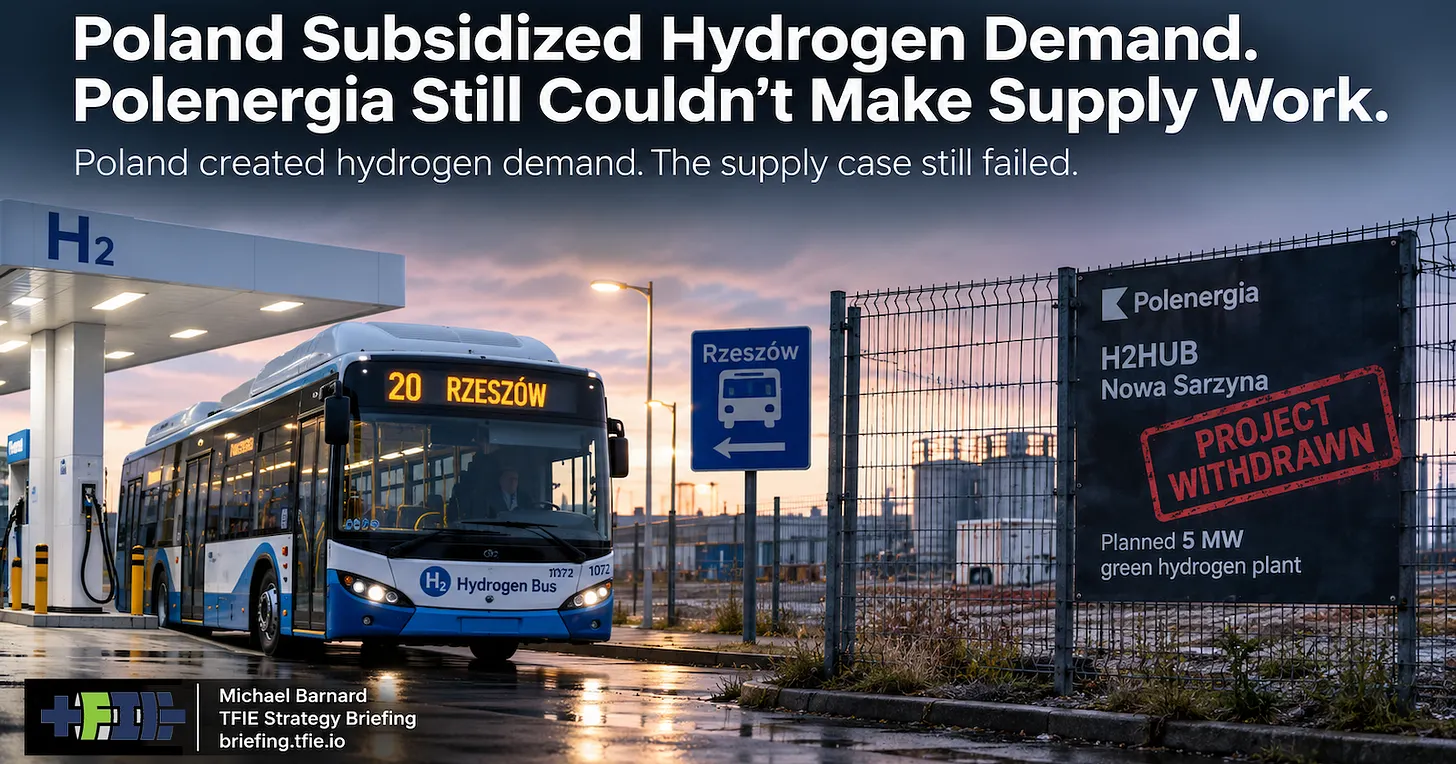
Poland aggressively pursued this industrial-policy playbook. Through a combination of national and municipal public subsidies, the country successfully seeded a burgeoning market for hydrogen-powered public transit. By April 2026, Poland boasted 153 registered hydrogen buses, with 140 actively navigating city streets and another 107 already under contract. What began as speculative, low-volume demonstrations had transformed into a tangible municipal fleet.
Yet, a major stress fracture in this top-down economic model has now been exposed. Polenergia, Poland’s largest private energy group, abruptly walked away from its flagship local green-hydrogen supply project—a venture specifically designed to feed this newly engineered demand.
Polenergia’s retreat is not merely the story of a single canceled corporate contract. It serves as a cautionary case study illuminating the structural disconnect that can occur when government-subsidized transport demand outpaces the economic and logistical realities of local green-hydrogen production. While public subsidies successfully filled city streets with hydrogen-powered buses, they failed to guarantee that a competitive, resilient, and locally integrated supply chain would organically emerge to keep them running.
Chronology of a Hydrogen Venture: From Permit to Pullback
To understand the magnitude of Polenergia’s reversal, one must examine how advanced its Nowa Sarzyna green-hydrogen project actually was. Unlike the countless memorandum-of-understanding (MoU) announcements that routinely populate clean-tech press releases, Polenergia’s initiative crossed multiple operational and regulatory thresholds that few hydrogen projects ever reach.
- The Blueprint: Polenergia conceptualized a 5-megawatt (MW) renewable-hydrogen plant located in Nowa Sarzyna, targeted to produce approximately 500 tonnes of green hydrogen annually. The project included comprehensive plans for localized distribution and refueling infrastructure.
- The Supply Chain: The company secured high-profile partnerships early on. Hystar was officially contracted to supply the project’s advanced electrolyzers, while the International Finance Corporation (IFC) stepped in to back development spending and equipment acquisition costs. Furthermore, Polish public funding was earmarked to support the associated refueling infrastructure.
- Regulatory Milestones (October 2024): The project achieved a major milestone when it secured its official building permit. Simultaneously, all eight electrolyzer stacks successfully completed rigorous factory acceptance testing.
- Securing the Customer (October 2024): Polenergia seemingly crossed the finish line when it secured a buyer. The municipal transit operator in Rzeszów initiated a procurement process for 20 fuel-cell buses, and Polenergia won a highly competitive 15-year fuel-supply tender. The proposed municipal agreement was valued at approximately PLN 120 million.
- The Sudden Pullback (January 2025): Despite having a permitted plant, manufactured equipment, international financial backing, and a 15-year municipal customer, Polenergia abruptly announced it could not conclude the Rzeszów agreement. Citing legal complexities tied to the tender and escalating risks regarding its ability to guarantee on-time hydrogen delivery, the energy giant walked away.
- Strategic Pivot: The decision in Rzeszów was quickly mirrored by a broader corporate reassessment. Polenergia’s updated corporate strategy outlined a deliberate, gradual withdrawal from the hydrogen transportation sector, with subsequent disclosures pointing to persistent green-hydrogen market immaturity, prohibitive investment risks, and restricted financing horizons.
Supporting Data and Economic Realities
The collapse of the Polenergia-Rzeszów agreement highlights a fundamental tension in modern industrial policy: the friction between artificial demand creation and natural market viability.
The Scale of Poland’s Hydrogen Fleet
- Registered Hydrogen Buses (as of April 2026): 153 units.
- Buses Active in Service: 140 units.
- Buses Under Contract: 107 units.
- Target Municipalities: Cities like Poznań, Konin, Wałbrzych, and Rzeszów integrated or planned fuel-cell fleets, leaning heavily on national structural funds and programs managed by the National Fund for Environmental Protection and Water Management (NFOSiW).
The Financial Architecture of the Nowa Sarzyna Project
- Electrolyzer Capacity: 5 MW.
- Annual Output Projection: ~500 tonnes of green hydrogen.
- Value of Rzeszów Tender: ~PLN 120 million for a 15-year supply window.
- Key Stakeholders Involved: Polenergia (developer), Hystar (technology/electrolyzers), International Finance Corporation (financier), and the Municipality of Rzeszów (off-taker).
The Core Economic Dilemma
The underlying logic of Poland’s hydrogen strategy was linear: subsidies buy the buses; the buses create local demand; demand justifies building refueling stations; and the combined infrastructure makes local green-hydrogen production bankable.
However, this linear projection breaks down when confronted with high capital expenditure (CapEx), operating expenditures (OpEx) tied to renewable power price volatility, and stringent timeline penalties in municipal contracts. For Polenergia, the risk-reward ratio of a 15-year municipal contract—pegged to a developing technology stack with unproven long-term operating margins—became unfeasible. The company chose to absorb the sunk development costs rather than expose its balance sheet to decades of operational risk in a fragile transport-hydrogen market.
Official Responses and Stakeholder Perspectives
The abrupt pivot by Poland’s premier private energy group sent shockwaves through the country’s clean energy sector, prompting a re-evaluation from municipal leaders, industrial analysts, and energy executives alike.
Polenergia’s Corporate Justification
In its official communications surrounding the withdrawal, Polenergia emphasized that the decision was rooted in rigorous risk management rather than a generalized rejection of decarbonization. The company pointed to specific legal ambiguities within the municipal tender framework that exposed the supplier to disproportionate liability. Furthermore, executives highlighted the structural challenges of securing long-term project financing for transport-grade hydrogen when upstream renewable power costs and downstream offtake pricing remain volatile.
Municipal Dilemmas: The Case of Rzeszów
For Rzeszów’s municipal transit authority, Polenergia’s withdrawal presented an immediate logistical crisis. Cities that commit to purchasing fuel-cell buses via public grants enter into multi-year operating covenants. Once a municipality takes delivery of hydrogen-fueled buses, it assumes a binding obligation to fuel and operate them, regardless of whether local, low-cost green hydrogen production ecosystems successfully materialize. Rzeszów was forced to scramble for alternative fuel-supply arrangements to honor its fleet commitments, exposing the vulnerability of cities that rely on a single, localized upstream supplier.
The Broader Industrial Divide
Industry analysts observing the Polish market have drawn a sharp distinction between different sectors of hydrogen consumption.

- Hard-to-Abate Industrial Sectors: Poland already consumes substantial volumes of carbon-intensive, fossil-derived (grey) hydrogen in domestic oil refining, chemical manufacturing, and fertilizer production. In these sectors, the molecule is a non-negotiable chemical feedstock. Replacing grey hydrogen with green hydrogen in these established industrial clusters represents a clear, direct decarbonization task where demand is already guaranteed and centralized.
- The Transportation Sector: Hydrogen buses, by contrast, represent an entirely manufactured demand vector. Municipalities adopting fuel-cell buses do so in direct competition with mature, highly efficient, and rapidly scaling direct-electric alternatives (battery-electric buses and overhead trolleybus systems).
Experts argue that while public subsidies can artificially induce a municipal bus fleet, they cannot easily override the fundamental thermodynamic and economic inefficiencies of converting renewable electricity into hydrogen, compressing it, transporting it, and re-converting it in a fuel cell, especially when battery-electric alternatives continue to drop in cost.
Implications for the Future of Hydrogen in Poland and Beyond
The unfolding events in Poland carry profound implications for European industrial policy, energy planners, and private investors navigating the energy transition.
1. The Limits of "Build It and They Will Come"
Poland’s experience demonstrates that successfully subsidizing downstream demand (buses) and upstream components (electrolyzers) does not automatically stitch together a functional, risk-balanced commercial ecosystem. If regulatory frameworks, municipal tender laws, and financing structures do not insulate private developers from extreme operational risks, even the most advanced projects—complete with building permits and tested hardware—will stall.
2. The Trap of Municipal Lock-In
Cities must exercise extreme caution when committing to hydrogen public transit infrastructure. Subsidies can successfully offset the high initial purchase price of a fuel-cell bus, but they do not subsidize the fuel pump price over a 15-year operational lifecycle. When local supply projects fail, municipalities are left vulnerable to high logistics costs, long-distance fuel hauling, and supply chain fragility.
3. Prioritizing Industrial Decarbonization Over Niche Transport
Polenergia’s strategic retreat suggests a broader market correction is underway. Private capital is increasingly recognizing that green hydrogen deployment should perhaps prioritize heavy industry, refining, and chemical feedstock replacement where economies of scale are immediate and alternatives are scarce. For light and heavy urban transit, battery-electric technology has largely established a dominant economic and operational lead, leaving hydrogen buses to fight an uphill battle for commercial relevance.
Ultimately, Poland’s bold experiment has provided the clean energy sector with an invaluable, albeit harsh, lesson. Pushing green-hydrogen technology out of the laboratory and onto the streets requires more than just political will and initial capital grants; it demands a resilient, economically viable supply chain that can survive the collision between utopian industrial policy and hard market reality.
