

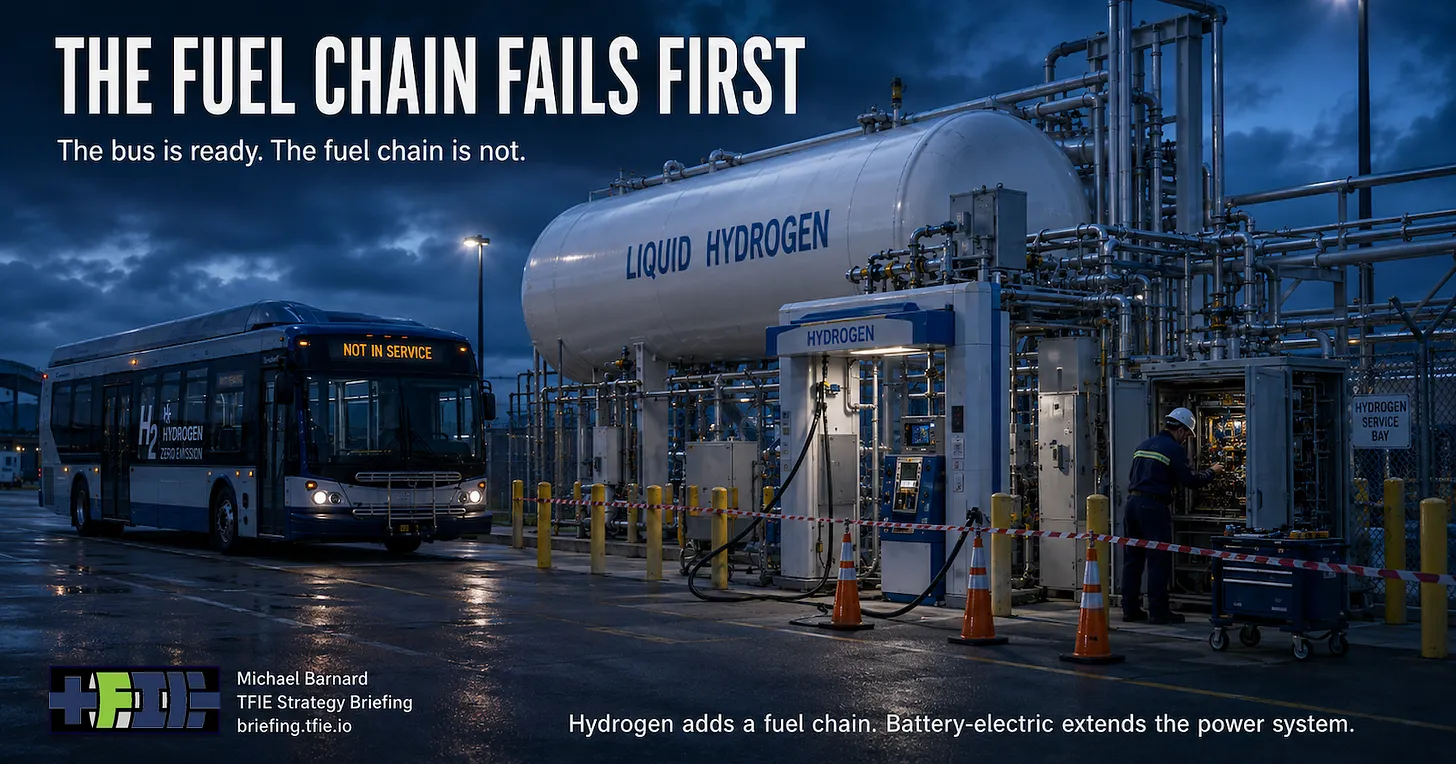
When transit agencies embark on the transition to zero-emission fleets, public announcements typically emphasize grand environmental goals, futuristic technology, and sleek vehicle designs. However, the hardware that carries passengers is only the most visible tip of a massive, complex operational iceberg.
The Orange County Transportation Authority (OCTA) in Southern California offers a stark, cautionary masterclass in this reality. OCTA is currently pushing forward with a $27.6 million investment in hydrogen infrastructure to scale its fuel-cell electric bus (FCEB) fleet from 10 to roughly 50 vehicles. On paper, it reads like standard, progressive fleet growth. In practice, it represents a doubling down on a fragile, costly, and high-risk energy pathway—especially when evaluated against the agency’s own successful deployment of battery-electric buses (BEBs).
OCTA’s turbulent history with hydrogen reveals that investing in fuel-cell buses without absolute certainty regarding long-term, independent fuel supply and infrastructure partnerships can paralyze a transit network. With total refueling expenditures soaring past $100 million, the agency’s struggles illuminate a broader, uncomfortable truth for the public transit sector: hydrogen transit depends entirely on a fragile, specialized supply chain that extends far beyond the bus itself.
Main Facts: The Anatomy of a Fuel-Cell Breakdown
To understand the friction surrounding OCTA’s latest infrastructure injection in Garden Grove, one must look at the foundational economics and engineering realities of hydrogen transit.
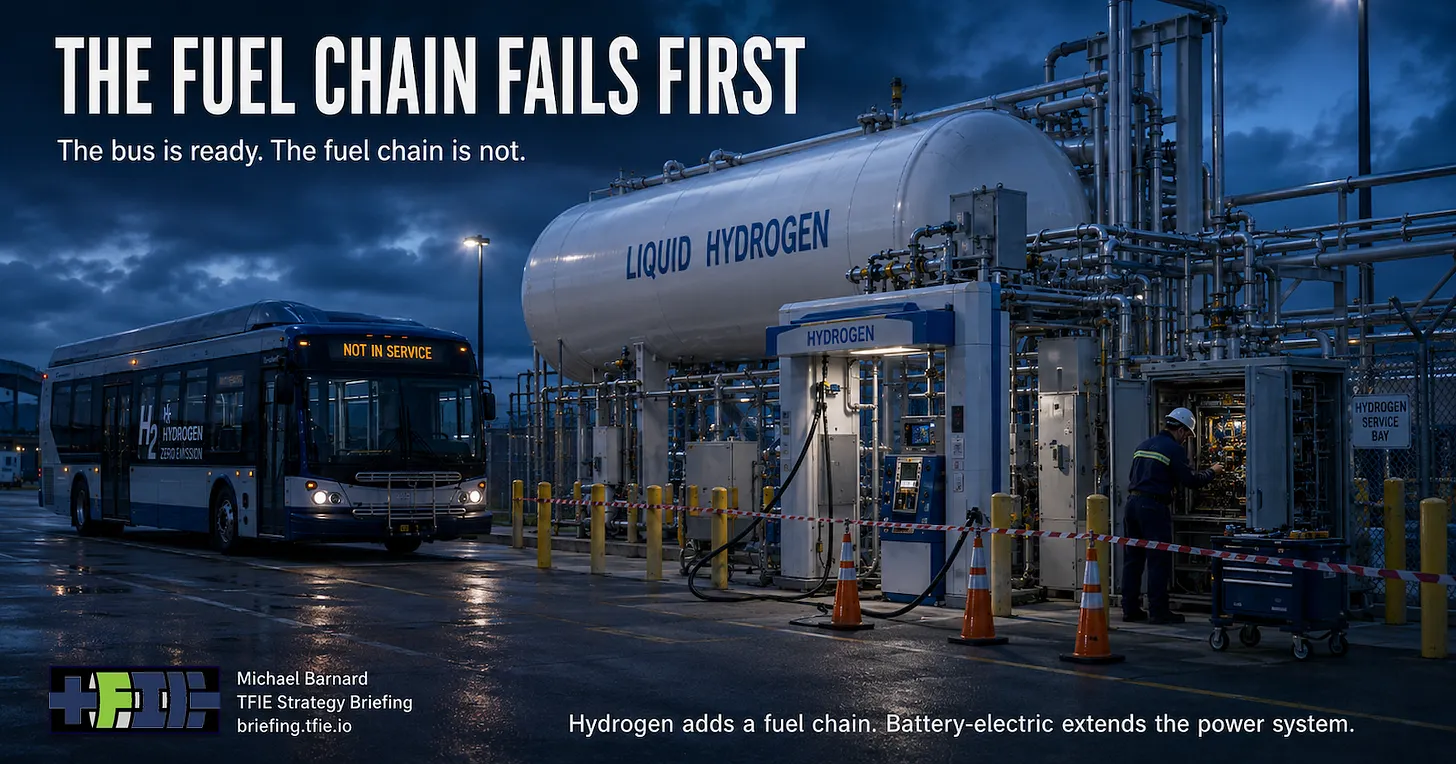
A fuel-cell bus can be mechanically flawless, possessing years of remaining structural and mechanical service life, yet be rendered completely useless if the fuel pathway behind it collapses. Unlike conventional diesel or even battery-electric infrastructure, hydrogen requires an entire secondary energy-delivery ecosystem. This includes:
- Bulk production (green, blue, or grey hydrogen)
- Specialized compression or liquefaction facilities
- Cryogenic or high-pressure over-the-road transport
- On-site storage vessels, vaporizers, and dispensers
- Specialized maintenance and safety protocols
When any single link in this chain snaps, the buses stop rolling. This was precisely the vulnerability exposed at OCTA’s Santa Ana base. The agency did not merely experience a minor maintenance hiccup; it suffered a complete structural failure of its fuel supply model.
Despite managing a modest fleet of just 10 hydrogen fuel-cell buses, OCTA discovered that owning the vehicles is the easy part. Securing a reliable, affordable, and genuinely low-carbon supply of hydrogen over a 12- to 15-year vehicle lifecycle is an entirely different operational mountain to climb. By contrast, battery-electric buses leverage an existing, ubiquitous electrical grid that already powers industrial, commercial, and residential sectors throughout the region. While depot power upgrades for large-scale battery fleets are far from trivial, they plug into a resilient, permanent utility network rather than requiring a proprietary, bespoke chemical supply chain.
Chronology: A Timeline of Stalled Progress and Escalating Costs
The timeline of OCTA’s hydrogen initiative highlights how quickly a promising pilot program can spiral into an operational and financial quagmire.
- 2020: OCTA proudly opens a substantial hydrogen fueling station at its Santa Ana base. Built to accommodate roughly 40 to 50 buses per day, the facility is heralded as a cornerstone of the agency’s transition toward a zero-emission future.
- 2024: OCTA’s initial fleet of 10 fuel-cell buses manages a combined total of 270,462 operational miles. While modest, the fleet is actively testing the waters of hydrogen transit integration.
- Late 2025 / January 2026: Commercial negotiations between OCTA and its primary hydrogen partner, Air Products, completely break down. The dispute centers on the commercial terms covering leased liquid-hydrogen equipment. Unable to reach a sustainable agreement, Air Products forcibly removes its storage tank and vaporizers in January 2026.
- 2025–2026: The operational impact is catastrophic. Deprived of an on-site depot fuel system, OCTA’s hydrogen bus mileage plummets by nearly 95%. The fleet records a meager 14,232 miles in 2025. To keep the buses moving at all, the agency is forced into expensive stopgap measures, relying on off-site commercial stations and temporary mobile fueling units.
- Mid-2026: Rather than reassessing the viability of hydrogen in light of the Santa Ana collapse—as other agencies, such as Aberdeen in the United Kingdom, have done when faced with insurmountable hydrogen hurdles—OCTA doubles down. The agency approves a $27.6 million contract for a new hydrogen station and associated infrastructure in Garden Grove, pushing total cumulative refueling expenditures past the $100 million mark as it targets a 50-bus hydrogen fleet.
Supporting Data: Hydrogen vs. Battery-Electric Performance
The most compelling aspect of OCTA’s operational data is the internal control group the agency accidentally created. Because OCTA operates both hydrogen fuel-cell buses and battery-electric buses simultaneously, industry analysts do not have to rely on hypothetical models to compare the two zero-emission technologies. They can look directly at OCTA’s internal metrics.
The comparative operational reality is striking:
- Zero Lost Deployments Due to Charging: Throughout the period when OCTA’s hydrogen fueling capabilities ground to a near-halt, the agency reported zero lost bus deployments due to unavailable battery-charging infrastructure.
- Capital Cost Disparities: OCTA’s battery-bus charging infrastructure required an initial capital investment of approximately $6 million. Meanwhile, cumulative hydrogen fueling expenditures for a fraction of the operational reliability have ballooned past $100 million.
- Mileage Collapse: The 95% drop in hydrogen bus mileage between 2024 (270,462 miles) and 2025 (14,232 miles) underscores how vulnerable a small fleet is when tied to a single, fragile supply contract. The battery-electric fleet experienced no equivalent systemic paralysis.
These figures illustrate a fundamental procurement lesson: the true cost of a zero-emission transit vehicle cannot be calculated by looking at the sticker price of the bus alone. It must factor in the total cost of building, maintaining, and insuring a resilient energy delivery pipeline over the lifetime of the asset.
Official Responses and Stakeholder Perspectives
The debate surrounding OCTA’s trajectory highlights deep ideological and pragmatic divisions within California’s public transit sector.
Proponents of the agency’s ongoing hydrogen expansion—including state-level grant allocators and traditional heavy-duty vehicle advocates—argue that hydrogen remains a vital technology for heavy-duty transit. They point to the faster refueling times of fuel-cell buses compared to legacy battery-electric charging, as well as the potential for hydrogen to handle grueling, high-mileage suburban routes without mid-day recharging constraints. From this perspective, the Garden Grove project is framed as a necessary evolution: a move toward greater capacity, multi-vendor redundancy, and modernized infrastructure that will stabilize the agency’s fuel supply once and for all.
Conversely, clean-energy analysts and transit procurement watchdogs view OCTA’s pivot in a much harsher light. Industry experts have criticized the agency for demonstrating "hydrogen fever"—a phenomenon where transit authorities continue pouring capital into hydrogen programs due to sunk-cost fallacies and historical grant structures, even when empirical data points unmistakably toward battery-electric superiority.

Critics argue that spending $27.6 million on a new Garden Grove station to rescue a troubled 50-bus fleet—after the Santa Ana facility was dismantled by Air Products—is a strategic failure. They point to international precedents, such as the municipal transit network in Aberdeen, Scotland, which pragmatically wrote off its troubled hydrogen bus fleet and redirected resources toward scalable battery-electric solutions when the local hydrogen supply chain proved economically unviable.
Implications: Lessons for the Future of Public Transit Procurement
The fallout from OCTA’s infrastructure crisis carries profound implications for transit agencies across North America and around the globe. As federal and state governments pour billions of dollars into zero-emission vehicle transitions, procurement officers must confront the hard lessons emerging from Orange County.
1. The Danger of Proprietary Dependency
When a transit agency relies on specialized, leased chemical infrastructure (such as liquid hydrogen tanks, proprietary vaporizers, and single-source industrial gas suppliers), it subjects itself to severe commercial risks. If negotiations stall or a supplier decides to exit a regional market, the transit agency is left holding multi-million-dollar rolling stock that cannot be fueled. Procurement frameworks must ensure open-access infrastructure and robust, long-term supply guarantees before a single fuel-cell bus is ordered.
2. Evaluating Total System Costs
A bus is not an isolated asset; it is the terminal node of an energy delivery network. Agencies must evaluate whether they have the institutional capacity and financial staying power to sustain a secondary energy-delivery system. While battery-electric transit presents its own hurdles—notably heavy-duty depot grid upgrades—it taps into an existing, regulated, and universally expanding electrical utility grid. Hydrogen requires managing a hazardous, energy-intensive chemical supply chain alongside regular transit operations.
3. Sunk-Cost Fallacies in Public Policy
OCTA’s trajectory demonstrates how subsidy-supported fleets can create dangerous momentum. Once an agency secures initial grants to purchase a handful of hydrogen buses, political and institutional pressure often forces it to chase those failing assets with tens of millions of dollars in fresh infrastructure funding rather than cutting its losses.
Conclusion
The Orange County Transportation Authority’s ongoing struggles with hydrogen infrastructure serve as a definitive warning flare for the public transit industry. As the agency breaks ground on its new Garden Grove facility, transit planners everywhere must ask themselves a fundamental question: Is it wise to establish and maintain a complex, fragile, multi-million-dollar chemical supply chain for a niche fleet, when a simpler, cheaper, and more reliable alternative is already humming quietly in the next bay over?
Until the hydrogen sector can guarantee the kind of frictionless, independent, and cost-effective fuel delivery that electricity grids provide by default, transit agencies diving headfirst into hydrogen may find themselves stranded at the depot—with millions spent, and nowhere to go.
