

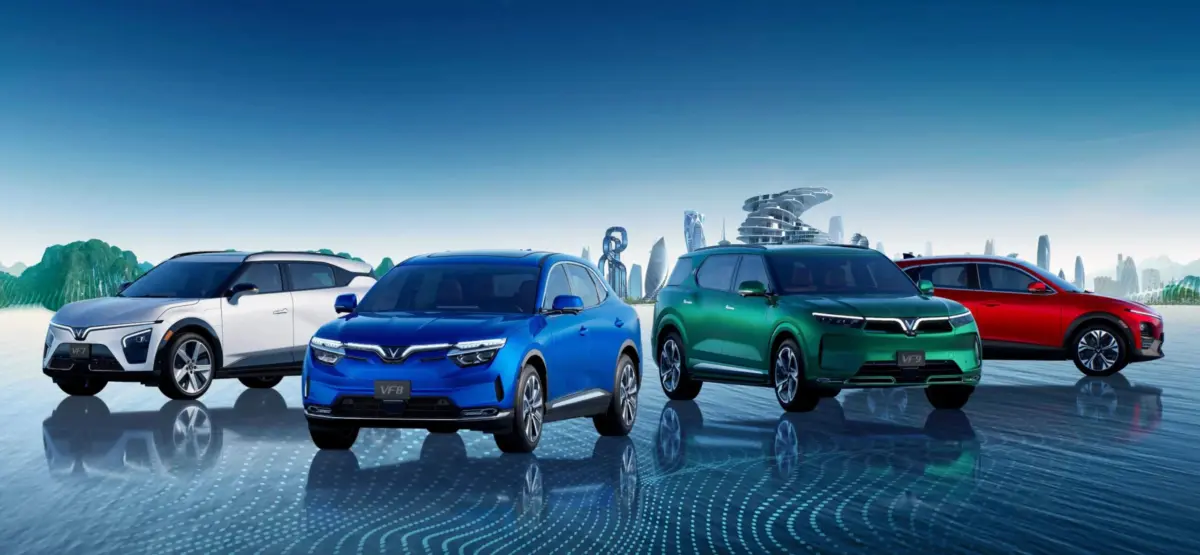
Main Facts
Electric vehicle manufacturer VinFast has posted remarkable domestic sales figures for July 2026, delivering 21,781 electric vehicles within Vietnam. This performance represents a 21.3% increase compared to June’s deliveries of 17,955 vehicles, pushing the company’s total sales for the first seven months of the year to 137,697 units.
The numbers place VinFast firmly on track to eclipse its record-breaking performance from the previous year. In 2025, the company delivered 175,099 vehicles in Vietnam, representing roughly 29% of the country’s total reported automobile market of 604,134 vehicles (compiled from VinFast, members of the Vietnam Automobile Manufacturers Association, and Hyundai Thanh Cong).
Rather than relying purely on high-end luxury models or premium passenger SUVs, VinFast’s growth is anchored in a diverse lineup of compact cars, high-mileage commercial vehicles, and urban alternatives designed to replace traditional gasoline-powered cars and even motorcycles. Models like the compact VF 3, the multi-purpose Limo Green, and the ultra-affordable Minio Green are driving a fundamental shift in how Vietnam approaches everyday mobility.
Chronology
- Throughout 2025: VinFast cements its dominance in its home market, delivering 175,099 vehicles—accounting for approximately 9 deilvered units out of every 10 globally—and capturing nearly 29% of Vietnam’s reported automotive market. This performance outpaces major traditional automakers like Toyota, which delivered 71,954 vehicles in the country over the same period.
- June 2026: VinFast reports robust monthly figures with 17,955 vehicle deliveries, setting the stage for a strong summer acceleration.
- July 2026:
- Monthly deliveries surge by 21.3% month-over-month to reach 21,781 units.
- Cumulative year-to-date sales reach 137,697 vehicles—already equivalent to 79% of total 2025 domestic deliveries.
- The compact VF 3 leads monthly sales with 5,564 units delivered (bringing its year-to-date total to 29,345).
- The commercial-focused Limo Green maintains its crown as the top-selling model year-to-date, hitting 32,331 total deliveries with 4,404 units sold in July alone.
- VinFast opens reservations for the ultra-small VF 2 model, securing an impressive 28,742 reservations by the end of the month.
- August 2026 (Upcoming): VinFast schedules the official commencement of deliveries for its new-generation VF 8.
- September 2026 (Expected): Customer deliveries for the highly anticipated, reservation-heavy VF 2 are slated to begin.
Supporting Data
A granular look at VinFast’s sales data reveals clear patterns regarding consumer and commercial demand in Vietnam. The brand’s diverse portfolio addresses multiple tiers of the transportation ecosystem simultaneously:

- Commercial Fleet Dominance: The Limo Green, a seven-seat electric MPV tailored for taxi and ride-hailing services, leads the company’s year-to-date sales with 32,331 deliveries (including 4,404 in July). Combined with the VF 5 and its Herio Green commercial variant (which added 4,407 deliveries in July for a seven-month total of 24,574), commercial applications have become a massive revenue and volume engine.
- Compact Urban Mobility: The small VF 3 led all individual models in July with 5,564 units delivered, bringing its yearly total to 29,345. Meanwhile, the tiny four-seat Minio Green recorded 2,429 deliveries in July following a strategic price reduction to 188 million Vietnamese dong (approximately $7,100 USD).
- Mid-to-Large Passenger Vehicles: The VF 6 and VF MPV 7 sustained steady momentum, registering 1,993 and 1,674 deliveries respectively in July, pushing their year-to-date totals to 16,038 and 10,851 units.
- Market Benchmarks: While Vietnam’s broader auto market includes uncounted luxury and imported brands (particularly an influx of Chinese manufacturers), reported sales data puts VinFast’s historical market share at roughly 29%. To put this in perspective, VinFast’s 2025 deliveries were nearly double its 2024 volume, dwarfing legacy competitors like Toyota (71,954 units in 2025). Furthermore, domestic sales traditionally make up about 90% of VinFast’s global output, underscoring how vital the local market is to the company’s financial and operational health.
Official Responses and Strategic Direction
While VinFast has broad global ambitions—including establishing manufacturing footprints and retail networks overseas—company executives and market analysts recognize that the domestic foundation remains the bedrock of its business strategy.
VinFast’s official communications emphasize a dual-track approach: scaling up accessible consumer models while aggressively courting commercial transport operators. By rolling out the "Green" branded range—specifically optimized for taxi fleets, ride-hailing networks, and long-hour urban duty cycles—VinFast has actively reframed commercial operators not as a secondary market, but as primary drivers of EV adoption.
Furthermore, company leadership has focused heavily on lowering the barrier to entry. By pricing ultra-compact urban models like the Minio Green around $7,100 and driving massive early interest in upcoming entries like the VF 2 (which secured nearly 29,000 reservations in July alone), VinFast is signaling that its manufacturing and pricing strategies are intentionally aligned with the realities of emerging Southeast Asian economies. Rather than waiting for consumers to climb an expensive pricing ladder, VinFast is directly targeting the price points traditionally occupied by high-end motorcycles and entry-level gasoline imports.
Implications
The explosive growth of VinFast in Vietnam carries profound implications that stretch far beyond the balance sheets of a single automotive manufacturer.

1. The Realities of Mass Electrification in Developing Markets
In Western markets, the EV transition has often been led by premium sedans and large SUVs. In contrast, Vietnam’s trajectory demonstrates that mass electrification in dense, emerging Southeast Asian economies requires a different playbook. With a massive legacy population of motorcycles and a rapidly growing urban middle class, the most consequential vehicles are not luxury flagships. Instead, they are affordable, highly efficient compact cars and commercial multi-purpose vehicles that can integrate seamlessly into congested city streets.
2. Commercial Fleets as the Vanguard of Adoption
The strong performance of the Limo Green and Herio Green highlights a crucial economic truth about EVs: high-mileage commercial operators realize a return on investment much faster than private drivers who only use their cars on weekends. By embedding electric vehicles into taxi and ride-hailing fleets, VinFast is putting thousands of EVs in front of everyday commuters daily, normalizing the technology, proving its reliability under harsh operating conditions, and building robust consumer trust.
3. Domestic Strength vs. Global Scaling
VinFast’s heavy reliance on its home market—where roughly nine out of every ten vehicles produced are consumed locally—presents both a stabilizing anchor and a strategic challenge. On one hand, dominating nearly a third of the reported domestic auto market provides the cash flow, brand equity, and manufacturing volume needed to weather global economic headwinds. On the other hand, the company’s international ventures must eventually mature to match the scale of its domestic juggernaut if VinFast is to realize its ambition of becoming a true global EV powerhouse.
As VinFast prepares to launch the new-generation VF 8 in August and roll out customer deliveries for the highly anticipated VF 2 in September, the company is showing no signs of slowing down. If current trends hold, 2026 will not only shatter previous domestic sales records but solidify Vietnam’s position as one of the most dynamic and rapidly electrifying transportation markets in the world.
