

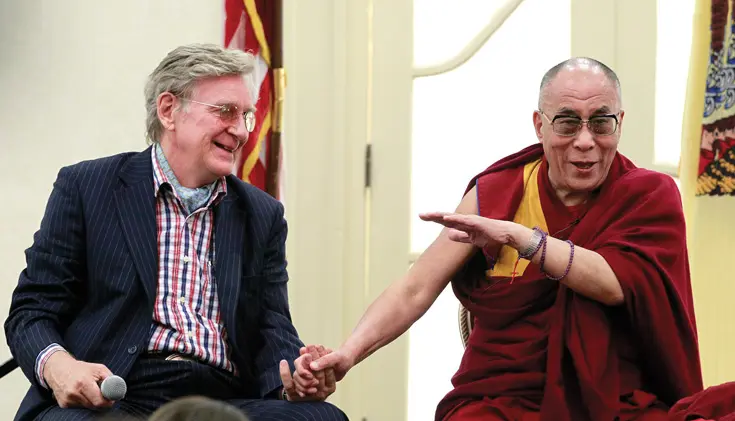
Main Facts
On June 16, the modern spiritual landscape lost one of its most towering and vibrant figures with the passing of Robert "Bob" Thurman. He died peacefully at his home in Woodstock, New York, at the age of 84. Widely recognized as the preeminent American Buddhist scholar, translator, teacher, and activist of our time, Thurman left behind an indelible legacy that bridged ancient Eastern traditions and contemporary Western life.
Thurman’s life was defined by a rare convergence of academic rigor, spiritual devotion, and relentless social activism. As a close confidant and friend of the 14th Dalai Lama, he was a key international supporter of the Tibetan people and culture. Alongside his wife, Nena, he co-founded Tibet House US, an organization dedicated to preserving Tibet’s endangered cultural heritage. Furthermore, he established the Menla Retreat and Spa in Phoenicia, New York, creating a sanctuary for Buddhism, wellness, and holistic healing.
His professional accolades were matched only by his magnetic, larger-than-life personality. Characterized by a brilliant intellect, a booming laugh, and a boundless capacity for compassion, Thurman transformed how Buddhism was studied, practiced, and understood in the West. He was remembered recently by family, colleagues, and global spiritual leaders at a poignant memorial service held on August 3 at Menla—a date that also marked what would have been his 85th birthday.
Chronology of a Remarkable Life and Legacy
To understand Robert Thurman’s impact is to trace a journey that moved seamlessly from the ivy-covered halls of elite academia to the rugged mountains of the Himalayas, and finally into the mainstream cultural consciousness of the West.
Early Life and Academic Beginnings
Born in New York City in 1941, Thurman’s early life did not immediately point toward the Dharma. He attended Harvard University, where his path shifted dramatically following a tragic accident in 1961 that resulted in the loss of his left eye. This profound personal crisis catalyzed a deep existential search, leading him to abandon his conventional trajectory and travel across Europe, the Middle East, and Asia.
The Encounter with the Dalai Lama
During his travels in the mid-1960s, Thurman encountered Tibetan Buddhism and the 14th Dalai Lama, an event that fundamentally altered his worldview. He became the first Westerner to be ordained as a Tibetan Buddhist monk by the Dalai Lama himself, studying closely under the Tibetan spiritual leader. Although he eventually returned to lay life—recognizing that he could be more effective as an academic and activist in the secular world—his lifelong bond with the Dalai Lama remained the anchor of his endeavors.
Pioneering Scholarship and Translating the Dharma
Thurman returned to academia to complete his Ph.D. at Harvard under the mentorship of renowned Buddhologist Nagao Gadjin. In 1988, he accepted a position as the Jey Tsong Khapa Professor of Indo-Tibetan Buddhist Studies at Columbia University, becoming the first endowed chair in Buddhist Studies in the United States.
Over decades of research and teaching, Thurman revolutionized the academic study of religion. Historically, Western academia approached Buddhism through a detached, purely historical lens, separating the philosophy from living practitioners. Thurman bridged this chasm, validating the study of Buddhism from the perspective of active faith and practice. He translated numerous complex traditional Tibetan texts into accessible English, including the influential Holy Teaching of Vimalakirti. His lively, jargon-free books—such as Inner Revolution and Why the Dalai Lama Matters—demystified ancient wisdom traditions for modern readers.
Activism and Tibet House
In 1987, at the direct behest of the Dalai Lama, Thurman co-founded Tibet House US in New York City. The institution was created to serve as a cultural embassy, protecting, preserving, and educating the public about Tibetan civilization at a time when it faced systemic eradication under Chinese rule. Thurman became one of the West’s most vocal and impassioned advocates for Tibetan human rights and cultural autonomy.
The Final Chapter and the 49-Day Ceremony
Thurman’s passing on June 16 initiated a sacred period of mourning rooted in Tibetan Buddhist traditions. On August 3, monks from the historic Sera Jey Monastery in India presided over a traditional 49-day puja memorial ceremony at the Menla Retreat and Spa. In Tibetan cosmology, the 49 days following death represent the bardo—an intermediate state between death and rebirth. The rituals performed during this window are designed to guide the consciousness of the deceased toward liberation, enlightenment, or an auspicious rebirth.
Supporting Data: The Magnitude of Thurman’s Impact
While metrics often fall short when quantifying a spiritual life, the scope of Robert Thurman’s influence can be measured across several distinct domains:
- Academic Footprint: As Columbia University’s inaugural Jey Tsong Khapa Professor, Thurman educated and mentored hundreds of students over a career spanning more than 30 years, shaping generations of scholars, practitioners, and religious leaders.
- Literary Output: Thurman authored, edited, or translated over 20 books on Tibetan Buddhism, Asian history, philosophy, and cross-cultural spirituality. His works have been translated into numerous languages, reaching millions of readers worldwide.
- Cultural Preservation: Through Tibet House US, Thurman curated hundreds of exhibitions, concerts, and educational programs, drawing hundreds of thousands of visitors to engage directly with Tibetan art, philosophy, and spiritual practices.
- Collaborative Initiatives: In his later years, Thurman worked closely with digital media platforms and cultural organizations—including Lion’s Roar and his son, Ganden Thurman—to produce large-scale digital events such as the annual Dalai Lama Global Vision Summits, which engaged global audiences numbering in the hundreds of thousands.
Official Responses and Tributes
The global response to Robert Thurman’s passing underscored his unique position as a cultural bridge-builder, academic luminary, and spiritual guide.
Colleagues, family members, and Buddhist leaders gathered at Menla to share moving testimonies of his character. Speakers highlighted his multifaceted identity: a pioneering scholar who legitimized Buddhist studies; a fierce advocate who gave voice to the marginalized Tibetan people; and, above all, a devoted family man. Despite rubbing shoulders with world leaders, Nobel laureates, and spiritual icons, Thurman consistently prioritized his role as a loving husband to Nena, father to his children (including actress Uma Thurman), and grandfather.
Melvin McLeod, editor-in-chief of Lion’s Roar, reflected on his years of working alongside Thurman, his son Ganden, and the team at Tibet House:
"What I learned during our lively discussions and negotiations was that Bob was ultimately motivated by only one thing: how to create the most possible benefit. I think that’s the definition of a bodhisattva: someone who amid all the challenges and eccentricities of this human life is concerned with one thing—creating benefit. Bob Thurman wanted only to create benefit, and he succeeded, in a big way."
Tibet House US released statements celebrating his tireless devotion to the Tibetan cause, noting that his spirit remains woven into the very fabric of the organization’s ongoing mission. Tributes also poured in from academic institutions worldwide, praising his relentless intellectual curiosity and his ability to make profound metaphysical concepts vibrantly relevant to contemporary societal challenges.
Implications: The Enduring Legacy of an American Bodhisattva
The passing of Robert Thurman marks the end of an era for Buddhism in the West. As one of the last remaining titans of the pioneering generation—those who brought Eastern contemplative traditions across the Pacific during the cultural shifts of the 1960s and 70s—his absence leaves a profound void. Yet, the implications of his life’s work ensure that his influence will continue to ripple forward for decades.
Normalization and Integration of Mindfulness
Thurman’s academic validation of Buddhist psychology helped pave the way for the secular mindfulness movement that has since permeated Western psychology, medicine, and corporate culture. By demonstrating that Buddhist philosophy was deeply compatible with modern science and rational inquiry, he dismantled outdated Orientalist tropes and integrated ancient contemplative tools into contemporary mental health frameworks.
The Future of Tibet’s Cultural Preservation
As the geopolitical struggle surrounding Tibet continues into an uncertain future, the institutional frameworks built by Thurman—particularly Tibet House and Menla—serve as resilient anchors. They ensure that Tibetan culture remains a living, breathing tradition rather than a preserved relic of the past. His advocacy established a blueprint for how diaspora communities can leverage Western cultural platforms to advocate for justice and human rights.
Redefining the Bodhisattva Ideal
Ultimately, Thurman’s greatest legacy may be how he embodied the archetype of the bodhisattva—a being dedicated not to personal spiritual escape, but to the alleviation of suffering for all sentient beings. In a modern world frequently fractured by polarization, cynicism, and systemic crises, Thurman’s joyful, relentless optimism serves as a guiding light. He demonstrated that rigorous intellectual pursuit and fierce social activism are not mutually exclusive with joy, humor, and boundless love.
As family, friends, and students completed the traditional 49-day rites marking his transition through the bardo, the overwhelming sentiment was not merely one of grief, but of profound gratitude. Robert Thurman made the world smile, he made it think more deeply, and, above all, he left it vastly better than he found it.
