

BEIJING — In the high-stakes arena of modern electric vehicles (EVs), the conventional wisdom has long dictated that to win, you must build the car. Brands like Tesla, BYD, and a swarm of ambitious startups have staked their fortunes on vertically integrated manufacturing, styling their metal and rubber as the ultimate trophies of the green transition.
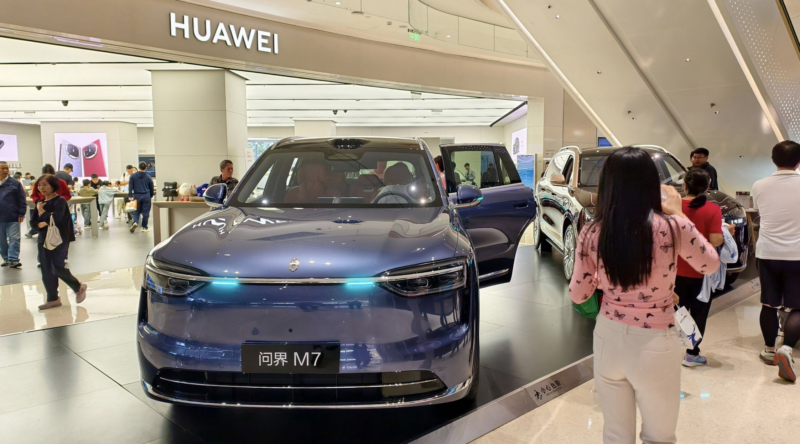
Yet, a profound shift is quietly reshaping the automotive landscape from the inside out. Huawei Technologies Co., barred from global telecommunications infrastructure markets in various Western jurisdictions, has executed a brilliant lateral maneuver. Rather than investing trillions in stamping plants, assembly lines, and paint shops, Huawei has positioned itself as the indispensable digital nervous system of the modern vehicle. Operating primarily as a Tier 1 supplier and joint-brand partner, the tech behemoth is stitching its software, sensors, and powertrains into the very fabric of the world’s largest automotive market.
Through the power of its Harmony Intelligent Mobility Alliance (HIMA) and its cutting-edge Qiankun smart driving platforms, Huawei is proving that in the era of software-defined vehicles, you don’t need to assemble the car to own the drive. As mid-year figures for 2026 roll in, the company’s expanding footprint offers a masterclass in industrial leverage—transforming traditional automakers into manufacturing partners while cementing Huawei’s software as the gold standard of intelligent mobility.
Main Facts: The Software Juggernaut Behind the Wheel
Huawei’s strategy hinges on a unique division of labor: legacy and new-age automakers handle the heavy physical lifting of vehicle manufacturing, vehicle dynamics, and structural engineering, while Huawei injects its intellectual property—ranging from autonomous driving platforms and digital cockpits to advanced electric powertrains.
This blueprint is scaling at an astonishing rate. By mid-July, Huawei’s proprietary Qiankun smart driving platform had been deployed across an incredible 1.9 million vehicles actively navigating public roads. The platform spans 50 co-developed models across 25 distinct automotive brands. These integrations run the gamut from full-stack software configurations to hardware component supply agreements with state-owned behemoths like Changan Automobile and Dongfeng Motor, as well as joint ventures such as GAC Toyota and Dongfeng Nissan.
At the core of this ecosystem is the Harmony Intelligent Mobility Alliance, which reported delivering 45,046 vehicles in July alone. This strong summer showing pushed the alliance’s cumulative deliveries for the first seven months of the year to a formidable 286,000 units. To put this in perspective, this represents a robust 13.7% increase compared with the exact same period in 2025. Among the standout contributors was Luxeed—a joint venture brand crafted in partnership with Chery Automobile—which churned out 10,709 deliveries in July alone, fueled by surging consumer appetite for its sleek electric sedan and crossover lineups.
Chronology: From Concept to Commercial Dominance
The current commercial triumph of Huawei’s automotive wing is no overnight success; it is the culmination of a meticulously planned, heavily financed multi-year trajectory.
- The Foundation Years (2023): Huawei establishes its initial cloud compute capacity for autonomous driving at a modest 2.8 EFLOPS. Early joint ventures begin experimenting with HarmonyOS-based digital cockpits, laying the groundwork for consumer trust.
- The Pivotal Spring (April 2026): At a major technology conference in Beijing, Jin Yuzhi, chief executive officer of Huawei’s Intelligent Automotive Solution unit, drops a bombshell on the industry. He outlines a massive, global research and development budget of 18 billion yuan ($2.63 billion) earmarked exclusively for intelligent driving R&D throughout 2026. This aggressive capital injection signals that Huawei views the software-defined vehicle not as a side project, but as a core pillar of its corporate future.
- Summer Accelerations (May – July 2026): Automakers rush to commercialize Huawei-backed platforms. On May 8, SAIC-GM-Wuling debuts the Baojun Huajing S, a six-seat plug-in hybrid SUV deeply integrated with Huawei technology. Just weeks later, on July 17, pre-sales open for the Avatr 07L—co-developed with Changan Automobile—showcasing Huawei’s latest ADS 5.0 suite and advanced lidar sensors. Simultaneously, Dongfeng Motor pulls the wraps off the Yijing X9, a flagship luxury SUV featuring full-stack Qiankun integration.
Supporting Data: Capital, Computing Power, and Hardware Specs
To understand the sheer magnitude of Huawei’s automotive ambitions, one must examine the numbers driving its R&D engine. The 18 billion yuan ($2.63 billion) allocated for 2026 R&D is heavily weighted toward the digital infrastructure required to train complex machine-learning algorithms.
More than half of that budget—totaling a staggering 10 billion yuan ($1.46 billion)—was poured directly into cloud computing infrastructure. This infrastructure is the invisible engine used to train and refine driver-assistance models. Thanks to this spending spree, Huawei’s cloud compute capacity skyrocketed from 2.8 EFLOPS in 2023 to an eye-watering 60 EFLOPS by April 2026. Industry insiders note that Huawei has mapped out an even more aggressive roadmap, with plans to spend up to 80 billion yuan on computing power over a five-year horizon.
This computational muscle directly translates into tangible hardware and software specifications on the road. The technological centerpiece of Huawei’s current offerings is the Qiankun Advanced Driver Assistance System (ADS) 5.0. This suite relies on an ultra-precise 896-line dual-optical-path lidar sensor. To put its acuity into perspective, this sensor is capable of identifying a tiny, 14-centimeter-high obstacle from a distance of 120 meters—giving autonomous safety protocols critical reaction time at high speeds.
This advanced vision system works in tandem with:
- HarmonySpace 6: The latest iteration of Huawei’s digital cockpit, offering seamless multi-screen integration, lightning-fast voice recognition, and deep smartphone-to-vehicle ecosystem connectivity.
- Zhiqing Motion Control System: A sophisticated chassis management system that utilizes silicon carbide power architecture to dynamically regulate braking, steering, and suspension characteristics in milliseconds, ensuring a ride that is both hyper-responsive and exceptionally smooth.
Official Responses and Strategic Partnerships
Huawei’s leadership has been transparent about its non-assembly business model. By sidestepping the capital-intensive and notoriously low-margin business of building physical vehicle frames, Huawei avoids the financial bruises that have plagued many dedicated EV startups. Instead, it invites the automotive establishment into a symbiotic relationship.

The breadth of these partnerships reads like a "Who’s Who" of the global and domestic manufacturing scene. Beyond its domestic tech-forward alliances, Huawei’s component supply agreements stretch across state-owned giants and international joint ventures alike:
- Aito (with Seres): The pioneer of the HIMA network, demonstrating that Huawei-infused SUVs can capture the public imagination and achieve sustained sales volume.
- Stelato (with BAIC): Focused on high-end luxury electric sedans designed to compete directly with traditional German luxury stalwarts.
- Shangjie (with SAIC Motor) & Maextro S800 (with Jianghuai Automobile Group): The Maextro S800, in particular, represents the absolute apex of the alliance network—an ultra-luxury executive sedan engineered to challenge ultra-premium global nameplates.
- Avatr (with Changan Automobile): Bringing advanced styling and tech-forward trims like the 07L to the competitive mid-size crossover market.
- Baojun Huajing S (with SAIC-GM-Wuling): Expanding the reach of hybrid-electric utility vehicles by pairing a 1.5-liter turbocharged engine with electric drive motors to produce a combined 386 kilowatts of power. This setup yields an impressive electric-only range of up to 255 kilometers and a combined range exceeding 1,100 kilometers under Chinese test cycles.
Implications: A Paradigm Shift for the Global Automotive Industry
The ripple effects of Huawei’s automotive strategy extend far beyond China’s borders, offering a profound glimpse into the future of how cars will be conceptualized, built, and sold worldwide.
For legacy automakers, partnering with a tech titan like Huawei is a double-edged sword. On one hand, it offers an immediate, highly cost-effective shortcut to competing with software-first juggernauts like Tesla and BYD. Automakers lacking the multi-billion-dollar R&D budgets required to develop competitive autonomous driving stacks can simply "plug in" Huawei’s Qiankun system and instantly modernize their vehicle lineups. On the other hand, it risks reducing traditional automotive manufacturers to mere contract assemblers—glorified sheet-metal benders whose brand value is eclipsed by the software operating system running on the dashboard.
For consumers, the Huawei model accelerates the democratization of advanced safety and autonomous features. When a 1.9-million-vehicle fleet is actively feeding data back into a 60 EFLOPS cloud training infrastructure, the learning loop for artificial intelligence shrinks dramatically. Features that were once considered science fiction—such as sub-centimeter obstacle avoidance, predictive suspension damping, and seamless cross-device digital ecosystems—are rapidly becoming table stakes for mid-market vehicles.
As Huawei continues to pump tens of billions of yuan into its computing power and refines its multi-brand alliance strategy, one reality becomes starkly clear. The future of transportation will not be defined solely by who builds the best chassis, but by who controls the code that tells it where to go. And in that race, Huawei has firmly secured the pole position.
