

SEDONA, Ariz. — For more than half a century, the shifting play of light, shadow, and geologic time across the Grand Canyon has found its most faithful and transcendent interpreter in painter Curt Walters. Widely celebrated as the unparalleled living chronicler of America’s premier natural wonder, Walters has spent a lifetime translating the monumental scale and ephemeral moods of the canyon onto canvas.
Now, art enthusiasts, historians, and collectors have a rare opportunity to witness the breadth of his extraordinary career. Through November 30, the Fine Art Museum of Sedona is hosting a landmark dual-venue career retrospective titled A Lifetime in Art. Spanning nearly five decades of creative output from 1979 to the present, the exhibition brings together 48 definitive works, offering an intimate look at an artist who made his home—and his artistic sanctuary—among the red rock landscapes of northern Arizona.
Main Facts: A Dual-Venue Retrospective in Sedona
The exhibition is uniquely distributed across two distinct locations in Sedona, a town Walters has called home for 47 years and which places him within a convenient two-and-a-half-hour drive of his ultimate muse: the Grand Canyon.
The primary exhibition is housed at the Mary D. Fisher Fine Art Complex, where visitors are greeted by a breathtaking collection of large-scale oil paintings centered heavily on the Grand Canyon. Among these monumental works is the striking recent piece Instant Opus, which captures an epic sunset lightning storm witnessed firsthand by the artist from Yavapai Point.
Two miles west, a museum pop-up located behind the Sedona Heritage Museum shifts the focus closer to home. Titled Impressions of Sedona 1980–2000, this auxiliary gallery features plein air paintings depicting the town’s surrounding landscape from Walters’ earlier decades in the area.

Complementing the visual art, both venues are hosting special screenings of Painting the Air, a documentary about the artist directed by his filmmaker daughter, Miranda Foreman. Additionally, visitors can explore a newly released illustrated biography, Resilience: The Life History and Grand Canyon Art of Curt Walters, penned by his grandson, Damien Foreman.
Chronology: From Teenage Inspiration to Master of the American West
The journey of Curt Walters is one of singular, lifelong devotion. Long before he was collecting prestigious accolades, a teenage Walters set his sights on the abyss of the Grand Canyon.
Key Milestones in Walters’ Career:
- 1969: At just 19 years old, Walters makes his first formative trip to the Grand Canyon. Struck by a diorama of Spanish conquistadors at the park, the seeds of a lifelong artistic obsession are planted.
- 1979: Walters establishes his permanent artistic roots in Sedona, beginning an era of intense plein air observation of the local landscape and frequent expeditions to the nearby canyon.
- 1980–2000: This period, highlighted in the Heritage Museum pop-up, captures the rapid transition of Sedona’s natural valleys and vistas, preserving ecosystems that would soon face development.
- Present Day: Walters continues his rigorous painting schedule, earning top-tier honors and expanding his visual vocabulary to include historical narratives, such as his new series featuring 16th-century Spanish explorers.
Throughout his decades-long career, Walters has accumulated many of the most coveted awards in Western art. His honors include top prizes at the Prix de West at Oklahoma City’s National Cowboy & Western Heritage Museum; Quest for the West at the Eiteljorg Museum in Indianapolis; and Masters of the American West at the Autry Museum of the American West in Los Angeles.
Supporting Data: Exhibition Highlights and Technical Mastery
A Lifetime in Art showcases Walters’ mastery of lighting, atmospheric perspective, and texture. The selected works range from intimate studies to massive museum-scale canvases.
Notable Works on Display:
- Tenebristic Spectacle (Oil on canvas, 48 x 78 inches): A monumental canvas demonstrating Walters’ command of tenebrism—the dramatic contrast between light and dark—highlighting the moody, cathedral-like atmosphere of the canyon depths.
- Instant Opus (Oil on canvas, 48 x 48 inches): Exhibited at the Mary D. Fisher complex, this piece encapsulates the raw electricity of a storm over Yavapai Point. Walters recalls the experience vividly: "I was right there, with big bolts of lightning everywhere."
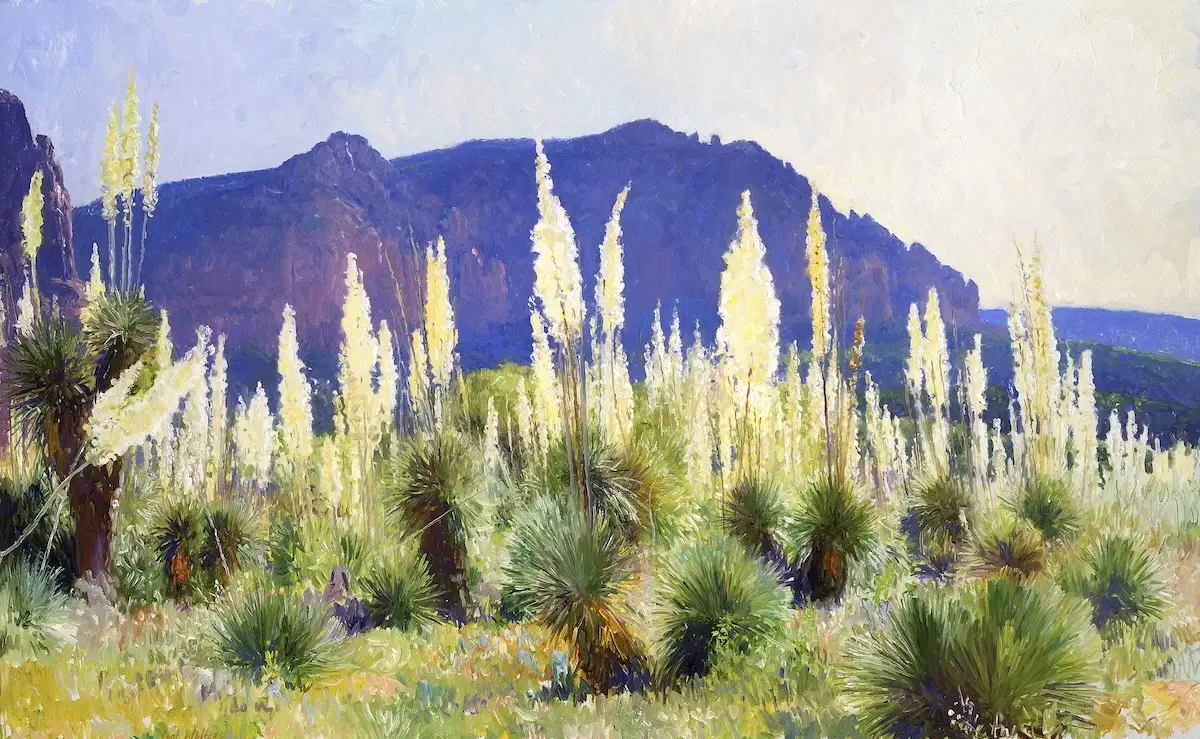
- Vicissitude (Oil on canvas, 30 x 48 inches): Currently displayed at the Heritage Museum pop-up, this plein air piece depicts yuccas in glorious springtime bloom against Sedona’s iconic red rock cliffs.
Official Responses and Artist Insights
Speaking on the evolution of his work, Walters reveals an exciting expansion in his artistic narrative. Beyond pure landscape painting, he has embarked on a historical series exploring the first European encounter with the Grand Canyon.

At the center of this new direction is a meticulously researched painting depicting García López de Cárdenas—the Spanish commander who led the first European party to discover the canyon—standing in full military attire at the South Rim in 1540.
"The first time I visited the Canyon, at the age of 19, I saw an incredible diorama there of the conquistadors, and it just stuck in my head all these years," Walters explains. "Now, I’ve collected all the costumes and saddles and bridles, and I have models coming to pose. I’m determined to do it. It’s a blast!"
This blend of historical recreation and direct observation demonstrates an artist who, even after decades of acclaim, continues to challenge himself and discover fresh entry points into a well-trodden subject.
Implications: A Subtle Plea for Environmental Preservation
While Walters’ paintings are visual celebrations of natural beauty, they also carry a profound, sometimes melancholic message regarding environmental change and development in the American Southwest.
This is nowhere more apparent than in the backstory of the Heritage Museum pop-up piece Vicissitude. While the painting portrays a pristine, idyllic spring morning bursting with blooming yuccas and towering red cliffs, the reality of the location today tells a sobering story of loss.

"That place doesn’t exist anymore," Walters says ruefully. "It’s now a shopping center and parking lot."
Through retrospective works like Vicissitude, Walters’ exhibition transcends a standard fine art showcase. It serves as a historical archive and a gentle yet urgent reminder of the fragility of the American landscape. By juxtaposing the eternal, unchanging majesty of the deep Grand Canyon with the vanished natural habitats of Sedona, the exhibition delivers a powerful plea to appreciate, cherish, and actively preserve the nation’s natural splendors before they are lost to the relentless march of progress.
Visitor Information
- Event: A Lifetime in Art – A Retrospective of Curt Walters
- Dates: Through November 30
- Locations:
- Mary D. Fisher Fine Art Complex (Main Exhibition)
- Museum Pop-up behind the Sedona Heritage Museum (Impressions of Sedona 1980–2000)
- Contact: (888) 602-2667 | fineartmuseumofsedona.org
(This story originally appeared in the October/November 2026 issue of Southwest Art magazine.)
