

Introduction: Rethinking the Energy Transition on the Farm
When the conversation turns to the feasibility of agricultural electrification, it almost invariably gravitates toward a single, heavy-duty machine: the tractor. Specifically, observers picture a large, high-horsepower diesel workhorse laboring relentlessly through short, narrow seasonal windows like planting and harvesting.
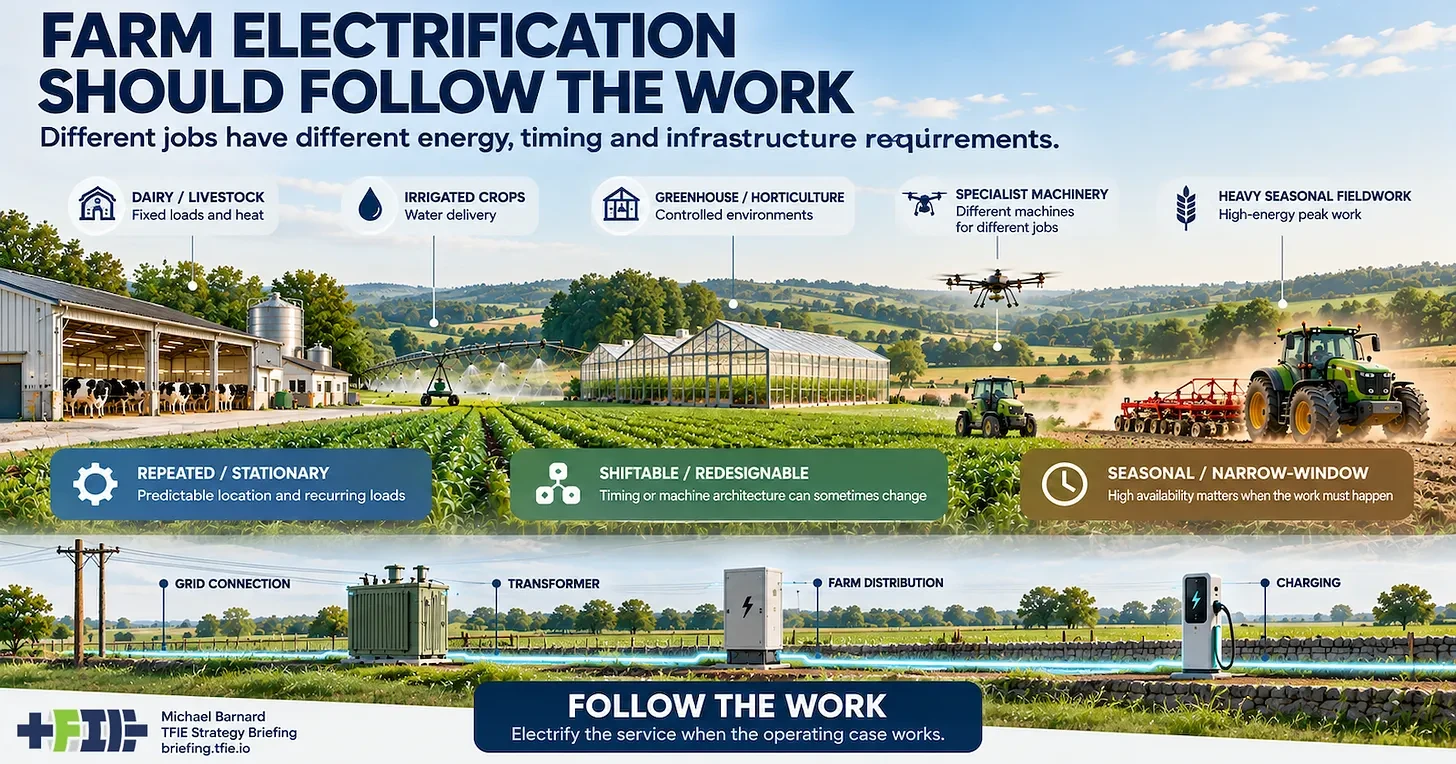
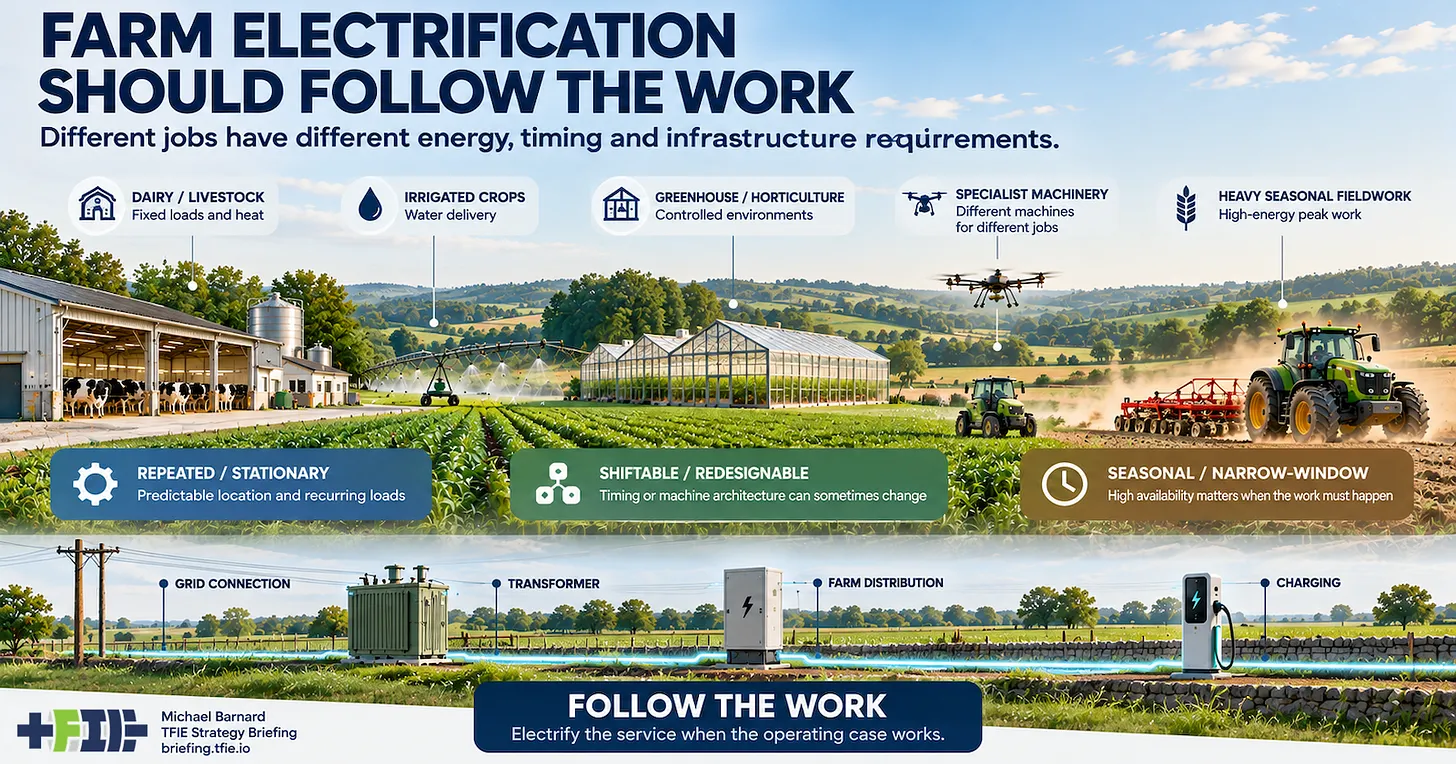
While transitioning heavy machinery remains a legitimate, complex engineering challenge, focusing solely on the diesel tractor is a flawed organizing principle for farm electrification. Agriculture is not a monolith; it encompasses a diverse ecosystem of stationary loads, redesignable services, and distinct operational workflows. Each component requires a tailored investment sequence.
Good farm electrification strategy must begin with the actual work the farm needs performed, rather than starting with a generalized shopping list of electric equipment. By breaking down agricultural energy use by function—from milk cooling and livestock ventilation to irrigation and greenhouse thermal loads—a clearer, more pragmatic path to decarbonization emerges.
Main Facts: The Anatomy of Agricultural Energy Demands
Farms perform a vast array of simultaneous and seasonal operations. Milk must be chilled immediately; water must be pumped reliably; livestock barns demand precise ventilation and heating; greenhouses rely heavily on thermal management; and harvested crops often require drying before storage. Furthermore, chemical application and processing equipment run at fixed locations across the enterprise.
The Diversity of Farm Operations
- Stationary vs. Mobile: Some machinery returns to the central yard every few hours, while other equipment must run nearly continuously when weather and crop conditions align.
- Energy Quantities and Timing: These services demand vastly different energy volumes, power requirements, timing constraints, and grid infrastructure.
- The Diesel Fallacy: The fact that a current battery-electric tractor cannot yet replace every 200-horsepower diesel machine tells us almost nothing about whether a kerosene space heater, an irrigation pump, or a milk chiller should still be burning fossil fuels.
Shifting the Strategic Framework
This realization forms the core of updated assessments on agricultural decarbonization. Spurred by agricultural protests and the systemic vulnerabilities exposed by fossil-fuel price volatility, energy analysts emphasize that the ultimate measure of agricultural electrification is not the date the final diesel tractor vanishes. Rather, it is whether successive equipment replacements, infrastructure upgrades, and operational shifts successfully reduce fossil-fuel exposure while preserving—or improving—the cost and reliability of global food production.
Chronology and Evolution: From Initial Shocks to Work-Based Strategies
The urgency behind rethinking agricultural energy stems from a series of systemic shocks and evolutionary steps in rural economies:
- The Wake-Up Call (Fuel Protests): Recent agricultural unrest, notably in Europe, highlighted the acute vulnerability of modern farming to fossil-fuel price spikes. Farmers caught between high diesel costs and rigid operating margins exposed the fragility of total fuel dependence.
- Initial Blind Spots: Early discussions of greening agriculture focused too narrowly on direct 1:1 replacements of internal combustion engines with electric motors, ignoring the nuances of stationary thermal loads and grid readiness.
- The Shift to Task-Oriented Analysis: Analysts began separating farm energy into discrete categories. Instead of asking "Can we build an electric tractor?", planners started asking "What is the most energy-efficient way to accomplish this specific agricultural task?"
- Commercial Realities (Present Day): The market introduction of bounded commercial electric tractors, such as the Fendt e107 Vario, has provided a reality check. Rather than serving as universal diesel replacements, these machines have defined duty cycles that prove useful for lighter, specialized tasks.
Supporting Data: Case Studies in Solar, Thermal, and Mobile Electrification
Examining real-world data across different agricultural sectors reveals stark contrasts between simplistic energy accounting and practical economic deployment.
1. Dairy Solar Integration: The Limits of Annual Balance
Consider a typical dairy farm model based on research from agricultural authorities like Teagasc. A 100-cow farm consumes approximately 25,000 kWh annually. A 25 kWp solar photovoltaic (PV) array can generate roughly 23,484 kWh per year.
- The Illusion of Independence: On annual accounting sheets, generation equals about 94% of consumption, painting a picture of near energy independence.
- The Reality of Self-Consumption: Without a battery storage system, the farm typically utilizes only 30% of the PV generation on-site; the rest is exported, often under unfavorable tariffs.
- The Battery Paradox: Adding a 12.5 kWh battery increases self-consumption to 45%. However, under standard modeled tariffs, the unsubsidized simple payback period actually worsens from eight years to ten years.
- The Takeaway: Annual energy balance is not synonymous with useful energy delivery. Batteries must solve specific operational problems—such as peak demand mitigation, backup power, or charging support—rather than merely inflating self-consumption percentages.
2. Stationary Thermal Loads: The Low-Hanging Fruit
Stationary thermal loads often present the most straightforward and economically viable electrification cases. Historical data from pig-farming operations illustrates this vividly. An 800-sow operation historically burned around 900 liters of kerosene every week purely for farrowing and weaner heating.
Replacing this setup with an industrial heat pump system drastically altered the farm’s ledger. While initial installation costs were significant, annual energy costs plummeted from roughly €46,800 to €12,800. This yielded a simple payback period of under two years before financing. While inflation and equipment costs have shifted since these models were first deployed, the underlying principle remains: many agricultural fossil-fuel problems are simply conventional stationary heating loads with mature, highly efficient electric alternatives.
3. Irrigation and Groundwater Governance
Irrigation presents a compelling study in service delivery rather than simple motor swapping. Large-scale government initiatives, such as India’s PM-KUSUM scheme, have deployed hundreds of thousands of standalone solar pumps and solarized agricultural feeders.
However, the core service is not merely "operating a solar pump"—it is delivering the required volume of water at the correct pressure without depleting the local aquifer.
- Operational Flexibility: Pumping schedules and water storage can often substitute for expensive electrochemical battery storage. Variable-speed drives can dynamically alter energy consumption and operating flexibility.
- The Groundwater Risk: Because solar power reduces the marginal cost of pumping to near zero, poorly governed systems risk accelerating groundwater depletion rather than just replacing diesel emissions. Consequently, irrigation electrification must be tightly integrated with robust water governance and intelligent tariff structures.
4. Mobile Machinery and Duty Cycles
Mobile machinery demands the same rigorous duty-cycle discipline. The Fendt e107 Vario tractor offers a practical benchmark: it features a 100 kWh battery, 55 kW of continuous power, and a 66 kW peak output.
Manufacturer specifications indicate it can run for four to seven hours in partial-load applications like mechanical weed control or planting. Energy-intensive transport work, conversely, reduces runtime significantly. This is not proof that electric tractors are unviable; rather, it demonstrates that duty cycle dictates feasibility. A machine tailored for lighter specialist work delivers high commercial utility long before heavy broadacre transport can be economically electrified.

Official Responses and Strategic Perspectives: The Infrastructure Trap
Agricultural experts and energy strategists increasingly warn of a hidden bottleneck: the rural grid infrastructure trap.
The Danger of Lagging Infrastructure
Rural electrical grids, local transformers, and regional substation capacities often require significantly more time to plan, permit, and construct than it takes to procure advanced farm machinery. Farms that wait until the "perfect" heavy electric tractor hits the market before upgrading their electrical supply will find themselves owning advanced machinery years before the local grid can support its charging requirements.
Proactive Infrastructure Investments
To prevent this lag, critical infrastructure must often precede equipment deployment:
- Capacity Headroom: Dairy farms upgrading their electrical supplies for heat pumps, refrigeration, and hot-water systems simultaneously create crucial headroom for future machinery charging fleets.
- Contractor Depots: Agricultural contractors represent prime candidates for early electrification. Because contractors concentrate expensive equipment and heavy annual operating hours into centralized locations, high utilization rates make costly electric machinery easier to amortize. Furthermore, a single robust grid connection and centralized battery buffer at a contractor yard can service equipment utilized across dozens of individual farms.
- Ownership Evolution: The optimal owner of an expensive, specialized electric agricultural machine may increasingly be a shared service business or contractor rather than the individual family farm whose land it works.
Implications: A Tailored Roadmap for Agricultural Decarbonization
Because agricultural systems vary wildly across sectors, there is no single, uniform sequence for electrification. Different farming models demand distinct strategic pathways:
- Dairy and Intensive Livestock: Cooling, hot water, ventilation, heat recovery, and automated pumps should sit at the front of the investment queue.
- Irrigated Agriculture: Priorities must begin with pumping efficiency, intelligent scheduling, water storage integration, and reliable grid supply.
- Greenhouses: Focus primarily on thermal electrification, geothermal integration, and advanced heat pump systems.
- Broadacre Systems: These face relatively low stationary fuel demands but massive seasonal mobile peaks. Prematurely replacing paid-off diesel tractors used sparingly each year is economically irrational if it triggers exorbitant rural grid upgrade costs.
- Smallholder Access: In developing regions, productive energy access is best unlocked by prioritizing refrigeration, irrigation, and local crop processing over direct fossil-fuel tractor replacement.
Policy Recommendations
Policymakers must align public incentives with these binding operational constraints rather than simply counting subsidized units sold:
- If local connection capacity bottlenecks viable decarbonization projects, governments must subsidize and accelerate rural distribution grid reinforcement.
- If equipment economics hinge on high utilization, policy frameworks must make contractors and shared-service cooperatives explicitly eligible for grants and tax credits.
- If solar-powered irrigation threatens local aquifers, energy subsidies must be strictly tied to enforceable water governance frameworks.
Ultimately, agricultural electrification is a multi-layered transition defined by physics, economics, and infrastructure timing. The tractor will successfully electrify when batteries, duty cycles, and grid economics finally align. Until then, the rest of the modern farm has a vast, highly profitable array of stationary and specialized electric solutions waiting to be deployed.
