

By the Investigative Editorial Desk
Published in Conjunction with Consciousness and Metaphysical Research Archives
Main Facts: The Phenomenon of Unfamiliar Familiarity
Have you ever awakened from a dream with a profound, unshakable conviction that you have walked those streets before? Not a memory tethered to this earthly life, nor a nostalgic echo of a childhood vacation, but a striking sensation of home within a landscape you are seeing for the very first time.
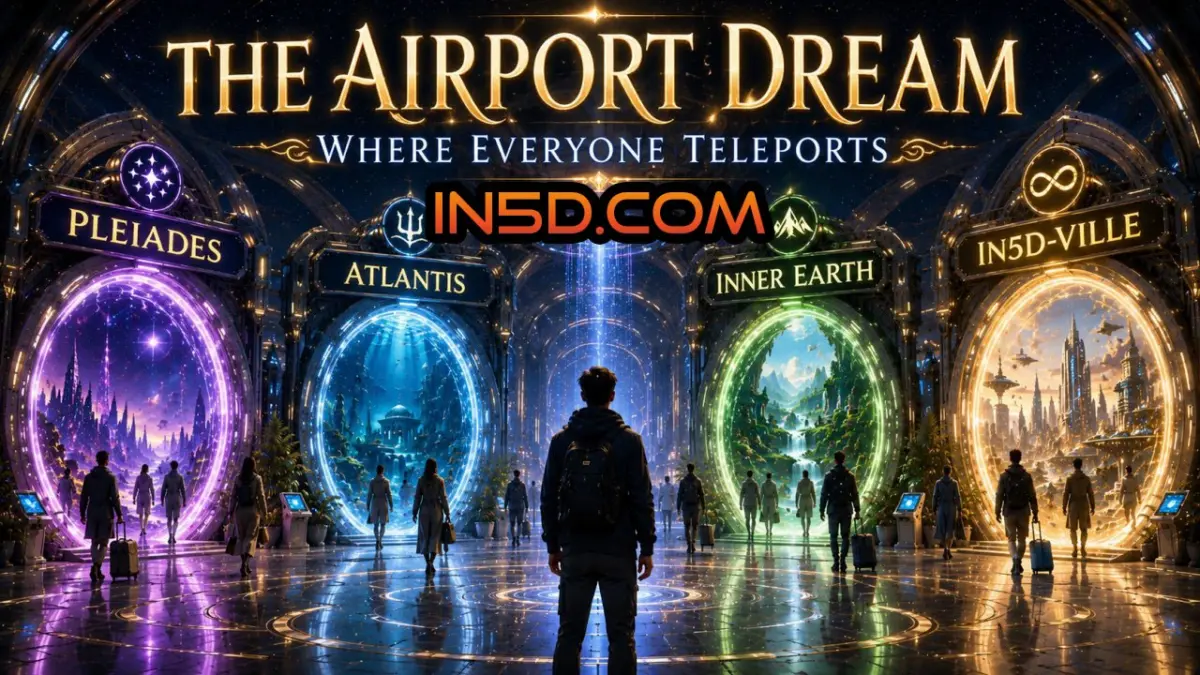
This profound psychological and metaphysical paradox forms the bedrock of a growing body of anecdotal research surrounding anomalous dreams. On January 2, 2014, In5D founder and researcher Gregg Prescott experienced a definitive iteration of this phenomenon. Finding himself within an expansive, airport-like hub devoid of conventional aviation infrastructure—no boarding gates, no roaring jet engines, and no asphalt runways—Prescott observed a collective reality operating under a vastly different physical paradigm. Rather than queuing for commercial transit, travelers moved effortlessly by way of teleportation.
What remains most striking about this account is not the presence of instantaneous spatial relocation, but the absence of cognitive dissonance. The dream state accepted teleportation as ordinary law, accompanied by a visceral anticipation of traversing interstellar distances in the blink of an eye.
This account is far from isolated. Across metaphysical forums and psychological case studies, individuals frequently report immersive dream environments featuring non-existent futuristic cities, sprawling multi-dimensional institutions, and advanced transit systems. Crucially, these dreamers share a unifying sentiment: "I have been here before." As researchers attempt to classify these occurrences, three primary hypotheses emerge:
- Symbolic projections of waking-life emotional landscapes.
- Glances into alternate or parallel realities accessed during deep states of physiological repose.
- Hyper-vivid cognitive constructions generated spontaneously by the human brain.
Chronology: Tracking the Evolution of Dream Interpretation and Pattern Recognition
To understand the trajectory of modern dream research, one must examine how humanity has historically engaged with the nocturnal mind.
- Ancient Epochs: Early human civilizations—including the ancient Egyptians, Greeks, and Indigenous peoples—viewed dreams not as random neurochemical firings, but as portals to divine dimensions, prophetic warnings, or visits from ancestral guides. Dream incubation temples were established where individuals sought healing and wisdom from higher realms.
- The Psychoanalytic Era (Late 19th to Mid 20th Century): The paradigm shifted toward psychoanalysis with figures like Sigmund Freud and Carl Jung. Freud famously termed dreams the "royal road to the unconscious," focusing on repressed desires, while Jung expanded the framework to include the collective unconscious—a shared pool of primordial images and archetypes common to all human beings.
- The Digital Awakening (2000s–Present): With the rise of digital connectivity, metaphysical researchers began cataloging anomalous dreams on a global scale. In 2009, pivotal experiences—such as Prescott’s reported "galactic download"—catalyzed the formation of independent esoteric databases like In5D. Observers began noticing recurring motifs among global communities, particularly involving futuristic technology, cosmic travel, and shifts in consciousness.
- Modern Technological Integration: Recognizing the fallibility of human memory regarding dreams, contemporary developers have begun introducing digital journaling tools designed to bridge the gap between fleeting subconscious imagery and long-term analytical tracking.
Supporting Data: The Mechanics of Memory Loss and Pattern Analysis
Scientific literature confirms that humans rapidly forget the vast majority of their dreams. Within minutes of waking, the neurochemical cocktail responsible for rapid eye movement (REM) dreaming—specifically the sharp decline in norepinephrine and frontal lobe activation—ensures that dream narratives fade from short-term memory unless intentionally recorded.
According to sleep researchers, this physiological bottleneck creates a significant blind spot in psychological self-awareness. When dreamers dismiss singular, bizarre nocturnal experiences—such as a dream involving teleportation, zero-gravity navigation, or complex multi-dimensional architecture—they lose access to longitudinal data threads.
Long-term qualitative tracking demonstrates that anomalous dreams do not usually occur in a vacuum. When analyzed across multi-year archives, researchers find statistical correlations between vivid dream motifs and significant waking-life milestones. For instance:
- Clustering Effects: Reports of spatial disruption, portals, and instant transit frequently cluster around periods of intense personal transformation, existential stress, or shifts in life trajectory.
- Archetypal Consistency: The sensation of returning to a familiar, non-earthly location persists across demographics, suggesting a structured baseline within the subconscious or collective mind that transcends individual imagination.
To mitigate the natural decay of dream recall, modern applications—such as the newly released In5D Infinite app on Google Play—have shifted from traditional static dream dictionaries to longitudinal pattern-recognition frameworks. By compiling years of entries side by side, these systems allow users to connect dots that would otherwise be lost to cognitive erosion.

Official Responses and Theoretical Perspectives
The scientific and metaphysical communities remain divided regarding the origin and validity of hyper-familiar dream landscapes.
The Neurobiological Perspective
Mainstream neuroscientists argue that dreams are the brain’s way of sorting, consolidating, and pruning memories acquired during waking hours. Dr. J. Allan Hobson’s Activation-Synthesis Theory posits that the pons sends random electrical impulses up to the forebrain during REM sleep, and the cerebral cortex attempts to make narrative sense of these signals, resulting in bizarre dream plots. The feeling of "having been there before" is classified simply as a misfiring of the brain’s déjà vu mechanism—specifically, a temporary glitch in the temporal lobe’s familiarity circuits.
The Metaphysical and Consciousness-Based Perspective
Conversely, esoteric researchers and consciousness theorists propose that awareness is not merely a localized byproduct of biological gray matter. Proponents of non-local consciousness argue that during sleep, the physical body rests while the energetic or conscious self detaches to explore alternate planes of reality, parallel timelines, or higher-dimensional spaces.
From this viewpoint, the instantaneous teleportation experienced in the 2014 airport dream is not a random neurological artifact, but an accurate perception of how consciousness operates outside the constraints of linear spacetime. The profound sense of "home" is explained as a literal cellular or spiritual memory of our origin point before incarnation.
Implications: What Visiting Alternate Realities Means for Human Awakening
As interest in lucid dreaming, astral projection, and altered states of consciousness continues to surge globally, the implications of these nocturnal experiences extend far beyond personal curiosity.
1. Redefining the Boundaries of the Self
If human consciousness regularly navigates complex, non-physical realities during sleep, our definition of "identity" must expand. We are no longer merely biological organisms bound by gravity and linear distance, but multidimensional observers capable of existing across multiple experiential frameworks simultaneously.
2. Navigating Personal and Collective Evolution
The observed correlation between futuristic dream motifs (such as teleportation, advanced energy systems, and global shifts) and waking-life transitions suggests that the subconscious mind acts as an early-warning system or a compass for personal evolution. By paying attention to these recurring patterns, individuals may better navigate major societal and personal paradigm shifts.
3. The Future of Dream Research
The transition from analog dream journals to data-driven consciousness tracking marks a new era in inner exploration. As technology enables humanity to map the subtle topography of the dream world over decades rather than days, we inch closer to answering humanity’s oldest question: Where do we go when we sleep, and why does it feel more real than waking life?
For more explorations into consciousness, metaphysics, and the uncharted territories of the human mind, visit In5D.com.
