By the In5D Editorial Desk Published in collaboration with In5D.com
Main Facts
For generations, mainstream astrology has been widely generalized through newspaper columns, pop-culture quizzes, and brief sun-sign horoscopes. Millions of people around the globe readily identify with a single zodiac sign—proclaiming proudly, "I’m a Libra," "I’m a Leo," or "I’m a Pisces." However, modern astrological practitioners and researchers argue that relying solely on your Sun sign is like reading only the first chapter of a complex, multi-layered biography and assuming you know the entire plot.
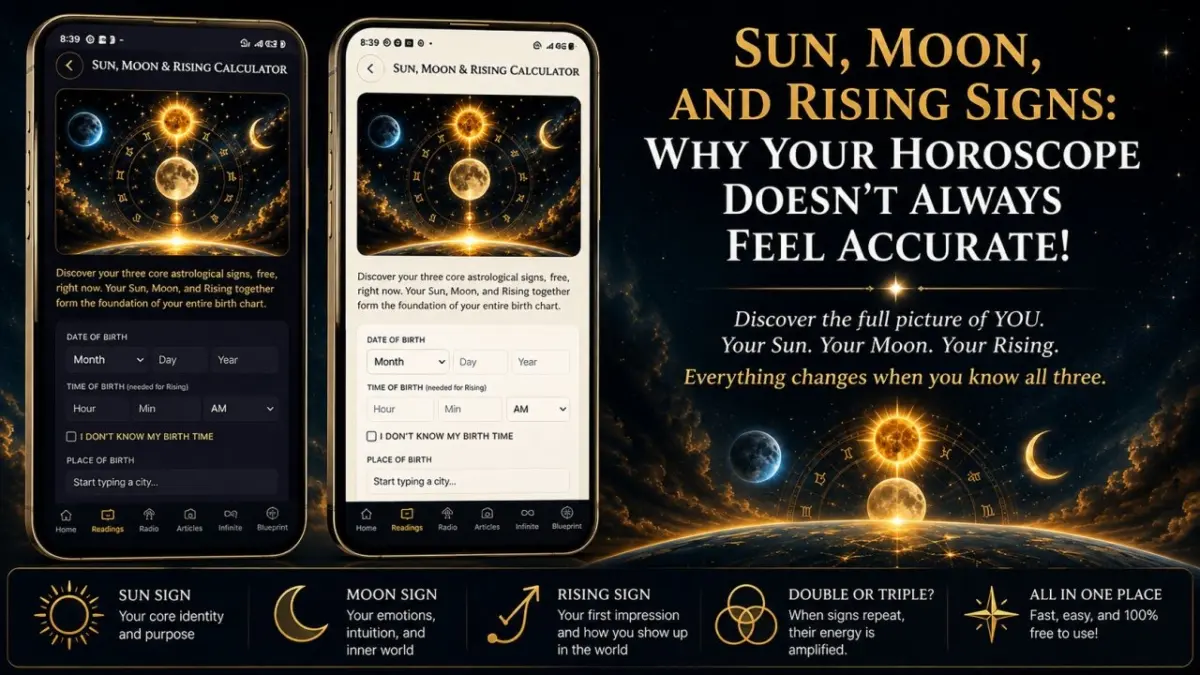
According to Gregg Prescott, M.S., founder, webmaster, and editor of In5D.com, true astrological self-awareness requires examining your "Big Three": the Sun, the Moon, and the Rising (Ascendant) signs.
The Sun Sign: Represents your core identity, life path, and conscious ego, dictated by the position of the sun on your exact day of birth.
The Moon Sign: Governs your internal emotional landscape, instinctual reactions, and subconscious needs, visible only to those closest to you.
The Rising (Ascendant) Sign: Controls your social mask, outer presentation, and the immediate first impressions you project, calculated strictly by the hour and minute of your birth.
When these three foundational pillars interact, they explain why a generic monthly horoscope often feels inaccurate or superficial. Furthermore, rare astrological configurations—such as "Double" or "Triple" signs, where an individual shares the same zodiac sign across two or all three placements—amplify specific personality traits, shedding new light on human psychology, interpersonal dynamics, and decision-making processes.
Chronology and Evolution of Modern Astrology
To understand why the public perception of astrology has shifted toward the "Big Three," it is helpful to look at how astrological interpretation has evolved over time:
Ancient Roots: Civilizations including the Babylonians, Greeks, and Egyptians tracked the movements of celestial bodies to map agricultural cycles, political shifts, and mythological archetypes. Early astrological tracking relied heavily on the precise hour of birth, making the Ascendant just as critical as the sun’s position.
The 20th-Century Sun-Sign Era: With the rise of mass media in the mid-20th. century, daily newspaper columnists sought a simple, universal way to categorize readers. By breaking the zodiac into twelve neat calendar blocks based solely on the Sun, astrology became easily digestible—yet deeply fragmented.
The Digital Age and Personal Empowerment: As personal computing and the internet expanded in the late 1990s and 2000s, software made calculating a complete, granular birth chart accessible to the general public. Instead of relying on generalized daily forecasts, individuals could suddenly generate precise ephemerides mapping out planetary angles down to the exact minute of birth.
The Launch of the In5D Infinite App: Continuing this trajectory of democratization, digital tools like the In5D Infinite App have introduced free, instant Sun, Moon, and Rising calculators. This technological advancement allows everyday seekers to instantly decode their complete cosmic blueprints without paying for expensive professional chart readings.
Supporting Data: Decoding the Big Three
To fully appreciate why a single horoscope fails to capture the human experience, researchers and astrologers break down the distinct functional roles of the Sun, Moon, and Rising signs.
1. The Sun Sign: The Foundation of Identity
Your Sun sign is the anchor of your astrological profile. Determined by the calendar day of your birth, it maps out your conscious vitality, primary creative force, and long-term evolutionary goals. If you are asked to summarize your fundamental character traits in a single sentence, your Sun sign provides the primary vocabulary. Yet, it remains only the scaffolding upon which the rest of your psyche is constructed.
2. The Moon Sign: The Internal Engine
While the Sun dictates how you act upon the world stage, the Moon rules how you process the world internally. Two individuals born under the exact same Sun sign can experience identical stressors—such as a sudden career setback—yet react with entirely opposite temperaments. A Capricorn Sun with a fiery Aries Moon may respond with impulsive anger and immediate action, while a Capricorn Sun with a sensitive Cancer Moon may retreat inward to process emotional safety. Your Moon sign governs your gut instincts, hidden vulnerabilities, and private emotional sanctuaries.
3. The Rising Sign: The Social Interface
The Rising sign, or Ascendant, represents the zodiac constellation peaking on the eastern horizon at the precise minute you drew your first breath. Because the Earth rotates completely on its axis every 24 hours, the Rising sign shifts approximately every two hours. This makes an accurate birth time non-negotiable for precise astrological work. The Rising sign acts as a lens or a filter; it influences your physical mannerisms, stylistic choices, and the initial energetic impression you give to strangers, employers, and casual acquaintances.
The Phenomenon of Double and Triple Signs
The complexity multiplies exponentially when an individual possesses a "Double" or "Triple" sign—meaning the same zodiac archetype dominates two or all three of their Big Three placements.
Consider the case of Gregg Prescott himself, who discovered through a professional birth chart reading that he is a Triple Libra (Libra Sun, Libra Moon, and Libra Rising). Far from simply embodying the stereotypical breezy, peace-loving Libran caricature, a Triple Libra experiences an intense, concentrated amplification of Air energy.
"Most people think that Libras are all about balance, and that’s true, but what most people don’t realize is that we’re constantly seeking balance," Prescott explains. "That’s a HUGE difference! And don’t ask a Libran to make a decision about anything. We’re amazing at seeing the bigger picture of A and Z, but struggle with B through Y… lol!"
This hyper-focused elemental concentration explains not only his chronic indecisiveness when weighing infinite variables, but also his lifelong drive to build community, host conscious conferences, and foster diplomatic bridges between disparate groups of people. Similarly, a Double Leo radiates heightened leadership and theatrical creativity, while a Triple Scorpio navigates emotional transformation with unmatched intensity.
Official Responses and Expert Perspectives
While mainstream scientific institutions continue to categorize astrology as a pseudoscience lacking empirical validation, psychological frameworks—most notably the work of Carl Jung—have long recognized the symbolic utility of astrological archetypes. Jung viewed astrology as a symbolic language of the collective unconscious, mapping internal human drives onto external cosmic patterns.
Modern psychological astrologers emphasize that tools like the Sun, Moon, and Rising calculations serve as exceptional mirrors for self-reflection. Rather than viewing astrology as a rigid determinant of fate, contemporary practitioners frame birth charts as dynamic psychological maps.
Behavioral Self-Awareness: Therapists and holistic counselors note that understanding one’s Moon sign can accelerate emotional intelligence by validating why an individual reacts defensively or seeks comfort in specific ways.
Interpersonal Harmony: Relationship counselors frequently utilize birth chart comparisons to help couples understand fundamental communication disconnects. For instance, an analytical Air-sign parent can better support a passionate, expressive Fire-sign child once they recognize how their respective elemental energies interact.
Implications for Personal Growth and Modern Technology
The growing accessibility of comprehensive astrological data carries significant implications for modern wellness, self-help methodologies, and digital app development.
1. Moving Beyond Reductionist Pop Astrology
As consumers grow weary of generic, one-size-fits-all horoscopes that rarely match their internal reality, the demand for nuanced, multidimensional self-analysis is surging. Recognizing the interplay between the conscious ego (Sun), emotional core (Moon), and social persona (Rising) encourages a more holistic, compassionate understanding of human complexity. People realize that inner contradictions—such as being a shy introvert with a commanding public presence—are not character flaws, but harmonious interactions between different chart placements.
2. The Integration of Digital Wellness Tools
The transition of astrological data into mobile applications represents a broader cultural shift toward decentralized, self-directed spiritual tools. Platforms like the In5D Infinite App democratize esoteric knowledge by offering free calculations alongside a suite of daily resources, including tarot readings, numerology reports, moon phase tracking, and dream journaling. By placing complex ephemeris calculations into the hands of smartphone users on Google Play and upcoming iOS platforms, technology bridges the gap between ancient esoteric wisdom and modern digital convenience.
Conclusion: Asking the Ultimate Question
Ultimately, diving deeper into your astrological profile is about much more than memorizing planetary symbols or identifying your elemental tribe. It begins with the fundamental, timeless question that has driven human philosophy for millennia:
"Who am I, really?"
By looking past the restrictive boundaries of a single Sun sign and embracing the full spectrum of your Big Three, you unlock a richer, more compassionate vocabulary to understand not only your own psyche, but the unique inner worlds of the family, friends, and colleagues who journey alongside you.