

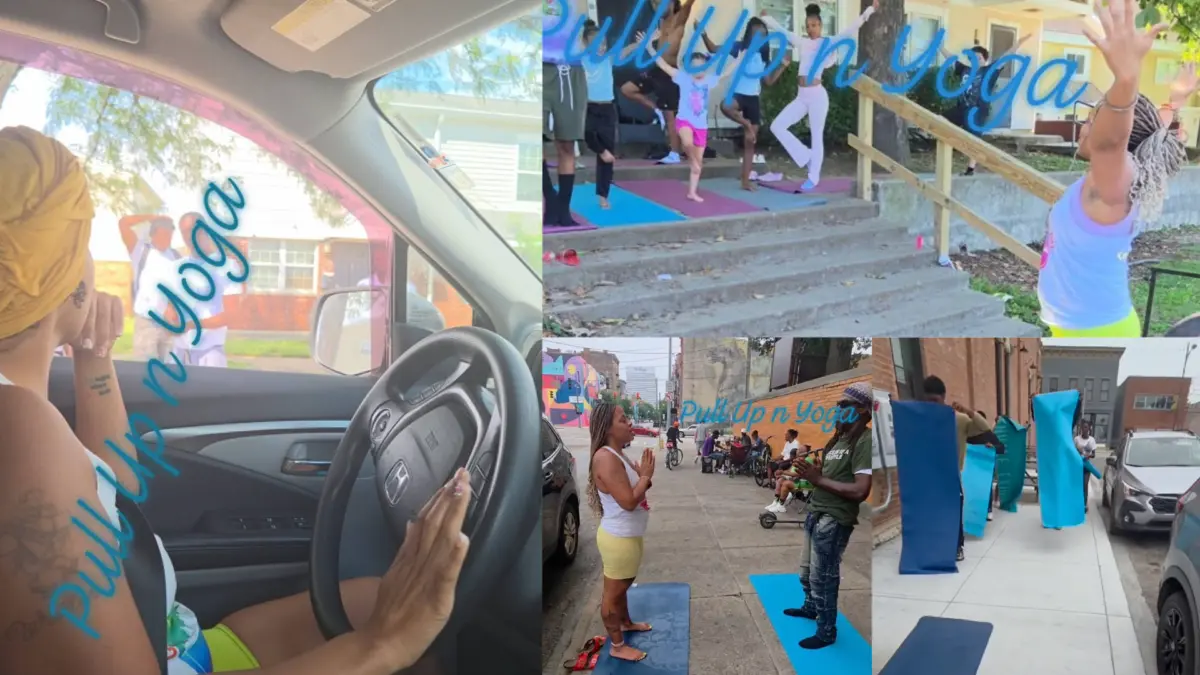
CINCINNATI — "Peace, y’all. You want to do some yoga real quick?"
For most people, the invitation to center one’s mind and body arrives inside the tranquil, climate-controlled confines of a wellness studio—surrounded by the scent of burning sage, ambient instrumental music, and the hushed whispers of participants clad in high-end athleisure. But for residents navigating the bustling, concrete-and-asphalt neighborhoods of Cincinnati, Ohio, that same invitation is just as likely to ring out from the driver’s seat of a passing SUV.
This is the domain of Blu Cauthen, a charismatic wellness entrepreneur, doula, and yoga instructor who is turning conventional wellness culture on its head. Through her grassroots initiative, aptly named "Pull Up n’ Yoga," Cauthen drives through local communities looking for people hanging out on street corners, lingering outside corner stores, or lounging in front of apartment buildings. When she spots a group she believes might be receptive, she pulls up, rolls down her window, and offers them an impromptu moment of peace.
Her classes require no money, no prior experience, and no special gear. They unfold right on sidewalks, public parks, and front lawns using borrowed mats. In an industry often criticized for being exclusionary, expensive, and culturally monolithic, Cauthen’s mobile approach is dismantling barriers one street corner at a time.
Main Facts: The Anatomy of "Pull Up n’ Yoga"
The mechanics of Pull Up n’ Yoga are disarmingly simple, yet the impact is profound. Cauthen cruises through neighborhoods in her vehicle, scanning for gatherings of people. Her target audience is diverse, encompassing anyone who happens to be outside: teenagers hanging out after school, seniors, families with young children, and young men navigating what she refers to as "their street business."
When Cauthen secures a group’s interest, a typical session lasts anywhere from five to ten minutes. Eschewing complex Sanskrit terminology, esoteric alignment cues, and intimidating postures, she keeps the barrier to entry remarkably low. A session might feature a few gentle stretches, targeted breathwork, a mini-meditation, or a brief sound bath generated by a small gong she keeps stored in her truck.
Crucially, participation is entirely voluntary and pressure-free. If a group initially resists—a common reaction from skeptical strangers—Cauthen lowers the stakes.
"We’ll do it for like five minutes, that’s it," she tells reluctant participants. When they push back further, she compromises: "We’re gonna take three deep breaths together." Sometimes, she simply tells them they can sit on a mat and do nothing at all. Yet, through sheer persistence, persuasive charm, and infectious energy, she almost always succeeds in getting them to take part.
"They don’t know me from a can of paint," Cauthen notes, laughing about the strangers who quickly become her students. Documented extensively on her Instagram page (@inoargyogaanddoula), these interactions showcase her playfully teasing, cajoling, and bargaining with community members until they unroll a mat and take a breath.
Chronology: From First Responders to Grassroots Revolution
To understand how Cauthen arrived at this unique intersection of community outreach and wellness, it is necessary to trace her personal and professional journey through the years.
The Spark: Stress and Survival
Long before she became a fixture of Cincinnati’s wellness scene, Cauthen was on a completely different career path. She was actively preparing to enter the firefighting profession, balancing a high-stress lifestyle that included paramedic school, working a job, and raising her young children.
"Life was crazy," Cauthen recalls. Seeking a healthy outlet for mounting stress, she turned to the internet, practicing along with YouTube yoga instructors and participating in wellness challenges on Instagram. Recognizing the transformative mental and physical benefits of the practice, she eventually enrolled in a yoga teacher training (YTT) program. At the time, her motivation was purely educational; she wanted to deepen her own practice, not necessarily teach others.
The Turning Point: Confronting Exclusion
That perspective shifted dramatically on the day of her teacher training graduation ceremony. "My cousins came and they were uncomfortable because we were the only Black people in the class," Cauthen explains.
Her discomfort extended beyond her graduation. As she frequented various yoga studios around Cincinnati, she realized a glaring disparity: she was almost always the sole Black person in attendance. The city’s existing wellness spaces lacked racial and cultural diversity, inadvertently signaling to Black and brown residents that yoga was not meant for them.
Refusing to let socioeconomic or cultural barriers gatekeep the restorative benefits of yoga, Cauthen made it her personal mission to bridge the gap. She wanted her community—her "Black and brown melanated loved ones"—to know that the mat belonged to them, too.
Building the Foundation: Studio Ownership (2019)
Recognizing that bringing people into traditional studios was an uphill battle due to geographic, financial, and cultural hurdles, Cauthen decided to create her own safe haven. In 2019, she opened what she notes was the city’s first Black-owned yoga studio. The space served as a vibrant community hub, offering traditional yoga programs alongside African dance classes and specialized events for children.
The Birth of Pull Up n’ Yoga (2023)
While the studio was a success, Cauthen recognized that many individuals still slipped through the cracks—either due to a lack of disposable income, a lack of transportation, or an intimidation factor associated with walking through a studio door.
In 2023, the inspiration for Pull Up n’ Yoga struck. "I was like, Ooh, I can start pulling up on people who don’t have the resources to come to a yoga class, or who would not even walk into a yoga class," she explains. "My goal was to make people see how easy it is to find peace. There’s no need to make it complex."
Supporting Data and Participant Perspectives
While quantitative metrics are difficult to apply to impromptu street-side wellness interventions, the qualitative feedback gathered from Cauthen’s sessions tells a compelling story of community impact.
Participants frequently report immediate physical and mental health benefits. For many, the brief stretches offer instant relief from chronic physical ailments common among manual laborers, service workers, and individuals under high chronic stress.
- "I feel good. Feel like I could run a marathon," remarked one local man after completing a session, gladly accepting a mat to take home with him.
- "I feel relaxed," noted a young woman following a sidewalk session. "It was a breath of fresh air."
- When asked to rate his street-side mat time on a scale of one to ten, a man wearing a yellow baseball cap answered without a moment’s hesitation: "Eleven."
Beyond individual wellness, the intervention has demonstrated a capacity to diffuse social tension. Cauthen recounts an instance where a group of young people appeared poised for a physical altercation just moments before she pulled up in her SUV. By the time the impromptu breathwork and movement session concluded, the potential conflict had evaporated, and the youth walked away together peacefully.
Official Responses and Societal Implications
As Cauthen’s work gains traction online—drawing widespread attention and praise across social media platforms—it has also sparked important conversations regarding safety, community dynamics, and the democratization of wellness.
Navigating Safety and Stereotypes
Viewers commenting on Cauthen’s Instagram videos frequently express concern for her safety, questioning the wisdom of pulling up on groups of strangers in urban neighborhoods. Cauthen, however, firmly rejects these outside anxieties, which she views as rooted in systemic biases and unfounded fears about urban communities.
"I feel safer in the hood than doing it in the suburbs," Cauthen asserts. "I love being surrounded by my people. I love getting to see us in our environment. We don’t have to worry about code switching. I get to be who I am, and we all get to be who we are together."
Implications for the Modern Wellness Industry
Cauthen’s initiative highlights a profound structural flaw in the modern wellness industry, which has grown into a multi-billion-dollar global market frequently skewed toward affluent, white demographics. By taking wellness out of exclusive, brick-and-mortar boutiques and bringing it directly to the public square, Pull Up n’ Yoga challenges the notion that healing must be monetized and packaged behind paywalls.
Her work aligns with a growing public health movement emphasizing the need for accessible, trauma-informed, and culturally competent mental health interventions in historically underserved neighborhoods. Chronic stress, poverty, and systemic adversity take a heavy toll on the nervous systems of urban residents; by offering tools for somatic regulation and breathwork, Cauthen is providing immediate, practical mechanisms for nervous system decompression.
Future Horizons: The Road Ahead
While some participants of Pull Up n’ Yoga frequently request return visits to their specific blocks, Cauthen currently maintains a broader strategic vision. Her priority is to cast a wide net, bringing her mobile practice to as many different neighborhoods and "yoga deserts" as possible.
Looking forward, Cauthen harbors an even larger dream: acquiring and outfitting a dedicated mobile wellness bus. She envisions taking this bus to local festivals, corporate events, and neighborhoods across the region.
"When you need a safe space, you need to just step away, you need to decompress, come on this bus and I’ll get you together," she says.
Despite the growing acclaim, media attention, and viral videos, Cauthen remains remarkably grounded about her role in her community. She views herself not as a savior imparting wisdom from on high, but as a facilitator of self-discovery.
"I don’t bring people peace," Cauthen reminds observers, encapsulating the core philosophy of her life’s work. "I show them how to find peace within themselves."
