

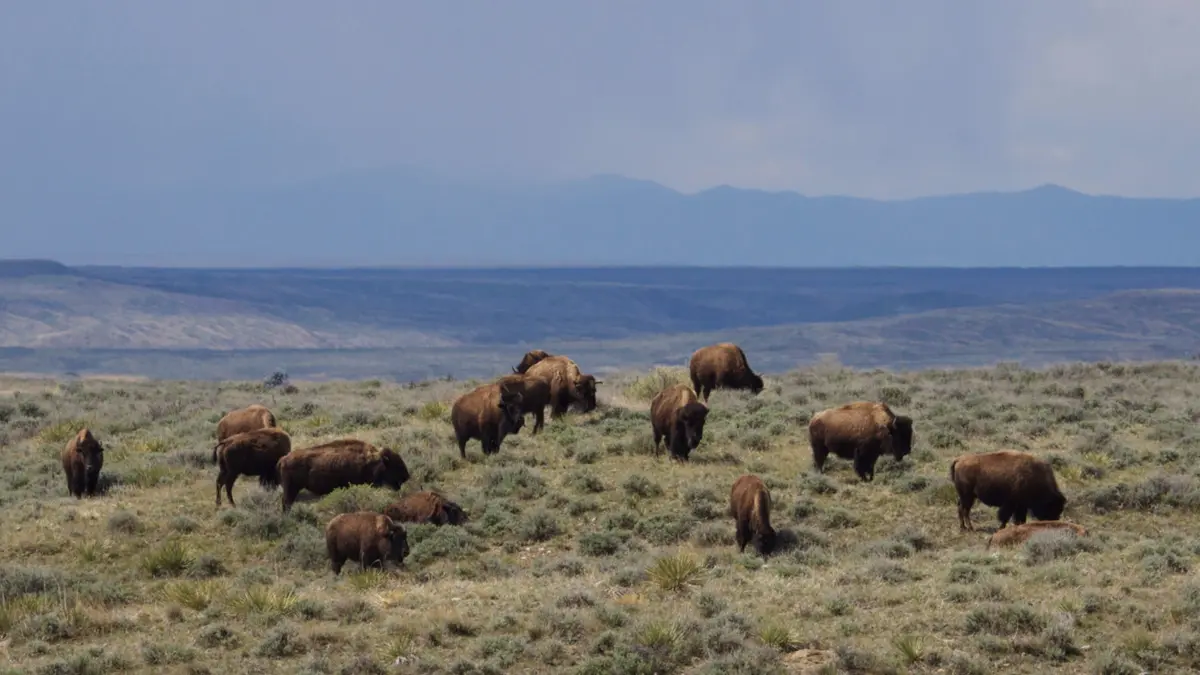
MONTANA — In a major victory for conservationists and tribal partners, nearly 1,000 bison slated for removal from federal public lands in Montana will remain on their native range for now. A federal district judge has issued a preliminary injunction halting a Bureau of Land Management (BLM) order that would have forced the animals off public grazing leases operated by the non-profit preserve American Prairie.
The decision grants temporary relief to a coalition of conservationists, scientists, and indigenous leaders who argued that the federal agency’s sudden policy shift lacked statutory backing and ignored decades of ecological data. While the legal battle continues, the ruling averts an immediate crisis for the preserve, which faced the difficult prospect of culling or relocating hundreds of animals ahead of a looming September 30 deadline.
Main Facts
The core of the legal dispute centers on a federal grazing order issued by the BLM in May 2026. The directive sought to cancel long-standing grazing permits held by American Prairie, a non-profit organization dedicated to establishing a vast, interconnected prairie ecosystem. Spanning more than 600,000 acres of combined private lands and public grazing leases across Montana’s shortgrass prairie, the preserve is freely open to the public for hiking, camping, and wildlife observation.
The BLM’s maneuver relied on a narrow reinterpretation of the historic Taylor Grazing Act of 1934. Under the agency’s newly minted definition, livestock permitted on public lands must be strictly "production-oriented"—meaning animals utilized to provide commercial outputs like meat, fiber, or milk, or working animals used to manage livestock.
Because American Prairie manages its bison primarily for conservation, range restoration, and ecological health rather than intensive commercial agricultural production, the BLM attempted to revoke permits it had originally granted in 2005.
U.S. District Court Judge Brian Morris firmly rejected the BLM’s logic in his ruling, writing that no existing statute or legal precedent requires a livestock operation to focus exclusively on commercial production while completely ignoring conservation, range improvement, or preservation values. The preliminary injunction shields the bison on the three federal allotments where they currently graze, though the court denied protection for three additional tracts where bison are not yet present.
Chronology of the Conflict
To fully understand how a decades-old grazing arrangement erupted into a federal lawsuit, it is necessary to examine the timeline of events leading up to the preliminary injunction:
- 2005: The BLM initially grants federal grazing permits to American Prairie, allowing bison to forage on designated public allotments alongside private lands within the Montana prairie.
- 2022: Following extensive environmental reviews, the BLM concludes in a formal decision that bison grazing actually improves rangeland productivity, biodiversity, and riparian health on the very public lands the agency would later target.
- January 2026: Tribal leaders step into the fray. J. Garret Renville, chairman of the Coalition of Large Tribes and the Sisseton-Wahpeton Oyate of the Lake Traverse Reservation, pens a strong letter to the Secretary of the Interior defending American Prairie. The letter highlights collaborative efforts to help native tribes build their own bison herds using practices virtually identical to American Prairie’s management techniques.
- May 2026: The BLM pivots drastically, announcing a reinterpretation of the Taylor Grazing Act to exclude non-commercial conservation herds. The agency issues an order requiring all bison to be removed from the public grazing leases by September 30, 2026.
- May 2026 (Post-Announcement): American Prairie representatives sound the alarm, explaining to environmental media that the worst-case scenario will force them to cull or hastily remove hundreds of animals, incurring massive financial and logistical costs while forcing the cancellation of the 2026 public bison harvest.
- September 9, 2026: U.S. District Court Judge Brian Morris hands down a decisive preliminary injunction, blocking the BLM’s removal order and allowing the bison to remain on the land while the lawsuit proceeds through the judicial system.
Supporting Data and Ecological Significance
Beyond the legal arguments over the Taylor Grazing Act, the case has highlighted a deep scientific divide over how rangelands should be managed. Environmental scientists and conservation biologists have long pointed to the fundamental differences between how cattle and bison interact with native North American ecosystems.
If American Prairie had been forced to remove its bison, the organization’s fallback option would have likely involved replacing them with domestic cattle to maintain its lease status. However, ecological studies demonstrate that cattle and bison graze in drastically different ways:
- Grazing Patterns: Cattle tend to linger in localized areas, heavily grazing riparian zones and small patches of land before being moved by ranchers. Bison, conversely, are nomadic by nature. They roam continuously across the landscape, covering up to two to three miles per day in a rolling, distributed grazing pattern.
- Biodiversity and Soil Health: Scientific research published in leading journals indicates that the natural movement of bison increases native plant biodiversity and enhances the soil’s drought tolerance. As native ungulates that co-evolved with the prairie ecosystem over millennia, bison act as a quintessential keystone species.
- Prior Federal Findings: Ironically, the BLM’s own internal 2022 environmental assessment explicitly recognized these benefits, noting that bison grazing would actively enhance rangeland productivity and health on the exact federal allotments the agency later attempted to clear.
Official Responses and Perspectives
The judicial ruling has drawn sharp, polarized reactions from stakeholders across Montana and Washington, reflecting deep divisions over public land use, agriculture, and conservation.
American Prairie Leadership
Chief Executive Officer Alison Fox celebrated the court’s decision as a triumph for common-sense conservation and historical restitution.
"Bison belong on this landscape, and today’s ruling gives them a chance to stay," Fox said following the verdict. "For more than 20 years, our bison have grazed these lands under federal authorization and without grazing violations. The court recognized the concrete harm that removing them would cause, not just to our work, but to our Tribal partners and the broader effort to return bison to their native home."
Beth Saboe, American Prairie’s director of public relations, emphasized earlier in the year that the organization was fully prepared to defend the herd against what she characterized as an arbitrary policy pivot. She noted that the removal order had already inflicted tangible damage, forcing the cancellation of the preserve’s 2026 public bison harvest due to herd uncertainty.
Tribal Allies
The initiative also received robust backing from Native American nations working to restore cultural and ecological connections to the American bison. Tribal leaders argued that penalizing American Prairie for raising bison under conservation-first principles undermined broader indigenous sovereignty and cultural restoration goals. In his January letter to the Department of the Interior, J. Garret Renville noted that the non-profit’s preservation methods mirror traditional and contemporary tribal herd management strategies.
Agricultural and Livestock Associations
Conversely, the BLM’s permit revocation found strong backing among traditional agricultural groups, including the Montana Stockgrowers Association and various local cattle ranchers. Livestock operators have historically expressed concerns regarding disease transmission between bison and cattle, fencing issues, and potential competition for public forage resources, viewing the expanding footprint of conservation bison herds as a direct challenge to traditional ranching livelihoods in the region.
Implications for the Future of Public Lands
The ongoing lawsuit carries profound implications far beyond the borders of Montana’s shortgrass prairie. At its core, the case tests the boundaries of executive agency authority and the flexibility of century-old public land statutes in the face of modern ecological challenges.
If the courts ultimately rule in favor of American Prairie, it could establish a powerful legal precedent protecting non-commercial, conservation-oriented wildlife and ecological restoration projects on federal grazing leases nationwide. It would signal that federal agencies cannot easily rewrite long-standing interpretations of resource laws to exclude non-traditional land uses that benefit biodiversity.
Conversely, a victory for the BLM could empower federal land managers to strictly enforce commercial productivity standards across millions of acres of public allotments. This would potentially squeeze out non-profit conservation groups, rewilding initiatives, and non-traditional agricultural models across the American West.
For now, the nearly 1,000 bison of the American Prairie graze undisturbed beneath the vast Montana sky—a temporary reprieve that keeps a native keystone species anchored to the landscape while the judicial system decides their long-term fate.
