

By Editorial Staff
Published in Metaphysical and Consciousness Research
Main Facts: The Phenomenon of Pre-Incarnation Memories
The nature of human consciousness and the origin of existence continue to challenge both traditional science and esoteric philosophy. At the center of this ongoing inquiry is a fundamental, haunting question: Why do humans retain virtually no conscious recollection of their existence prior to birth?
While conventional materialism attributes memory strictly to neurological development and brain function, metaphysical researchers, lucid dreamers, and spiritual historians have long explored an alternative hypothesis. They suggest that consciousness predates physical incarnation, operating behind a psychological and energetic boundary often referred to as "the veil."
Recent discussions within the global consciousness community have brought renewed attention to detailed anecdotal accounts of pre-birth planning. Central to these accounts is the concept of "soul contracts"—pre-life agreements allegedly made before incarnation that outline key relationships, life lessons, and potential milestones.
While mainstream scientific institutions categorize such experiences as vivid products of REM sleep, hypnagogic imagery, or active imagination, millions of individuals worldwide report experiences that transcend ordinary dreaming. These events are frequently described as hyper-realistic, emotionally resonant windows into a pre-physical state of awareness.
Chronology: A Decade of Documentation and the 2012 Dream Revelation
The exploration of pre-incarnation mechanics gained significant momentum following documented experiential accounts recorded by researchers and authors over the past decade. A foundational point in this specific modern dialogue occurred on January 23, 2012, when In5D founder and researcher Gregg Prescott documented a profound, paradigm-shifting dream sequence.
The 2012 Dream Sequence
According to Prescott’s personal dream journal, the experience began on what he perceived to be the "other side of the veil," operating within a multidimensional framework. Rather than a passive spectator, Prescott described active participation in the finalization of a soul contract prior to earthly descent.
- Pre-Life Agreements: In the dream state, Prescott negotiated relational arrangements with a soul group member named Amie—who closely resembled his future family dynamics—under the sanction of his spiritual counterpart.
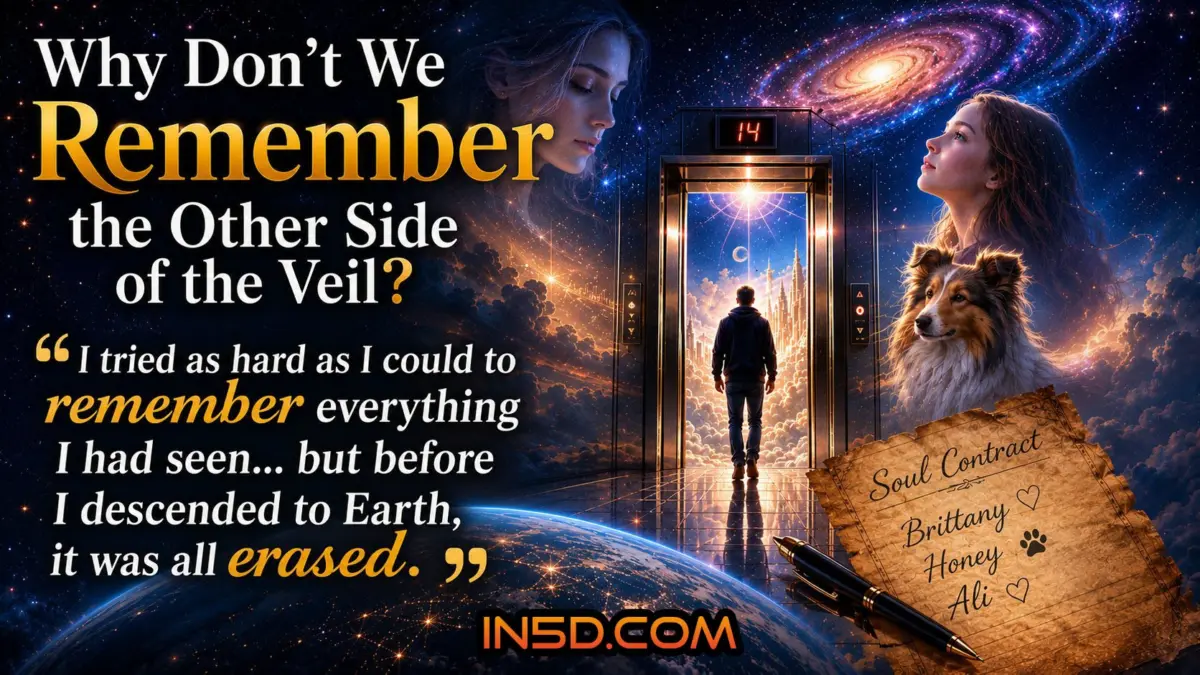
- Foreshadowing Earthly Realities: During the review of his pre-birth contract, specific nomenclature and imagery appeared, including the name of his future daughter, Brittany, and a childhood pet, a Shetland Sheepdog named Honey.
- The Descent and the 14th Dimension: As the transition toward physical incarnation approached, Prescott reported being informed that his memories of the pre-birth realm must be systematically erased. Entering an apparatus resembling an elevator situated on a structure representing the 14th dimension, he experienced a deliberate clearing process designed to strip away higher-dimensional awareness.
- The Testing Mechanism: The dream narrative highlights an intentional "test" within the descent protocol. The clearing process was so absolute that the dreamer struggled to remember how to descend into the third-dimensional reality, illustrating a simulated threshold where retaining too much pre-birth memory might trigger a reset.
Over the ensuing twelve years, Prescott cross-referenced these fragmented dream states with waking life synchronicities, noting that the entities, names, and relational structures previewed in the 2012 vision ultimately manifested physically during his lifetime. Furthermore, comparative accounts from family members—including recurring spiritual visitations and intuitive pre-knowledge of life locations reported by his father—suggested a consistent architecture to these pre-birth experiences.
Supporting Data: The Prevalence of Anomalous Consciousness Phenomena
To understand the weight of these anecdotal accounts, researchers look at broader psychological and parapsychological data regarding anomalous states of consciousness.
1. Dreams as Access Points to Subconscious Archives
According to historical and contemporary sleep research, the human brain processes millions of bits of sensory and intuitive data daily. Carl Jung, the Swiss psychiatrist who founded analytical psychology, theorized that dreams serve as a bridge to the "collective unconscious"—a deep reservoir of shared human symbols, archetypes, and ancestral memory. While Jung approached the psyche through a psychological lens, metaphysical frameworks extend this model, proposing that the subconscious mind can bypass linear time during states of deep sleep, accessing nonlocal awareness.
2. Pre-Birth Memories in Children
Independent research into past-life and pre-birth memories—most notably pioneered by the University of Virginia’s Division of Perceptual Studies (DOPS)—has cataloged thousands of cases where young children articulate detailed memories of choosing parents, planning lives, or existing in a non-physical realm before birth. These children frequently share common traits:
- Detailed, verifiable descriptions of deceased relatives they never met.
- Precise accounts of observing their own parents prior to conception.
- A sudden fading of these memories typically occurring between the ages of five and seven, aligning with the consolidation of the ego and left-brain dominance.
3. The Mechanics of the "Veil"
Across diverse spiritual traditions—ranging from Platonic philosophy (the Myth of Er) to Eastern concepts of Samsara and Maya—a systematic barrier to memory is considered a functional necessity. Without a temporary blackout of origin, the intense catalysts, moral dilemmas, and existential lessons of physical reality would lose their potency. Faith, discovery, and autonomous choice require a blank slate to operate effectively.

Official and Institutional Perspectives: Science Meets Metaphysics
While metaphysical researchers interpret these phenomena through spiritual and dimensional frameworks, mainstream scientific institutions maintain rigorous, materialist explanations for dreams involving pre-birth memories and soul contracts.
The Neurobiological Viewpoint
Neurologists and sleep scientists assert that dreams are the brain’s way of consolidating memories, regulating emotions, and processing daily stimuli. During Rapid Eye Movement (REM) sleep, the limbic system—responsible for emotional processing—is highly active, while the prefrontal cortex, which governs logical reasoning and reality-testing, is largely deactivated.
This neural imbalance explains why dreams can feel absolute, emotional, and bizarrely coherent while they are happening. When a dreamer experiences a vivid narrative about "soul contracts" or "dimensional descents," neuroscientists argue that the sleeping brain is creatively weaving together scattered waking memories, unconscious desires, and archetypal symbols into an immersive theatrical production.
The Psychological Perspective
From a depth psychology standpoint, encounters with pre-birth contracts, spirit guides, and dimensional elevators are viewed as powerful internal metaphors. The "veil" represents the boundary between the conscious ego and the vast ocean of the unconscious mind.
Proponents of this view argue that whether these encounters are literal metaphysical journeys or symbolic messages generated by the psyche, their psychological utility remains profound. They allow individuals to navigate grief, find meaning in chaotic life circumstances, and cultivate a deep sense of personal purpose.
Implications: The Evolution of Consciousness and Digital Preservation
The exploration of pre-incarnation dreams and memory loss carries significant implications for modern philosophy, mental health, and the evolving intersection of technology and spirituality.
1. Redefining Purpose and Resilience
If individuals operate under the assumption that life challenges are consciously chosen prior to physical birth, the psychological burden of suffering can shift. Rather than viewing hardship as random or purely punitive, individuals frame difficulties as curriculum—lessons designed to test, strengthen, and expand consciousness. This shift in perspective has been linked by holistic practitioners to improved psychological resilience and a reduction in existential dread.
2. The Danger and Value of Forgetting
As Prescott and other consciousness researchers note, complete remembrance of a limitless, multidimensional existence could paralyze human motivation. If an individual possesses full conscious awareness of an eternal, pain-free existence "on the other side," the urgency of moral choices, artistic creation, and interpersonal connection in the third-dimensional world might diminish. Consequently, forgetting is framed not as a cosmic punishment, but as a vital protective mechanism that preserves the integrity of the earthly experience.
3. Technological Interventions in Spiritual Tracking
Recognizing the ephemeral nature of dreams, synchronicities, and intuitive breakthroughs, contemporary innovators have begun developing digital tools designed to capture these fleeting states of awareness before the waking mind erodes them.
The launch of memory-preservation platforms, such as the In5D Infinite application, highlights a growing movement to systematically document spiritual experiences over time. By utilizing structured digital journals that integrate dreams, syncs, and metaphysical data points, modern researchers aim to map patterns in human consciousness that were previously lost to the passage of time.
Conclusion
The boundary between what we know and what we have forgotten remains one of the greatest mysteries of human existence. Whether pre-incarnation dreams are literal recollections of a multidimensional soul journey, profound psychological metaphors, or complex neurological artifacts, their impact on the human spirit is undeniable.
As technology, neuroscience, and metaphysics continue to evolve, the quest to understand the "veil" persists. In the end, the most valuable outcome of exploring these hidden dimensions may not be finding definitive proof of where we came from, but rather waking up to who we are right now, in the time we have left.
