

By Karen Greenspan
Main Facts
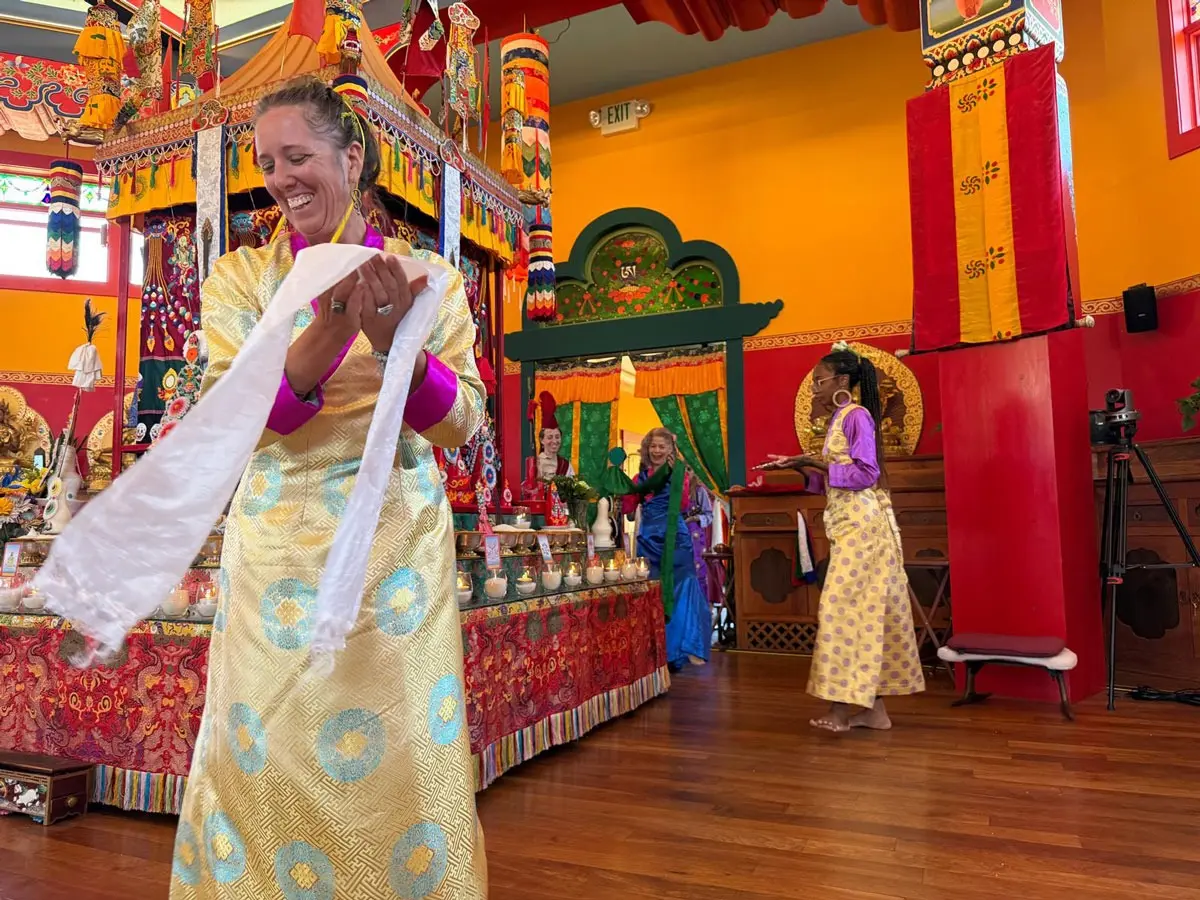
In the quiet sanctuary of Tara Mandala’s prayer hall, a circle of dancers moves in a graceful grapevine step, carrying symbolic objects of enjoyment mounted on colorful ceremonial scarves—musical instruments, delicate flowers, and fragrant perfumes. Draped in luminous, bright-hued silk Tibetan gowns, these practitioners circle the ritual mandala, engaging in a physical prayer known as Chötreng, or the "Garland of Offerings."
This sacred choreography forms a vital component of the "White Dakini Drupchen," a communal ritual of spiritual accomplishment rooted in Vajrayana Buddhism. As the chant master leads the congregation, participants perform intricate mudras (hand gestures) while visualizing the multiplication and delivery of sixteen splendid gifts by celestial Wisdom Goddesses.
Across the Himalayas and within diaspora centers worldwide, sacred dance—known broadly as cham—is far more than a mere cultural performance or visual spectacle. It is an advanced technology of transformation. Within Vajrayana practice, physical movement, breath, and visualization merge to cultivate generosity (dana), one of the foundational transcendent qualities or paramitas. As the late Nyingma master Thinley Norbu Rinpoche (1931–2011) famously observed, "In the precious Vajrayana tradition, in which the offering of dance is practiced, everything is turned into virtue, including all movement."
Chronology and Historical Roots: From Vedic Chants to Himalayan Monasteries
The integration of rhythmic movement, music, and spiritual contemplation did not begin in the monasteries of Tibet or Bhutan; its roots stretch back millennia into the pre-Buddhist cultural landscape of South Asia.
The Vedic Foundations (1500–1200 BCE)
The earliest foundations of these ritual conventions are preserved in the Vedas, a vast body of sacred Hindu texts composed between 1500 and 1200 BCE. The Yajur Veda, a foundational compilation of sacrificial formulas, offering rituals, and mantras, documents an era where rhythmic recitation and embodied physical action were understood to directly influence cosmic order.
Fast forward to the development of Vajrayana deity yoga, systematically codified by Indian Buddhist commentators around 700 CE. Practitioners retained this embodied philosophy, chanting Sanskrit recitations while executing precise mudras. These gestures invite divine presence, expanding individual consciousness through multi-sensory visualization.
The 8th Century: Introduction to the Land of Snows
In the mid-8th century, the Indian tantric master Guru Padmasambhava (Guru Rinpoche) brought Vajrayana Buddhism to Tibet and Bhutan. He established the foundational lineages that would preserve and develop these dance traditions for over a thousand years.
The Newar Tradition of Nepal
In the Kathmandu Valley, indigenous Newar Buddhists have practiced charya nritya ("dance as a spiritual discipline") for at least a millennium. Maintained by non-monastic vajracharya priests, this yogic dance tradition features the Sodasha Lasya—the sixteen expressions of grace—where dancers physically embody offering goddesses, playing lutes, beating drums, and wafting incense. These exact archetypes eventually migrated into Tibetan and Bhutanese traditions as the Rigma Chudruk Cham (Dance of the Sixteen Wisdom Goddesses), of which Chötreng is a direct descendant.
Supporting Data and Regional Manifestations
Sacred dance permeates every tier of Himalayan Buddhist life, functioning dynamically to welcome dignitaries, invoke deities, enhance auspiciousness, and celebrate spiritual milestones.
Welcoming the Sacred: Jipai Pawo Cham
In Bhutan, high lamas, monarchs, and visiting dignitaries are traditionally welcomed to celebrations and public teachings through the Jipai Pawo Cham (Majestic Hero’s Dance). Performed by two to four pawo (heroes) flanking the honored guest, the dance is a kinetic display of bounding, hopping, and rhythmic damaru (hand drum) rattling. Upon arrival, the dancers perform a complete suite incorporating peaceful, semi-wrathful, and wrathful sections while a serkyem (ritual libation) is offered.
Summoning Guru Rinpoche
During Tsechu (Guru Rinpoche Day) celebrations, practitioners invoke Padmasambhava through the Zheng Zhik Pema cham. Costumed as dakas and dakinis—inhabitants of the Guru’s Glorious Copper-Colored Mountain Paradise—dancers spin and leap to a declaimed liturgy attributed to Guru Rinpoche’s foremost disciple, Yeshe Tsogyal. Conversely, the Kadrinchenma Cham—a treasure text revealed by Chokyi Wangchuk (1212–1270)—is performed at the conclusion of Tsechu Puja to express immense gratitude and the longing for the Guru’s return.
Augmenting Auspiciousness: The Drukpa Kagyu Tradition
Under the guidance of His Holiness the Twelfth Gyalwang Drukpa, Drukpa Kagyu monastics frequently integrate dynamic cham into major rituals. At Druk Amitabha Mountain in Kathmandu, Nepal, the nine-day Avalokiteshvara Drupchen is richly punctuated with dramatic and peaceful cham dances.
These monastics also perform gurma (songs of realization)—poetic verses sung while executing folksy, joyous choreographies. Celebrated during temple consecrations, retreat completions, and feast-day pujas, gurma dances often feature monastics wearing the white cotton repa sash of accomplished tantric yogis over their traditional robes.
Longevity Rituals and the Khandro Tenzhug
Himalayan Buddhism places supreme value on the longevity of spiritual teachers, viewing a lama’s extended life as the primary vehicle for collective enlightenment. To counteract the traditional belief that celestial dakinis seek to summon great teachers to higher realms, monasteries perform Khandro Denga Cham (also known as Khandro Tenzhug). This specialized longevity ritual uses the kinetic offering of dance to appease the dakinis and secure the continued presence of the lama.
Official Responses and Cultural Shifts
For centuries, sacred cham was performed almost exclusively by male monastics, as religious institutions were historically populated by monks. However, the contemporary landscape of Vajrayana Buddhism is undergoing a profound demographic and institutional shift.
Over the past two decades, senior lineage masters have actively invited female practitioners—both within Himalayan nunneries and at international dharma centers—to learn and perform complex dakini cham. Nuns in Bhutan, Nepal, and the West are no longer passive observers of ritual; they are master practitioners, tradition-bearers, and innovators of sacred movement.
By stepping into roles traditionally reserved for monks, female monastics are actively revitalizing ancient texts, ensuring that the embodied wisdom of the lineage is preserved across gender lines. This democratization of ritual performance has brought unprecedented vitality to institutions such as Tara Mandala and the Drukpa nunneries, where female practitioners demonstrate that the integration of body, speech, and mind belongs to all dedicated seekers.
Implications
The preservation and global transmission of Himalayan sacred dance carry profound implications for modern spiritual practice, cultural anthropology, and somatic psychology.
1. The Integration of Embodied Mindfulness
In an era dominated by cognitive, intellectualized approaches to spirituality, Vajrayana sacred dance offers a radical counter-model: the complete integration of physical movement with meditative absorption. By transforming the body into a mandala and physical actions into transcendent generosity, practitioners bypass purely mental conceptualization, engaging the nervous system directly in the cultivation of virtue.
2. Preservation of Intangible Cultural Heritage
As traditional societies across Tibet, Bhutan, and Nepal face rapid modernization and globalization, ritual arts like cham and charya nritya serve as vital anchors of indigenous identity. Documenting and performing these traditions—not merely as museum artifacts, but as living, breathing spiritual practices—ensures that centuries of accumulated somatic wisdom are not lost to history.
3. The Climax of Auspiciousness: Tashi Cham
The ultimate philosophical implication of Himalayan dance is vividly demonstrated in the Tashi Cham performed by Drukpa Kagyu monastics to conclude major ceremonies. Holding five-colored streamers representing the five natural elements and five wisdoms, dancers move in concentric circles, using their stomping feet to metaphorically crush negativity while sweeping up joy with their arms.
Singing lyrics that herald the arrival of the Five Wisdom Buddhas, they repeatedly invoke the refrain: "How delightful and joyful!" In this climactic offering, body, speech, and mind unite to dispense boundless good wishes to all sentient beings. Just as generosity is recognized as a transcendent virtue in Buddhist philosophy, so too are the luminous, dynamic dances that deliver its boundless goodness across the world.
