

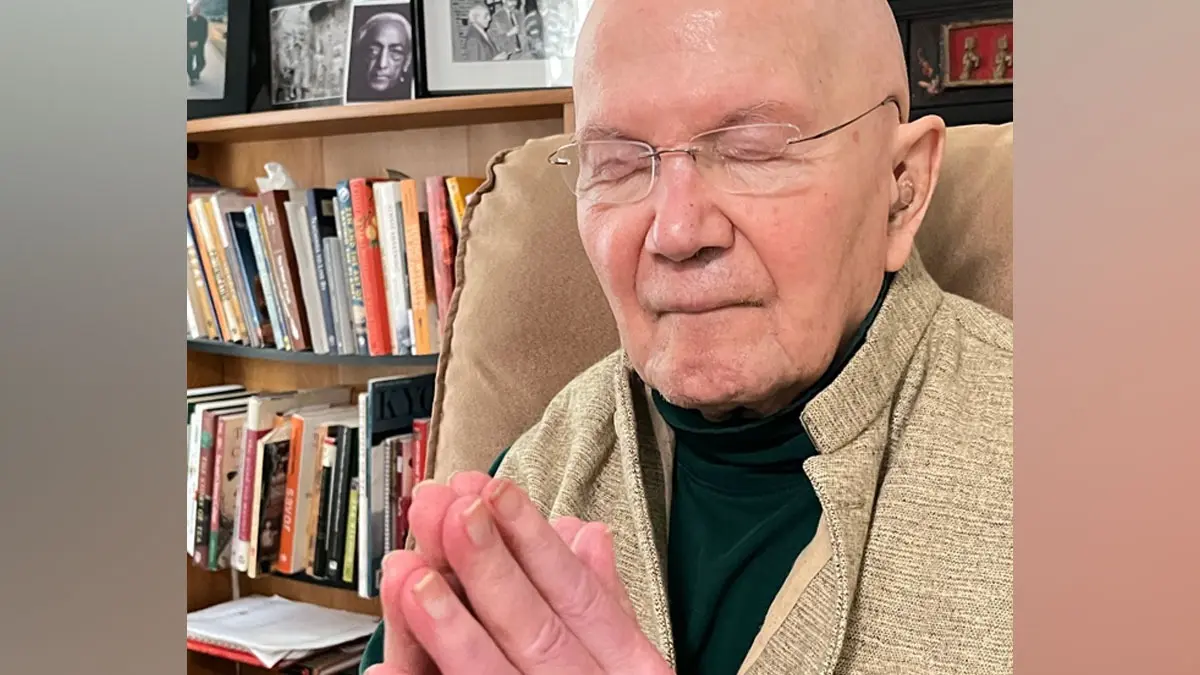
CAMBRIDGE, Mass. — As he approaches his 94th December, renowned meditation teacher Larry Rosenberg is finding that his personal relationship with aging, sickness, and mortality has fundamentally shifted. Rosenberg, the founder of the Cambridge Insight Meditation Center and author of several seminal spiritual books, recently shared a deeply reflective update with his community regarding how decades of Buddhist practice translate into the raw, physical reality of advanced old age.
The reflections, originally published to update supporters contributing to a GoFundMe campaign facilitating at-home health care for Rosenberg and his wife, Galina, offer a rare and unvarnished look at the intersection of lifelong spiritual discipline and the final chapter of human life.
Main Facts: The Reality of Suffering and the Illusion of Perfection
For many newcomers to Eastern philosophy, the foundational narratives surrounding the life of the Buddha can inadvertently create a misleading impression. It is easy to read ancient texts and conclude that meditation serves as a magical talisman, offering permanent immunity from all forms of suffering.
According to Rosenberg, that assumption is simply not true. He points to an insight from the late Zen master Thich Nhat Hanh, who frequently reminded students that even after attaining supreme enlightenment, the historical Buddha still suffered. The critical distinction, however, lay in the Buddha’s mastery over his reaction to that suffering.
"The difference is, the Buddha knew how to take care of his suffering," Rosenberg noted.
Most individuals, Rosenberg admits, have never fully learned this subtle art of tending to pain, which invariably exacerbates physical and mental distress. Despite spending a lifetime studying mortality—including grueling immersive trainings such as observing a decomposing corpse through the night in Mexico and dedicating months to maranasati (death awareness) under master Ajahn Suwat—Rosenberg does not claim to be immune to pain or fear.
While his decades of preparation radically reoriented his perspective and inspired his book Living in the Light of Death, the core message of his recent update is sobering: spiritual training does not make suffering vanish. Instead, it alters how one meets it.
Chronology: A Lifetime of Preparing for the Final Chapter
To understand Rosenberg’s current state of mind, it is necessary to look at the timeline of his spiritual evolution and the physical realities he now confronts daily.
- Decades Past: Rosenberg spent years immersing himself in intense meditation practices, studying under renowned masters across various traditions, and establishing the Cambridge Insight Meditation Center. He authored influential texts including Breath by Breath, Three Steps to Awakening, and Living in the Light of Death.
- Recent Years: As he entered his nineties, Rosenberg began facing escalating physical challenges, notably Parkinson’s disease and increasing bodily disabilities. These conditions severely impacted his mobility and daily independence.
- Summer: Team Rosenberg, a collective managing his care and communications, noted a recent uptick in his energy levels. This resurgence allowed the veteran teacher to articulate his current mental and emotional state for his global sangha (community).
- September 10: An update was published via the community GoFundMe page, detailing Rosenberg’s cycle of waking up to the present moment, falling into conditioned fear, and using mindfulness to reset his equilibrium.
Supporting Data and Context: The Mathematics of Mindfulness
The physical trials Rosenberg faces are quantifiable and shared by millions entering advanced age. According to the Parkinson’s Foundation, more than 10 million people worldwide live with Parkinson’s disease, a neurodegenerative disorder that progressive impairs motor control, balance, and autonomy. For a lifelong meditation teacher who once guided students through vigorous physical retreats, the daily decline presents a profound existential paradox.
Yet, Rosenberg measures his resilience not in physical recovery, but in cognitive "sleep and wake" cycles. He describes his daily reality using a cyclical framework:
$$textAwakening to Pain longrightarrow textConscious Observation longrightarrow textLapsing into Conditioned Fear longrightarrow textRe-Awakening via Awareness$$
When a novel physical pain arises, Rosenberg notes that bringing immediate, objective awareness to the sensation helps diminish its psychological weight. However, the human conditioned mind remains stubbornly persistent.
"It’s too easy to fall into sleep again—to let the old conditioned mind creep back in with some semblance of fear or concern," Rosenberg writes, detailing internal monologues familiar to anyone facing chronic illness:
- "How much worse will my Parkinson’s get?"
- "The disability today is worse than yesterday."
- "Will I ever be able to walk again?"
- "Oh no, a new ailment!"
When caught in these loops, the mind drifts into a past that has already concluded or a catastrophic future that may never materialize. Yet, Rosenberg observes that the mere act of catching oneself in this mental trap—of seeing the fear clearly—immediately dissipates its power, restoring him to a state of wakefulness and peace.
Official Responses and Community Support
The dissemination of Rosenberg’s reflections was managed by "Team Rosenberg," the organizers behind the ongoing fundraising efforts to secure at-home medical support for Rosenberg and his wife.
"After a period when Larry was simply not feeling up to it, his energy seems to have improved and we’re thrilled to offer new words here that Larry wishes to share with the sangha," the organizing team stated in the introduction to the September update. "They provide a window into how he’s been feeling this summer along with reflections on using his practice to face his challenges."
The response from the global meditation community has been profound. Followers, former students, and fellow practitioners have rallied not only through financial contributions on the GoFundMe platform but also by sharing how Rosenberg’s transparent documentation of his aging process has demystified the final stages of life for younger generations of spiritual seekers.
Notably, Rosenberg’s vulnerability extends to his own teachers. He recounted asking the legendary philosopher Jiddu Krishnamurti, "Krishnaji, are you awake all the time?" to which Krishnamurti bluntly replied, "Of course not. I’m still human." This humanizing anecdote underscores Rosenberg’s rejection of spiritual perfectionism.
Implications: A Call to Action for Younger Practitioners
The ultimate takeaway from Rosenberg’s twilight reflections is not a passive acceptance of decline, but an urgent call to action for active practitioners of all ages.
Why Early Practice Matters
Rosenberg stresses that building mental stability cannot be postponed until old age or terminal illness strikes. The neurological and psychological conditioning cultivated through decades of meditation acts as a critical reserve fund of resilience.
"Those of you practicing, especially when you’re young, please… do it now! Keep at it! Because it’s not just about now. When you take care of now, you take care of the future."
By establishing a daily practice in youth and middle age, individuals increase the probability that they will be equipped to handle the inevitable universal truth: that every human being must eventually bid farewell to everything and everyone they love.
Redefining Fearlessness at the End of Life
As he looks toward what he half-jokingly refers to as his "final graduation," Rosenberg maintains that his practice has spared him from helplessness. Even as his body fails him, he retains the inner tools required to care for his mind.
"I feel extremely fortunate in having this practice, because even facing the end, I really don’t feel helpless," Rosenberg concludes. "I have the ability to take care of myself. And I know it’s possible for others to find the same peace."
Through his unflinching honesty, Larry Rosenberg continues to teach—not from a pedestal of transcendent perfection, but from the very trenches of human vulnerability, proving that being awake remains the ultimate path through the dark.
