

Published: September 13, 2026
From the Yoga Journal Archives (Originally published in the July–August 1978 issue)
Main Facts: The Enduring Blueprint of Downward-Facing Dog
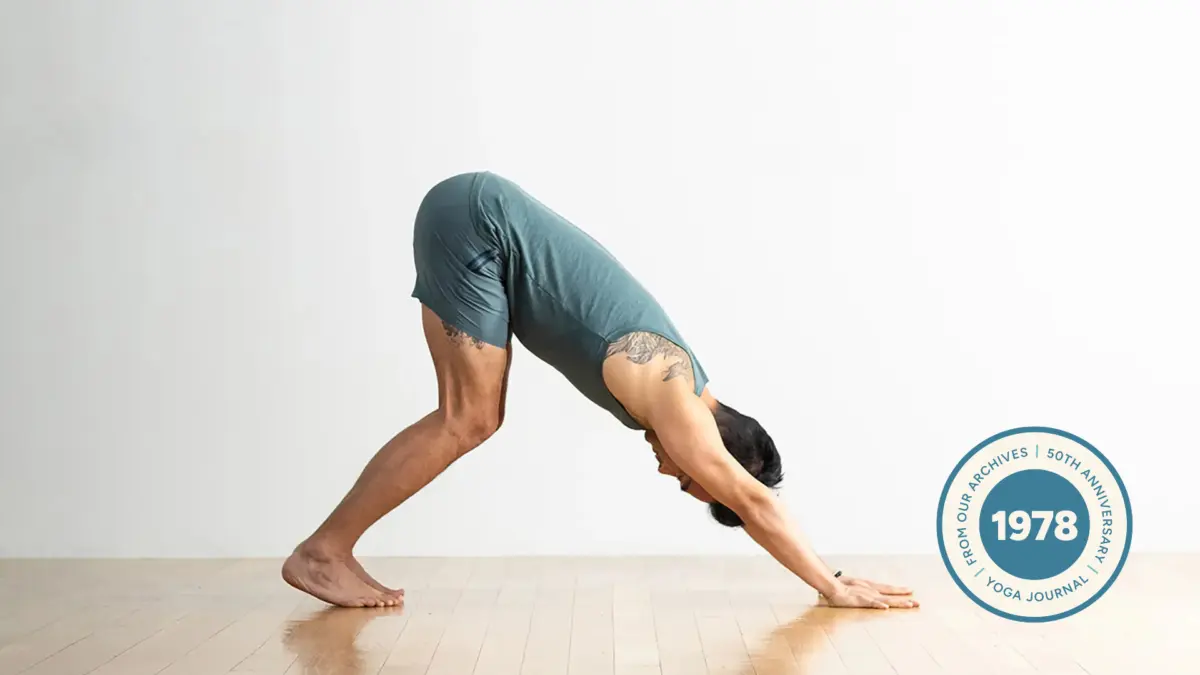
For generations of practitioners stepping onto the mat, Adho Mukha Svanasana (Downward-Facing Dog Pose) has served as the quintessential gateway to physical practice. Particularly potent in the crisp chill of early morning—when joints are stiff and connective tissues feel locked in place from hours of nocturnal rest—this foundational inversion releases an immediate, invigorating surge of energy through the limbs and the posterior chain.
Far more than a simple transition between postures, Downward-Facing Dog is a complete structural framework. The mechanics are elegantly straightforward yet profoundly effective: full extension of the arms unlocks and releases the shoulder girdle; spinal decompression creates vital space between the vertebrae; and a deliberate forward tilt of the pelvis introduces functional movement into the lumbar spine while awakening the notoriously stubborn muscles at the back of the legs.
For modern athletes, runners, and sedentary desk workers alike, the pose acts as both a diagnostic tool and a therapeutic remedy. It exposes the hidden architectural imbalances of the body, offering a living blueprint for structural integration that bridges the gap between active exertion and restorative surrender.
Chronology: A Half-Century Evolution of a Master Asana
To understand the modern practice of Downward-Facing Dog, one must trace the lineage of its technical refinement, which has evolved significantly over the past fifty years of modern postural yoga.
- Pre-1975 (The Traditional Era): Adho Mukha Svanasana was historically practiced as an intuitive, breath-linked transition within vinyasa sequences, often taught broadly without the granular anatomical breakdowns common today.
- July–August 1978 (Yoga Journal Archives): A landmark pedagogical shift occurred as Western instructional writing began heavily integrating B.K.S. Iyengar’s precision-based methodology. Articles from this era began dissecting the exact biomechanics of the pose—analyzing pelvic rotation, hamstring composition, and weight distribution across the palms.
- The 1980s and 1990s (Prop Innovation): Teachers influenced by the Iyengar tradition popularized the use of chairs, wall ropes, and straps to modify the pose. These props transformed Downward-Facing Dog from an inaccessible struggle for stiff practitioners into an adaptable geometry available to all body types.
- The 2000s to Present (Sports Medicine Integration): As sports science validated the necessity of posterior chain mobility, physical therapists, marathoners, and CrossFit athletes increasingly adopted Downward-Facing Dog as a primary restorative movement to counteract the shortening effects of repetitive running and sitting.
Supporting Data: The Anatomy of the "Ornery" Hamstring
Why do the backs of the legs resist the stretch of Downward-Facing Dog with such persistent stubbornness? The answer lies in human histology and kinesiology.
Within hatha yoga, practitioners quickly develop an intimate, subjective awareness of muscular personalities. Certain muscle groups are cooperative and responsive; others are dense and forgetful. But of all the skeletal muscles in the human body, the hamstrings are widely regarded as the most brazen and unyielding. Make them yield a single inch today, and they are prone to tightening back up by tomorrow.
The Anatomical Reality of Tendinous Tissue
This recalcitrance has a precise physiological basis. Skeletal muscles are composed of a central contractile belly of muscle fibers flanked by terminal tendons that anchor the muscle to bone. Muscle tissue is richly vascularized (well-supplied with blood) and features a microstructure of overlapping, sliding filaments that grant it remarkable elasticity.
Conversely, tendons feature poor vascularity and consist of dense, inelastic collagen fibers. Stretching a tendon is structurally akin to stretching a rubber band: release the tension, and it snaps instantly back to its original resting length.
[Muscle Belly: High Elasticity, Rich Blood Supply]
       <--->
[Tendinous Fiber: Low Elasticity, Poor Blood Supply (Dominant in Hamstrings)]
The hamstring complex—comprising the semitendinosus, semimembranosus, and biceps femoris—is exceptionally unyielding because it contains a remarkably high proportion of tendinous fiber. True to its name, the semitendinosus is virtually split down the middle, existing as half muscle and half tendon.
Because these bi-articular muscles cross both the hip and knee joints, any foreshortening drastically inhibits both forward-bending at the hips and full extension of the knees. Over time, this tightness compromises lower back mobility, creating chronic stiffness for both sedentary individuals and high-mileage runners.
Official Responses and Expert Modifications: Optimizing the Pose
For the beginner or the tight-hamstringed athlete, forcing Adho Mukha Svanasana often results in trembling knees, buckling elbows, and sharp pain. According to classical pedagogical standards, such symptoms indicate that a practitioner is over-extending within the structural framework of the pose.
1. The Chair Modification
To alleviate excessive strain on the hamstrings and invite a healthier, safer stretch into the lower back, students are advised to elevate their hands. By placing the hands on a sturdy, low chair or bench—firmly braced against a wall for stability—the practitioner reduces the acute downward angle of the torso, making the pose accessible without sacrificing spinal elongation.
2. The Rope and Strap Variations (The Iyengar Method)
For those seeking a deeper, more profound opening of the thighs and calves, B.K.S. Iyengar pioneered the use of wall ropes at his Institute in Poona. Replicable at home using a secure strap or lasso looped over a banister, dance bar, or sturdy doorknob, this method involves stepping inside the loop so that the strap presses squarely across the front of the pelvis at the hip creases.
As the upper body folds forward, the backward pull of the strap physically assists pelvic rotation. This mechanical advantage deepens the stretch along the back of the legs, vividly demonstrating the intimate mechanical link between pelvic tilt and hamstring length.
Implications: The Mind-Body Dichotomy and the Pyramid of Energy
Ultimately, aids, props, and anatomical preparations are merely preliminary scaffolding. From a profound yogic perspective, they are not ends in themselves, but educational tools designed to teach isolated segments of the physical form before reintegrating them into a unified whole.
Refining the Internal Experience
When holding the framework of Downward-Facing Dog, subtle micro-adjustments dictate the quality of the posture:
- The Hands and Shoulders: Gravity naturally coaxes the body’s weight toward the outer edges of the hands, causing the elbows to collapse inward. By consciously shifting weight toward the inner hands—pressing firmly into the mounds of the thumbs and forefingers—the practitioner broadens the shoulder blades, opens the armpits, and stabilizes the upper body.
- The Knees and Skin: When hamstrings are locked, the back of the legs can feel mentally vacant, like an unmonitored skin zone. By rising high onto the toes, freeing the hips, rotating the pelvis toward the thighs, and pressing the top shinbones backward before slowly lowering the heels back down, the skin and muscle at the back of the knees are suddenly brought back to life.
The Restorative Paradox
When the internal flows of energy achieve equilibrium, Adho Mukha Svanasana reveals its true character: a simple, balanced pyramid of energy.
Because the head dips below the level of the heart, the pose naturally increases arterial blood flow to the head and upper torso. This grants Downward-Facing Dog many of the profound, restorative benefits typically reserved for full inversions—making it an invaluable therapeutic sanctuary for beginners not yet prepared for headstands (Sirsasana).
In the end, practicing Adho Mukha Svanasana evokes a curious, beautiful dichotomy. The outer shell of the body works diligently to build structural strength and resilience, while the inner mind retreats to a quiet, nourished interior space—much like the secret, sacred chamber hidden deep within the stone walls of an ancient pyramid, resting at the precise center of mathematical and mystical calm.
